
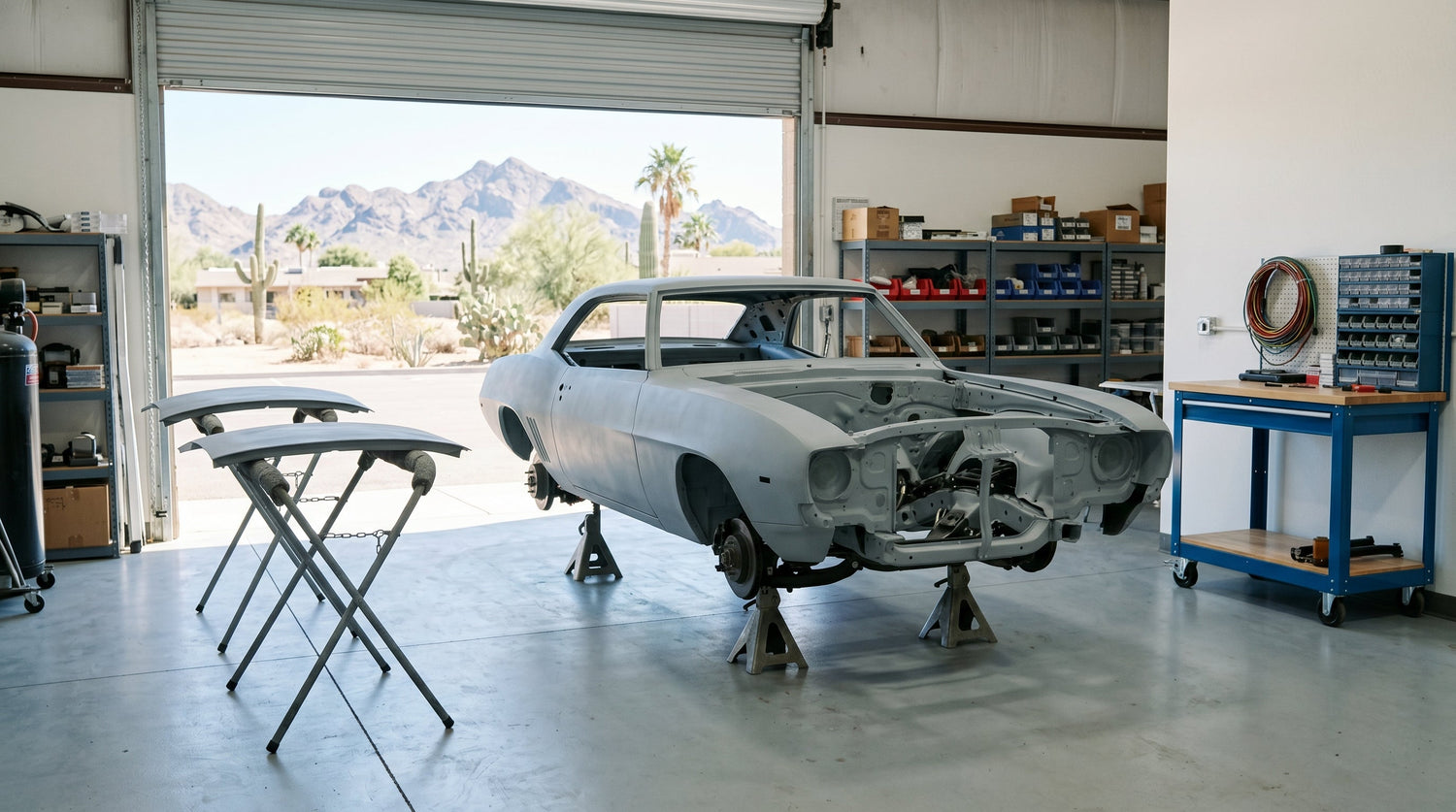
Someone reached out the other day with a fair question. If you do most of the work yourself, what does a frame off restoration actually cost? It is the kind of question that sounds simple and is not. So here is the honest answer, the same one I gave him, with a little more detail on where the money goes and the things almost nobody plans for.
The honest number
If you can do most of the work yourself, plan on landing somewhere around $100,000 to $200,000, depending on how nice you want it. That is not me being dramatic. The numbers across the industry line up with it. Most full frame off and concours level builds run north of $100,000, and the nicer ones climb past $200,000 once everything is added up. Where you land on that scale comes down to two things: the condition of the car you started with and how far you decide to take it.
Doing the work yourself saves you the labor bill, which is the single biggest line item on any build. It does not save you on parts. That is the part people get wrong.
Parts are parts
Parts do not care how good you are with a welder. A water pump costs what a water pump costs. If you buy good stuff, and you should, you are looking at at least $100,000 in parts on a nice build. Suspension, brakes, wheels, glass, the drivetrain, the interior, the gauges, the cooling system, the fuel system. Every one of those is real money, and the good versions are not the cheap ones.
That number scares people because they price out one or two big items and assume the rest is filler. It is not. A full build is hundreds of separate purchases, and the quality version of each part is rarely the one in the bargain bin. For perspective, the interior alone on a nice build commonly runs $5,000 to $15,000, a full wiring setup can run $6,000 to $15,000, and a single rust repair panel like a rocker can be $2,000 to $6,000 on its own. Cheap parts show up later as rattles, leaks, and do-overs, and a do-over costs you twice. Buy it once.
Why a shop bill is about three times the parts
Here is where the real number lives. If you hand the whole project to a shop and pay the going rate, the labor usually runs about three times the cost of the parts. That is not a markup. That is hours.
A full frame off takes thousands of hours of skilled work. A complete build commonly runs 2,000 to 3,000 hours, and concours level restorations can climb to 4,000 or 5,000. Skilled shop rates generally run from about $75 to $150 an hour depending on the shop and the region, with most established restoration shops sitting around $125. Run a few thousand hours against a real hourly rate and you understand very quickly why these cars cost what they cost. For context, Hagerty has noted that the old rule of thumb for a high-end muscle car restoration used to be about 1,000 hours plus rust repair. Today that number has easily doubled and shop rates have roughly quadrupled. The standards went up, and so did the clock. Time is money, and a build is mostly time.
Metal work eats the clock
Metal work is the slowest part of the whole job, and it is the part you cannot rush. Rust is the troublemaker. You do not know how bad it is until the car is apart, and it is almost always worse than it looked from the outside.
Just getting a body straight enough for paint can take a skilled hand 40 to 100 hours of block sanding before a drop of color goes on. A body off job where every seam is opened up and inspected can run 600 to 1,200 hours or more on its own, depending on how much metal has to come out and how much of the replacement has to be fabricated by hand. And the metal work under the paint is what decides whether the finish lasts. Paint laid over filler laid over rust will crack and blister within a couple of years. Every panel you cut out and rebuild is time that was not on the original plan. This is why an honest shop will tell you the number can move once they get into it. They are not padding the bill. They are finding the truth under the paint.
Wiring is its own project
Wiring is the other quiet time sink, and it surprises almost everyone. The harness itself is not the expensive part. The time is. A full 30 circuit harness can take 40 to 60 hours just to build on the bench, and another 20 to 30 hours to install in the car.
To do it right you are pulling the column, the cluster, the glove box, the kick panels, and the carpet, then routing and terminating every circuit so it works and looks clean behind the dash. There is a good reason to do it now rather than patch the old stuff. Automotive wiring was only ever designed to last 10 to 20 years. After 50 plus years the copper inside the insulation goes brittle and corroded, and that is a genuine fire risk, not just an annoyance. Get it wrong and you will be chasing electrical gremlins for years. Get it right and you forget it is even there. It is worth doing slowly and once.
The little things that quietly kill the budget
Here is the one nobody believes until they live it. Plan on spending another $10,000 or so on the stuff you forgot. Fittings, lines, fasteners, brackets, clamps, gaskets, fluids, the correct plating on the bolts, and the one adapter you need at nine at night to finish a job.
None of it is glamorous and all of it adds up. Braided lines and AN fittings alone get expensive fast once you are cutting and fitting every run on the car. Reassembly by itself commonly runs $3,000 to $15,000 in labor, because putting a car back together correctly takes longer than tearing it apart. Then there is the trap every builder knows, the while I am in there thinking, where one job opens up the next and the budget quietly grows. This is the most predictable overrun in the hobby, which is exactly why you build for it from the start instead of pretending it will not happen.
So what should you actually plan for
If you take one thing from this, take this. Build your budget, then add a real cushion on top of it, because the build will find that cushion. Buy good parts once instead of cheap parts twice. Decide up front how nice you actually want the car, because that single decision drives every number above it. And be honest with yourself about how much of the work you can really do, because the labor you keep off the bill is the labor that lands on your nights and weekends.
None of this is meant to talk you out of it. A frame off build is one of the most rewarding things you can do with a car. It is just better to walk in with your eyes open. Plan it right, expect the surprises, and enjoy the process, because that is the real reason to do it in the first place.
If you are starting a build and want a straight answer on parts or direction, the crew at Fesler is always happy to talk shop.

Leave a comment
This site is protected by hCaptcha and the hCaptcha Privacy Policy and Terms of Service apply.