TL;DR
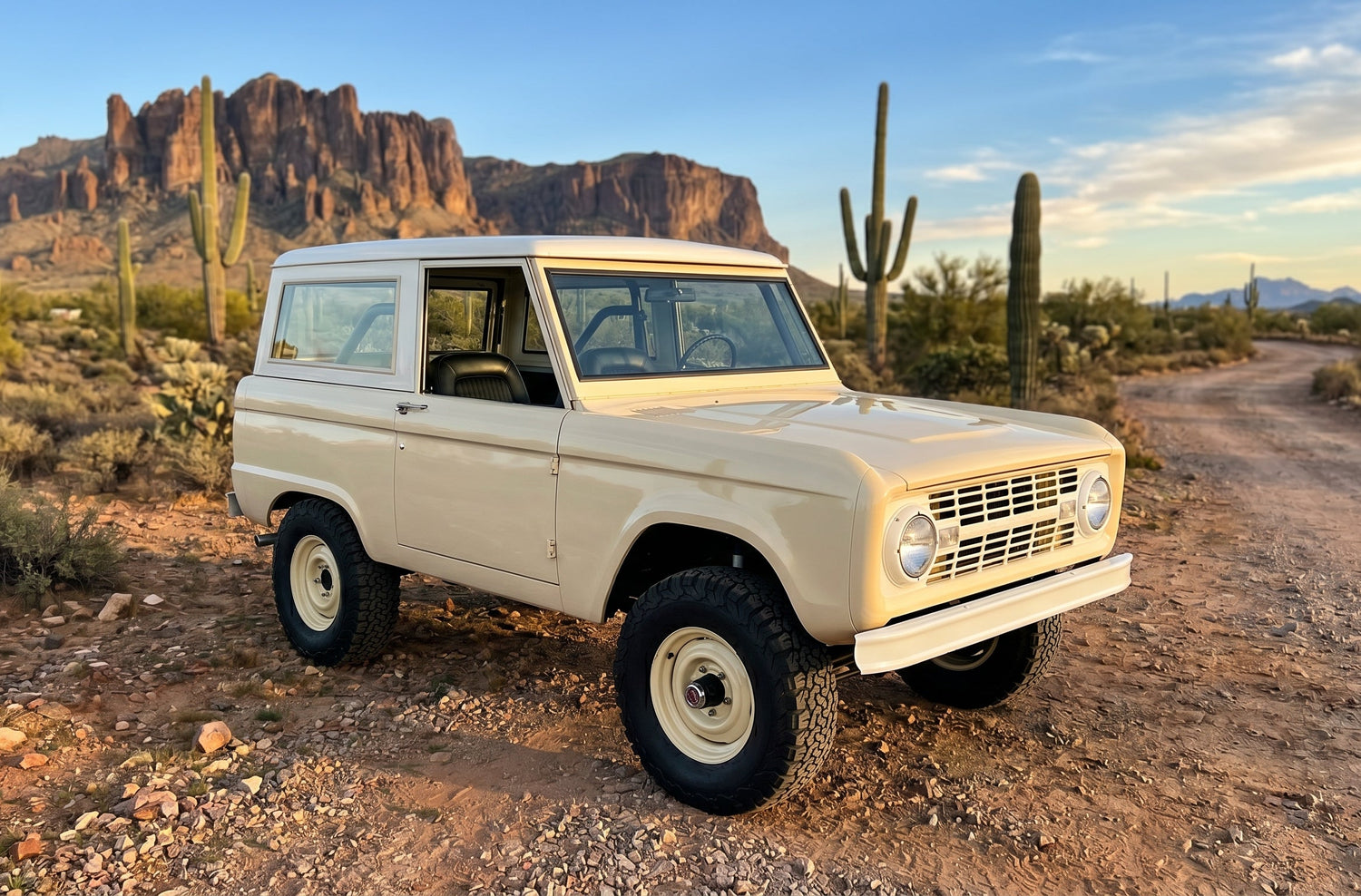
The first-generation Ford Bronco ran from 1966 to 1977, and it turns 60 this year. Three body styles. Two inline-six engines. Two V8s. A Dana 30 that became a Dana 44. Drum brakes that became discs. A Roadster that disappeared in 1968. A Pickup that disappeared in 1972. A Stroppe Baja edition that fewer than 700 people ever bought. This guide covers all of it. Year by year, decision by decision. Then we get into what every serious Bronco build eventually needs: glass that fits like the factory should have done it the first time. Fesler builds a DOT-approved, American-made flush-mount glass kit for the 1966-1976 Bronco. Pilkington glass. Phoenix shop. Pre-order open now.
Why the early Bronco matters in 2026
The Bronco launched in August 1965 as a 1966 model. Ford product manager Donald Frey pushed the concept. Lee Iacocca got it greenlit. Internal Ford memos called it the GOAT, short for "Goes Over Any Terrain." It was Ford's answer to the Jeep CJ-5 and the International Harvester Scout, and it was the first vehicle Ford ever built on a chassis that was not shared with another model.
Sixty years later, the first-gen Bronco is one of the hottest collector vehicles in the country. Median Hagerty quoted values for early Broncos are up roughly 74 percent over the last five years. At Barrett-Jackson Scottsdale, the average sale price for modified early Broncos has been north of $111,000. A 1969 Bronco called "Big Oly" sold for $1.87 million in 2021.
This is not a Jeep. This is not a Scout. This is the truck that defined the compact American 4x4, and the aftermarket is finally catching up to what serious builders need to make these things look the way they always should have.
The three body styles: U13, U14, U15
Every first-gen Bronco shared the same 92-inch wheelbase and the same boxy body shell. The difference between them was the roof and the rear.
U13 Roadster. No doors. No roof. Removable door inserts and a snap-on soft top were optional accessories. Designed for beach cruising and recreation, not daily driving. Produced 1966 to 1968 only. Roughly 5,000 total units built across all three years, with 4,090 in 1966 alone. Today, fewer than 200 authentic U13s are believed to exist. Authentic, frame-off restored U13 Roadsters routinely sell in the $60,000 to $80,000 range, with exceptional examples going much higher. Most "doorless" Broncos you see at shows are actually U14 or U15 trucks that have been modified.
U14 Half Cab (Pickup). A steel roof over the front cab, a small pickup bed behind. Sold as the "Sports Utility" in 1966 and renamed "Pickup" by Ford marketing in 1967. Discontinued after 1972. The U14 was the working man's Bronco. Farmers, ranchers, contractors. Today they are less common than wagons and command a premium with collectors who appreciate the utility-first design.
U15 Wagon. Full-length steel hardtop. Rear side glass. The most produced and most practical of the three body styles. The U15 is what most people picture when they think "first-gen Bronco," and it is the body style that drove the modern restomod movement. Sport package starting in 1967. Ranger package starting in 1972.
Fesler's flush-mount glass kit is engineered for the U15 Wagon with a full hardtop. The kit includes the windshield, both hardtop side glass panels, and the rear glass. If you're running a Roadster with a soft top, or a Half Cab without the hardtop, you'll only need the front glass and we sell the panes individually.
Year-by-year breakdown, 1966 to 1977
1966: The original
Base price: $2,194. Standard engine: 170-cubic-inch inline six derived from the Ford Falcon, rated 105 horsepower. Optional 289 V8 introduced in March 1966, rated 200 horsepower. Three-speed column-shift manual transmission. Dana 20 transfer case. Dana 30 front axle. Ford 9-inch rear axle. Drum brakes all around. Scalloped "eyebrow" grille unique to 1966 with no FORD lettering. T-handle transfer case shifter replaced a ball-style shifter mid-year. Production for 1966: roughly 23,776 trucks, including 4,090 U13 Roadsters. The first roughly 200 Broncos were stamped by Budd Manufacturing and have no VIN tag indent on the kick panel. Those early Budd-built trucks are the holy grail of first-year Broncos.
1967: Sport package debuts
The Sport package added chrome bumpers, chrome headlight bezels, chrome grille and windshield trim, red die-cast F-O-R-D letters on the grille, a bright horn ring, and upgraded interior trim. Dual master cylinder with split hydraulic system became standard. Self-adjusting brakes. Back-up lights standard. U14 renamed from "Sports Utility" to "Pickup." Production: 14,230.
1968: Last year for the 289 and the Roadster
Curved-end bumpers with integrated side marker reflectors. Locking front hubs became standard. Recessed flipper-style interior door handles replaced the pull-up handles. Swing-away spare tire option introduced. A dry replaceable air filter replaced the oil-bath unit. The 289 V8 was in its final year. The U13 Roadster was discontinued after 1968. Production: 16,629.
1969: 302 V8 arrives
The 289 V8 was replaced by the new 302 V8 rated 205 horsepower. The 302 would remain the V8 option through 1977. Door window frames changed from a bolt-in design to a welded design. Production jumped to 20,956, the best year so far.
1970: Steady as she goes
Few notable mechanical changes. Front auxiliary fuel tank dropped to 10.3 gallons. Color options expanded to 17. Production: 18,450.
1971: Dana 44 and the Baja Bronco
This is a big one. The Dana 44 front axle replaced the weaker Dana 30 mid-year in 1971. Late-1971 and later Broncos are the preferred starting points for serious off-road builds because of this single upgrade. Bill Stroppe and Associates also released the special-edition Baja Bronco this year, marketed through Ford dealers in collaboration with the factory. The package included a Poppy Red and Wimbledon White paint scheme with a Bright Blue Metallic roof, a satin black hood to reduce glare, a roll bar, dual shocks front and rear, Gates Commando tires, fender flares, a rubberized steering wheel, bumper braces, factory power steering, and the C-4 three-speed automatic. Priced at $5,566 versus $3,665 for a standard V8 Bronco. Approximately 650 Baja Broncos were built between 1971 and 1975. Production for the 1971 model year: 19,784.
1972: Last year for the U14 Pickup
Vapor control system added for emissions compliance. Last full year for the T-handle transfer case shifter. The "302" emblem disappeared from the front fenders. The U14 Pickup was discontinued after 1972. From 1973 on, the Wagon was the only body style Ford offered.
1973: The modernization year
Ford finally answered the Blazer challenge. Factory power steering became an option, a Saginaw box with 5.3 turns lock-to-lock. The C-4 three-speed automatic transmission became an option. The 170 inline six was bumped to a 200-cubic-inch inline six rated 84 horsepower (net, not gross). The J-handle transfer case shifter replaced the T-handle with a 2.34:1 low range. Production jumped to 21,894.
1974: Best sales year of the run
Mostly cosmetic. Lighted gear indicator on automatic-equipped Broncos. Dome light replaced the map light. Front limited-slip differential dropped from the option list. 4.11 gear ratio discontinued. Production hit 25,824 trucks, the best year of the first generation up to this point.
1975: The valley
Unleaded fuel engines and catalytic converters added in response to tightening emissions regulations. V8 became the only available engine in California (the 200 inline six was no longer compliant there). Sport and Ranger trims got the F-Series steering wheel. Production crashed to 13,125 trucks, the lowest of the entire first generation.
1976: Power-assisted disc brakes
The bicentennial year brought long-overdue upgrades. Front disc brakes became standard. Vacuum-assisted power brakes became an option that almost everyone checked. Rear drums upgraded to 11 x 2.25 inches. Steering box ratio shortened to 3.8 turns lock-to-lock. Front anti-sway bar. Mid-year Special Decor Group introduced. Production: 15,256.
1977: The peak
The final year of the first generation and, for many builders, the best one. Standard front disc brakes, almost-always-optioned power brakes and power steering, and the most refined drivetrain of the run. Production hit 30,700 trucks across 18 colors, the highest annual production of the entire first generation. The 1977 model is widely considered the most desirable year for drivers because of the brake and steering improvements.
A quick note on the Fesler glass kit. Our 1966-76 kit covers the eleven model years from launch through 1976. If you're building a 1977, contact the shop and we'll get you the right answer on fitment and availability.
Engines, transmissions, and axles at a glance
Engines. 170-cubic-inch inline six (1966-1972, 105 horsepower gross), 200-cubic-inch inline six (1973-1977, 84 horsepower net), 289 V8 (1966-1968, 200 horsepower), 302 V8 (1969-1977, 205 horsepower gross dropping to roughly 125-135 net by the mid-1970s). Both sixes and both V8s are simple, reliable, and cheap to rebuild. The 302 is by far the most common starting point for modern builds because parts support is endless.
Transmissions. Three-speed column-shift manual (1966-1977 standard), C-4 three-speed automatic (1973-1977 optional). Floor-shifted manual conversions are a common period-correct modification. For modern restomods, almost everyone goes to a four-speed automatic or a five- or six-speed manual.
Transfer case. Dana 20 throughout the entire run. One of the strongest, lightest, most capable transfer cases of the era. T-handle shifter (1966-1972, 2.46:1 low) or J-handle shifter (1973-1977, 2.34:1 low).
Axles. Dana 30 front (1966 through mid-1971), Dana 44 front (mid-1971 through 1977). Ford 9-inch rear throughout the run, with 3.50, 4.11, or 4.57 gear ratios depending on year and engine.
Sport, Ranger, and Stroppe Baja
Three trim packages defined the desirable end of the first-gen Bronco market.
Sport package (1967-1977). Chrome trim, upgraded interior materials, red F-O-R-D grille letters, full wheel covers. The standard "nice" Bronco that most enthusiasts know.
Ranger package (1972-1977). Plush carpeting, high-back bucket seats with unique upholstery, woodgrain accents on the dash and door panels, additional sound insulation. Ford's attempt to push the Bronco upmarket as the Blazer and Ramcharger gained ground.
Stroppe Baja Bronco (1971-1975). Roughly 650 produced total. Bill Stroppe and Holman-Moody (SHM) had been winning the Mint 400, Baja 500, and Baja 1000 in modified Broncos since the late 1960s, and the dealer-sold Baja Bronco was a street-legal celebration of that program. Today, authentic Baja Broncos with documentation are six-figure trucks. Tribute builds in Stroppe colors are one of the most popular restomod paths in the entire first-gen market.
What to look for when you buy
The first-gen Bronco has a few well-known weak spots. Every truck has them. Inspect for them.
- Rust. Floor pans, rocker panels, tailgate seams, the cowl, the rear quarters, and the area under the rear hardtop seal. Arizona trucks tend to be cleaner. Northeastern and Midwestern trucks were often used for plowing snow and salted roads chewed them up.
- Frame cracks. Especially at the front shock towers on trucks that were lifted or trail-used hard. Get under it with a flashlight.
- Vacuum wipers. Original early Broncos used vacuum-actuated wipers that were sluggish when new and almost useless now. Electric conversions are common and welcome.
- Steering slop. The original manual steering box wears out, especially with oversized tires. Power steering conversions on pre-1973 trucks are a near-universal upgrade.
- Brakes. Pre-1976 drum brakes are inadequate for modern traffic. Disc brake conversions are widely available.
- Original engine and drivetrain. If you want a numbers-matching restoration, verify the engine, transmission, and axles match the build sheet. If you're going restomod, none of this matters and a clean rust-free shell is worth more than a matching-numbers truck with a rotten cab.
- Glass. Original Bronco glass is brittle, often delaminated, and sits behind chrome trim and aging rubber gaskets that leak. We'll get to this.
Current market values
Hagerty's median quoted value for an early Bronco sits around $29,600 across all conditions. That number is up roughly 74 percent over the last five years. Median #2 (Excellent) condition value for a 1966-77 Bronco is approximately $53,650, which is meaningfully higher than a 1969-72 Chevy Blazer ($39,500) or a 1972-80 International Scout II ($28,500) at the same condition grade.
Modified and restomod builds carry the biggest premium. At Barrett-Jackson Scottsdale auctions in recent years, the average sale price for first-gen Broncos has consistently been over $100,000, and roughly 60 percent of those trucks were modified in some way. A perfectly restored stock truck and a high-end restomod with a Coyote 5.0 swap, a Roadster Shop chassis, and a full custom interior can both clear $250,000 at the right auction.
What this means for you as a builder: there is no longer a financial penalty for building exactly the truck you want. The market values quality builds. Spending real money on glass, interior, and drivetrain is rewarded.
The glass problem
Here is the part of the build that most owners underestimate.
Original Bronco windshields, hardtop side glass, and rear glass were installed with rubber gaskets and stainless trim. That worked in 1966 because the body shells were straight from the factory. Sixty years later, most Bronco bodies have been worked, repainted, and repaired at least once. Original rubber gaskets shrink and harden. Stainless trim gets pitted, dented, and stretched. Replacement gaskets are available but they sit proud of the body and reintroduce the visual "step" that ages the truck immediately.
There are a few different ways to address this. You can use a new rubber-gasket replacement glass setup from any number of suppliers. You can use polycarbonate, which is not DOT approved and is not street legal for windshields. Or you can go flush-mount, where the glass bonds directly to the body with a FRIT band, primer, and urethane, eliminating the rubber gasket and stainless trim entirely.
Flush-mount is what every serious first-gen Bronco build needs. It is the single biggest visual change you can make to the truck, and it transforms the entire profile. Read our full breakdown of why flush-mount glass works the way it does and why polycarbonate windshields are not a legal substitute for actual DOT-approved automotive glass.
The Fesler 1966-76 Bronco flush-mount glass kit
This is the kit that has been on every Bronco builder's wish list for years.
Fesler's 1966-1976 Ford Bronco flush-mount glass kit is DOT-certified, trimless, American-made, and built in partnership with Pilkington, the same OEM glass supplier trusted by major automakers. The complete kit includes the laminated windshield, both tempered hardtop side glass panels (driver and passenger), and the tempered rear glass. You can also order individual panes if you only need to replace one. Pre-order is live with a $1 deposit that holds your place, and we don't bill the full amount until your kit ships.
What "flush-mount" actually means on a Bronco. Fesler glass is engineered and molded specifically for the 1966-76 Bronco body. The glass sits inside the factory aperture and bonds directly to the body with a FRIT band, urethane primer, and automotive urethane adhesive. No rubber gasket. No stainless trim. No exterior molding of any kind. The result is a clean, even reveal around every piece of glass with a modern bonded look that completely changes the silhouette of the truck.
Why our kit fits the way it does. A lot of glass on the market is just slightly oversized stock glass that needs to be "massaged" into place. We don't do that. Fesler glass is prototyped, test-fit, re-molded, manufactured, and test-fit again on real customer builds before it ships. No sanding required to fit. When you order our Bronco kit, you get glass that drops into the factory opening cleanly on a properly prepared body.
DOT-certified and laminated. Every Fesler windshield is laminated safety glass that meets FMVSS 205, the federal motor vehicle safety standard for automotive glazing. It blocks 99.9 percent of UVA radiation, resists penetration in a collision, and is fully street legal in every U.S. state. The side glass and rear glass are tempered for the same reason factory side and rear glass is tempered: shatter pattern safety. There are cheaper options out there. None of them are this.
Phoenix shop. Every Fesler glass kit is staged, inspected, and packaged at our Phoenix, Arizona facility before it ships. If something is off, we catch it before it leaves the building. Reserve your kit here or head to the Bronco collection page for the full lineup.
Other Fesler parts that finish a Bronco build
Glass is the headline. The rest of the build matters too. Here's the short version of what we stock for Broncos.
Carpet kits. Fesler offers molded carpet kits for the 1966-77 Bronco in a wide range of colors, including Black, Charcoal, Red, Ford Blue, Ivy Gold, Medium Saddle, and Dark Green among others. We stock two backing options. Standard backing is lighter and works well for weight-focused builds. Mass Back is heavier and substantially better for noise and heat insulation, which matters a lot in a Bronco because the body has minimal factory sound deadening from the factory. For a street-driven Phoenix Bronco that sees highway miles, Mass Back is almost always the right call. Full carpet guide here.
Dakota Digital gauges. Dakota Digital builds direct-fit instrument clusters for the first-gen Bronco in two series. The HDX series is the high-performance digital cluster with a built-in display screen, Bluetooth app, and the widest fitment coverage. The RTX series (Retrotech) is designed to look factory-correct by day and light up like a modern cluster at night. Both work with the Bronco's factory gauge opening and can be configured to read coolant temp, oil pressure, fuel level, voltage, and speed from either the original sender or a modern EFI ECU. Pricing starts around $1,543 for the HDX and $1,676 for the RTX, with a 5 percent Fesler discount off MSRP. Read the full Dakota Digital buyer's guide.
Detail products. When the truck is done, our American-made detail products (glass cleaner, ceramic spray, interior cleaner) are formulated to be safe on the urethane bond around your new flush glass. Many off-the-shelf glass cleaners contain ammonia or solvents that can attack urethane over time.
Stock or restomod? The honest answer
This is the question every Bronco owner eventually faces. Here's how we'd think about it.
Go stock if your truck is an authenticated rare configuration. A real 1966 U13 Roadster. A documented Stroppe Baja. A low-mile original survivor. These trucks are worth more in original condition than they will ever be modified, and the collector market is paying for originality.
Go restomod if your truck is one of the 220,000-plus regular U15 Wagons, especially from the post-1971 Dana 44 production years. Modify it. Coyote swap it. Modern brakes, modern steering, modern suspension. Add air conditioning, which was never a factory option on the first-gen Bronco. Drop in Dakota Digital gauges and Fesler flush-mount glass. The market rewards quality builds.
There are a lot of shops out there that will build a Bronco for you turnkey if you don't want to wrench on it yourself. They do good work. What we sell is the parts that those shops put on the trucks they build. Either path, Fesler glass ends up on the finished product.
Recommended build sequence
If you're starting fresh, here's the order we'd put a Bronco build in. Read our full builder's ordering guide for the deep version.
- Body and frame work first. All rust repair, all metalwork, all body alignment, then paint. Flush-mount glass needs a properly prepared body opening. We are not the right kit for a project where the floor pans aren't done yet.
- Drivetrain. Engine, transmission, transfer case, axles, suspension, brakes, steering. Get the truck running and tracking straight before you touch the interior.
- Glass. Install the windshield, side glass, and rear glass once paint is fully cured and the body is sealed. Fesler glass bonds directly to the body with urethane and will not come off, so install only when you're confident in the bodywork.
- Interior. Sound deadening, carpet, headliner, seats, gauges, wiring, console. The Fesler flush glass does not affect any interior trim or garnish moldings. The interior pieces install the same way they always did.
- Final detail. Wheels, tires, paint correction, ceramic coating, anything else. Drive it.
FAQ
Does Fesler's Bronco flush-mount glass fit every year from 1966 to 1976?
Yes. The kit is engineered for the full first-generation body shell from 1966 through 1976, including all U15 Wagon configurations across those years. If you're working on a 1977, reach out to the shop and we'll confirm fitment for your specific truck.
What does the complete kit include?
Laminated windshield, both hardtop side glass panels (driver and passenger), and the tempered rear glass. Individual panes are also available if you only need to replace one.
Is the glass DOT approved?
Yes. The windshield is DOT-stamped laminated safety glass that meets FMVSS 205. The side and rear glass are DOT-stamped tempered glass. Street legal in all 50 states.
Will my Bronco need bodywork to install flush-mount glass?
If the body is straight and the factory aperture is intact, no. Fesler glass is sized specifically to drop into the factory opening. If your truck has been heavily customized, has bondo around the glass openings, or has structural rust at the windshield frame or hardtop edge, that needs to be addressed before the glass goes in. Talk to your installer.
Can I install it myself?
Flush-mount glass installation requires modern automotive urethane, primer, a FRIT band on the glass perimeter, and the technique to bond glass cleanly to a body. Most experienced glass installers and most full-service body shops can do it. If you've never done a urethane-bonded windshield, hire it out. See our flush-mount glass install guide for the full process.
How long does pre-order take?
$1 holds your place in line. We don't bill the full $2,929 until your kit ships. Final samples are in testing now and production kits are on a short timeline. The wait is much shorter than people expect for a kit this specific.
Does Fesler ship internationally?
Yes. If you are willing to pay for it, we are willing to ship it. We have shipped Fesler glass and parts to builders in every U.S. state and to a long list of countries. International freight is quoted per order.
Does Fesler offer carpet, gauges, and interior for the Bronco?
Yes. Molded carpet kits, Dakota Digital instrument systems (HDX and RTX), and a growing list of detail and finish products. Browse the 1966-1976 Ford Bronco collection for everything currently available, and reach out for anything you don't see listed yet.
Build it once, build it right
The first-gen Bronco hits 60 in 2026. Values are at all-time highs. The aftermarket has finally caught up with what these trucks deserve. There has never been a better time to start, finish, or refresh a Bronco build, and there has never been a better moment to put proper American-made flush-mount glass on one.
If you're ready, reserve your 1966-76 Bronco flush-mount glass kit here. If you're still planning, browse the full Bronco collection and the flush-mount glass guide. If you have questions about your specific truck, your specific build, or fitment on a year we haven't covered above, call or text the shop at 480-748-2000, Monday through Thursday, 8am to 5pm Arizona time.
Hand-built in Phoenix. Glass made in America with Pilkington. Shipped worldwide.
If you are willing to pay for it, we are willing to ship it.


Leave a comment
This site is protected by hCaptcha and the hCaptcha Privacy Policy and Terms of Service apply.