
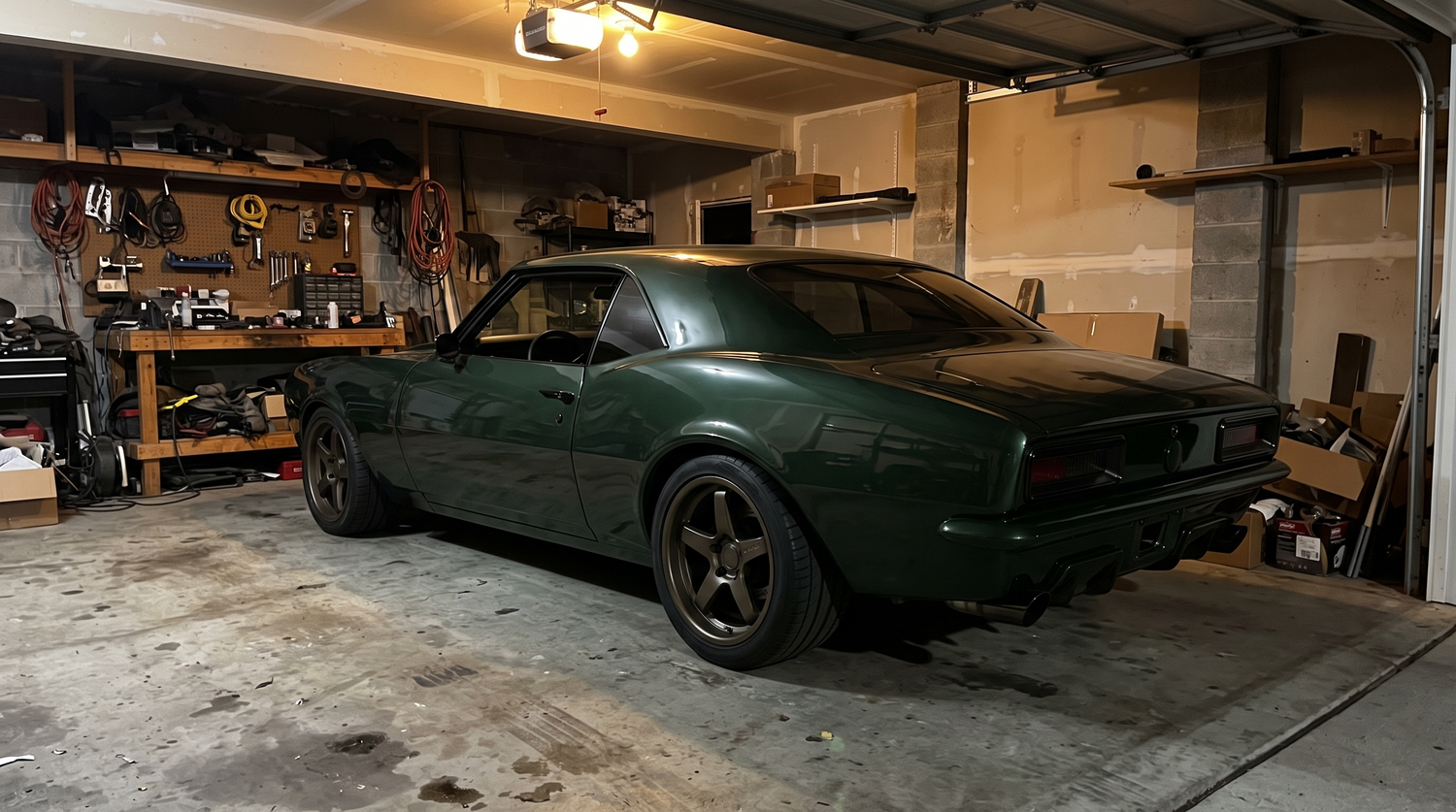
You do not have to cut your car to get real sound out of it. Fiberglass interior panels with speaker fitment molded in give you four to six proper mounting locations, kick panels, door panels, A-pillars, and the package tray, without a hole saw touching a single piece of original sheet metal.
That matters because the alternative is what most classics have already had done to them: a jigsaw taken to a quarter panel in 1994, and a set of 6x9s screwed to a piece of particle board.
Why is car audio so hard in a classic?
Because these cars were designed around one speaker. A single paper cone in the center of the dash, mono, aimed at the windshield. There were no door speakers, no tweeters, and no thought given to anything we would now call staging.
That leaves three problems. There is nowhere to put a woofer that is not a hole you have to make. There is nowhere to put a tweeter at ear height. And every surface in the car is bare steel or a thin panel that resonates, so whatever you install is fighting the car.
The traditional answers are all bad. Cutting the doors devalues the car and often puts the speaker where the window regulator lives. Cutting the kick panel area risks the fresh air vent and the wiring. Cutting the package tray shelf is the most common and the most regretted, since it weakens a structural area and you can see the damage forever.
What is the fix?
Use panels that already have the fitment in them. Every Fesler fiberglass interior panel that can accept a speaker is molded with the mounting area built into the part, reinforced, and located where the speaker actually works. You bolt the panel to factory locations, the speaker mounts to the panel, and if you ever pull it all back out the car is untouched.
Concretely, that is four to six locations:
- Kick panels. 6.5 inch fitment, low and forward, the best midbass location in most of these cars.
- Door panels. 6.5 inch fitment molded in, reinforced baffle area.
- A-pillars. Tweeter location at or near ear height, which is what actually creates a sound stage.
- Package tray. Rear fill without cutting the shelf.
Why does a rigid baffle matter so much?
This is the part that separates a system that sounds expensive from one that just sounds loud. When a woofer cone pushes forward, the basket pushes backward with equal and opposite force. If the surface it is bolted to flexes, that energy goes into moving the panel rather than moving air.
Bolt a good 6.5 inch driver to a thin vacuum-formed ABS panel and the panel becomes a passive radiator working out of phase with the speaker. The result is the boomy, smeared, indistinct midbass that people blame on their head unit and then spend money on an amplifier to fix. It is not the amplifier.
Hand-laid fiberglass is several times stiffer and heavier. The speaker's energy goes where it is supposed to go. It is the same reason a serious home speaker lives in a heavy braced cabinet instead of a cardboard box. We went deeper on the material differences in fiberglass vs ABS interior panels.
Where do the tweeters go?
A-pillars, and this is the single most underrated upgrade in a classic. Tweeters mounted low in a kick panel or down in a door fire at your knees, and your brain places the whole soundstage at floor level. Move them up to the pillar, roughly at ear height and aimed across the cabin, and the stage rises up onto the dash where it belongs.
This costs almost nothing relative to what it does. We stock the Morel Reference MT120N tweeter at $299 specifically for A-pillar mounting, and our fiberglass A-pillars run $399.
What speakers should you actually buy?
Buy fewer, better drivers rather than more cheap ones. A classic has a small cabin, a lot of glass, and no rear seat passengers worth designing for. Two excellent front stage speakers beat six mediocre ones every time.
We stock Morel Virtus Nano Carbon because it is built for exactly this situation, shallow mounting depth and real output from a 6.5 inch driver:
- Virtus Nano Carbon Integra Point Source, $799
- Virtus Nano Carbon 2-Way, $849
- Virtus Nano Carbon 3-Way, $1,149
The point source and 2-way sets are the right starting point for most builds. Step to the 3-way when you are running a dedicated midrange in the A-pillar and want the full stage.
What has to happen before the speakers go in?
Sound deadening, and it is not optional if you care about the result. Deadener on the door skins, the floor, the roof, and the rear wheel tubs does three things: it stops the metal from ringing along with the music, it lowers the road noise floor so you are not fighting tire roar, and it turns the door into something closer to a sealed enclosure so the woofer works properly.
Order of operations: deaden, then panels, then speakers, then tune. Doing it backward means pulling everything apart again. Our sound deadening guide covers where the material goes and how much you actually need.
Do you need an amplifier?
If you bought real speakers, yes. Quality drivers want clean power, and a modern head unit's internal amplifier is not it. The good news is that a compact multi-channel amplifier hides easily under a seat or behind a kick panel, and the wiring run happens naturally while the interior is already apart.
Plan the amplifier location and the power run at the same time you plan the panels. Finding a home for it after the interior is trimmed is how amplifiers end up bolted to the trunk floor in plain view.
Which Fesler panels have speaker fitment?
- 1967-69 1st Gen Camaro Kick Panels, 6.5 inch fitment, $299
- 1970-81 2nd Gen Camaro Kick Panels, $399
- 1968-72 Chevelle Kick Panels, $399
- 1967-69 1st Gen Camaro Package Tray, $349
- 1970-81 2nd Gen Camaro Package Tray, $349.99
- 1968-72 Chevelle Package Tray, $349.99
- Door panels across most platforms, 6.5 inch fitment molded in
Quick answers
Do I have to cut anything at all? Not on the car. The panels mount to factory locations and the speaker mounts to the panel.
What size speakers fit? Our kick panels and door panels are molded for 6.5 inch drivers. Check mounting depth against your specific speaker.
Can I run rear speakers? Yes, through the package tray, without cutting the shelf. On a two door classic we would spend the budget on the front stage first.
Will the panels come with speaker grilles? They ship in raw gel coat for your upholstery shop, which is also when grille cloth or a custom cover gets handled.
Is this reversible? Completely. Pull the panels and the car is exactly as it was.
Do I still need door panels if I have kick panels? They do different jobs. Kick panels give you the best midbass position, door panels give you a second location and seal the door opening.
Shop Morel speakers, shop kick panels, or browse the full interior lineup.

Leave a comment
This site is protected by hCaptcha and the hCaptcha Privacy Policy and Terms of Service apply.