
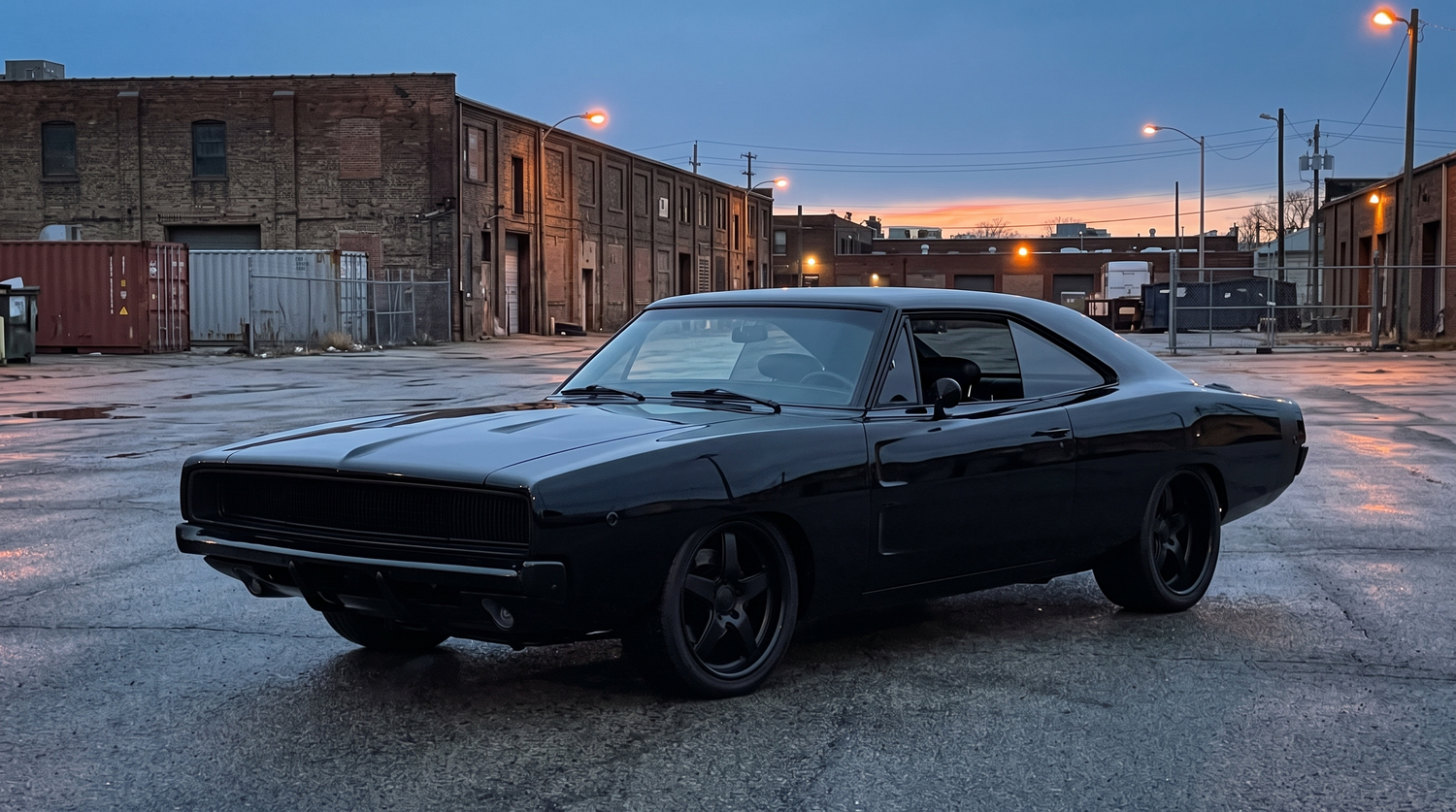
The 1968 to 1970 Dodge Charger is, by fairly wide agreement, one of the best-looking American cars ever built, and it is also one of the least well-supported by the restomod aftermarket compared to a first-gen Camaro or a C10. That gap is the whole reason this guide exists.
Short version: build the base and 383 cars freely, leave documented Hemi cars and low-production 1969 variants alone, budget more than you think for rust, and start the interior with glass and door panels rather than seats.
What changed between 1968, 1969, and 1970?
All three years share the same second-generation B-body shell with the recessed rear window between the flying buttress sail panels. The differences are almost entirely front and rear.
- 1968. Full-width blacked-out grille with hidden headlights and no divider. Round taillights. The purest version of the shape and the one most people picture.
- 1969. Grille gains a center divider, splitting it into two openings. Taillights change to a full-width horizontal treatment. A small rear-facing scoop appears on the quarters on some trims.
- 1970. A full chrome loop bumper wraps the grille opening, which is the fastest way to spot a 1970 from fifty feet.
Mechanically the three years are close enough that most chassis and interior work carries across. Trim, grille, and lighting parts generally do not.
Which Chargers should you not modify?
We will say this plainly, because it is easy to talk yourself out of it once a car is already in your shop.
- Documented Hemi cars. Verified 426 Hemi Chargers are worth substantially more original than modified, and the delta is not close.
- 1969 Charger 500 and Daytona. Low-production aero cars built for NASCAR homologation. These are historically significant, and cutting one up is the kind of thing people write articles about later.
- Genuine, documented, unmolested R/T cars with matching numbers. Not an absolute rule, but the burden of proof shifts. If the car is honest and complete, think hard.
Everything else, meaning the base cars, the 318 and 383 cars, the tired ones, and the many Chargers that have already been apart three times, is fair game and is exactly what the restomod market should be built on. Build those.
Where do Chargers rust?
Learn these five spots before you buy one, because they determine whether a $20,000 car is a bargain or a money pit.
- The rear window channel. The recessed backlight is a water trap by design. Water sits in the channel, the drains plug, and the metal underneath the trim goes away. Pull the trim and look.
- Trunk floor and extensions. Downstream of the same problem. Lift the mat.
- Lower quarters and wheel arches. Universal on the era, and expensive because of the body line.
- Frame rails and torsion bar crossmember. Structural. Get under the car.
- Floors under the front seats. Cowl leaks feed this.
Two of these five are glass-related, which is the point we keep making about this platform. Water management around the backlight is the Charger's defining structural weakness.
What should the upgrade order be?
Our recommended sequence, and the reasoning behind it.
- Metal and rust repair. Everything else is decoration until this is right.
- Glass and body prep, together. If you are going flush-mount, the trim clip holes get filled and the openings get checked before paint. Doing this after paint means paying twice.
- Chassis and drivetrain. Torsion bar front suspension responds very well to modern geometry and shock work. Leaf spring rear is the usual limiting factor.
- Interior, starting with door panels and console. Not seats. Seats are the most visible and the least structural.
- Gauges and wiring. Plan these before the dash is finished, not after.
What Charger parts does Fesler build?
This is a platform we support deliberately, because most of the aftermarket does not.
- 1968-1970 Charger Flush-Mount Glass Kit, DOT certified, American-made, from $2,099
- 1968-70 Charger Door Panels, hand-laid fiberglass, set of four, $1,499
- 1968-69 Charger Steel Center Console, $1,999
- 1968-69 Charger Fiberglass Center Console, $699
- 1968-70 Charger Power Window Kit, from $1,290
- Charger Carpet Kit, from $296
- RingBrothers Charger Deck Lid Hinges, billet 6061-T6, $500 per pair
The full 1968-70 Charger collection has everything together.
Why flush-mount glass changes a Charger more than most cars
On most muscle cars, deleting the trim is a styling improvement. On a Charger it is that plus a functional one, because of that recessed backlight.
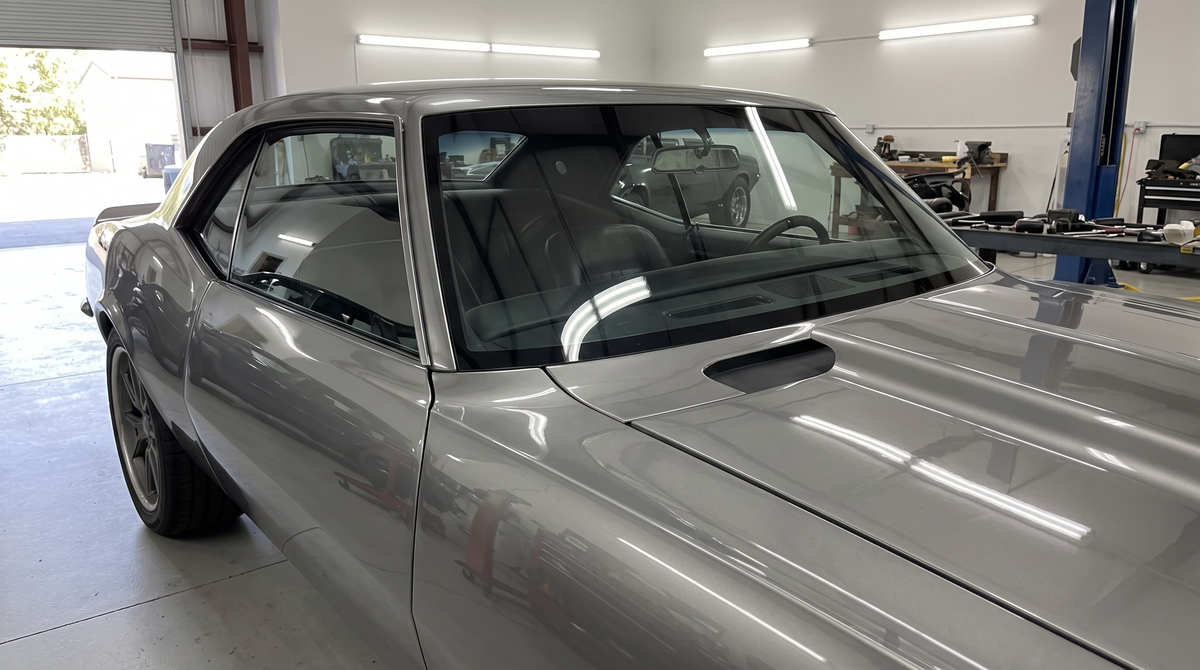
The factory setup runs a rubber gasket and a stainless trim ring around a piece of glass sitting at the bottom of a tunnel that collects water. Bonded urethane glass with no gasket removes the seam that fails and the trim that traps debris. You get the cleaner look and you stop feeding the rust problem described above.
Same rules apply as any flush-mount job: professional installation with automotive urethane, never butyl. Our guide on who actually installs flush-mount glass and what it costs covers finding someone who will take the work.
What about power windows and door panels together?
Order them as a pair. Fesler fiberglass door panels are built for power windows and do not accommodate manual crank mechanisms without modification, so on a Charger the panel and the window kit are one decision, not two. The reasoning is in our power window guide, and the case for fiberglass over reproduction panels is in why fiberglass door panels are worth it.
Quick answers
Does the glass kit fit all three years? The kit covers 1968 through 1970. Confirm your body before ordering, since glass is non-returnable.
Will 1968 trim fit a 1970? Front and rear trim, grilles, and lighting are year-specific. Interior and chassis parts generally carry across.
Is a 318 Charger worth building? Absolutely, and it is the smart way into the platform. Nobody is upset about a drivetrain swap on a base car.
Do the door panels fit 1970? Our panels are listed for 1968-70. Ask us about your specific car if you are unsure.
What is the biggest budget surprise on a Charger build? Rust repair around the rear window and trunk. Inspect it before you buy, not after.
Shop the 1968-70 Charger collection or contact us to plan your build.

Leave a comment
This site is protected by hCaptcha and the hCaptcha Privacy Policy and Terms of Service apply.