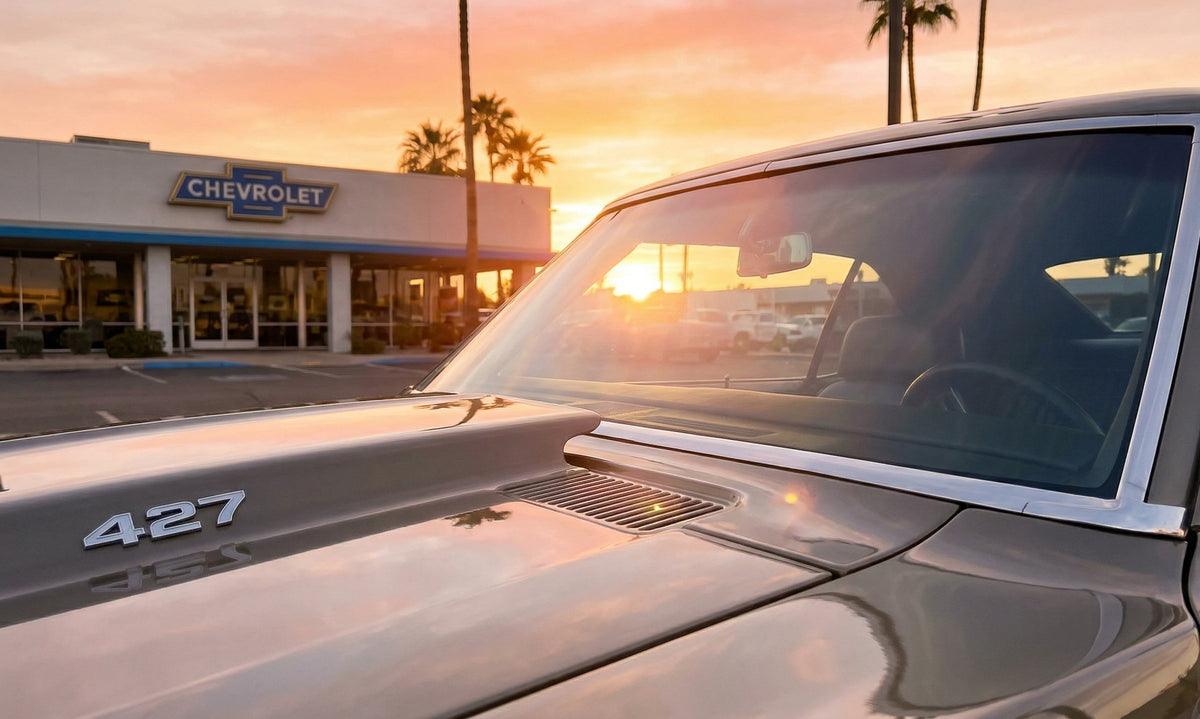
In the late 1960s, General Motors had a corporate rule that seemed simple enough: no engine over 400 cubic inches in anything smaller than a full size car, Corvette excepted. That covered pony cars, intermediates, and compacts alike. The Camaro topped out at 396 cubic inches. The Chevelle topped out at 396. The Nova was in the same box.
Meanwhile, across town at Chrysler, they were dropping 426 Hemis into Barracudas and Road Runners. Ford had the 428 Cobra Jet Mustang. Chevy guys were showing up to the drag strip with one hand tied behind their back.
A Chevrolet dealer in Canonsburg, Pennsylvania decided that wasn't going to work. So did one in La Harpe, Illinois.
Don Yenko Wasn't Just a Dealer
Don Yenko ran Yenko Chevrolet, a family dealership about 20 miles southwest of Pittsburgh. But calling him "just a dealer" is like calling Carroll Shelby "just a chicken farmer." Yenko was a serious racer. He won SCCA B Production national championships in 1962 and 1963, took a GT class win at Sebring in 1967, and ran Corvettes backed by Gulf Oil and later Sunray DX. Not by the factory: GM had walked away from racing in 1963, which is exactly why the rest of this story had to happen through a back door.
His first major project was the Yenko Stinger, a modified Corvair built for SCCA racing. Production started in December 1965 and the SCCA approved it in January 1966.
When the Camaro launched in 1967, Yenko started buying L78 SS 396 Camaros, pulling the 396s, and installing L72 427s. Worth being precise here, because it gets repeated wrong: the L72 was a Corvette engine in 1966 only. By 1967 it had been dropped from the Corvette and was available over the counter and in full size cars. So these were not "Corvette motors" in any 1967 or 1968 car.
He did 54 of them in 1967 and another 64 in 1968. A total of 118 engine swaps in two years. For the 1968 cars he was already working inside Chevrolet's special order system, using COPO 9737, the Sports Car Conversion package, to get the heavy duty hardware from the factory before doing the engine himself.
The swaps worked. Yenko Camaros were running mid 13s at the strip right off the showroom floor. With slicks and headers, they were in the 11s. But the process was expensive, time consuming, and the swapped cars only carried a limited engine warranty. Yenko needed a better way.
The Loophole: COPO
General Motors had an internal system called COPO, which stood for Central Office Production Order. It was the channel for vehicle configurations that were not available through the normal option book: fleet orders, taxis with heavy duty cooling, police cars with upgraded electrical, municipal equipment. Unglamorous stuff. Nobody at corporate was watching it for performance applications.
Yenko saw the gap. He had an ally inside Chevrolet in Vince Piggins, the company's product performance manager, who quietly kept a back channel open to racers after the 1963 corporate racing ban. Piggins knew how to route a request so it never reached the committee that would have killed it.
Two separate orders came out of this, and they are constantly credited to the wrong people.
COPO 9561 was Yenko's. He approached Chevrolet about a special production run of 427 Camaros for 1969 using the iron block L72, and an agreement was reached. The cost was $489.75 per car on top of the base price.
COPO 9560 was not Yenko's. That was the all aluminum ZL1 427, and it was initiated by Fred Gibb, of Fred Gibb Chevrolet in La Harpe, Illinois, an AHRA racer who wanted a car that could win in Super Stock. Gibb worked the request through Piggins, Chevrolet general manager Pete Estes signed off, and Gibb took the first 50 cars. If you only know the Yenko half of this story, you are missing the half that produced the most valuable Camaro ever built.
The factory built them both.
What Came Off the Assembly Line
The COPO Camaros rolled off the Norwood, Ohio assembly line looking almost completely anonymous. No special badging. No 427 callouts on the fenders. Nothing identifying the engine under the hood. Assembly workers marked "427" in crayon inside the fender extensions so nobody would punch emblem holes. Gibb's first 50 cars had no options at all, not even radios.
Under the hood sat the iron block L72 427, officially rated at 425 horsepower. You will see 450 quoted, including on Yenko's own cars, and there is a reason for that: Chevrolet originally advertised the L72 at 450 hp back in 1966 and quietly cut the rating to 425 shortly after release with no mechanical change. The 450 was Chevrolet's number first.
The cars came with a Muncie four speed or the Turbo Hydramatic 400, a heavy duty 4.10:1 Posi rear end with heat treated gears, the cowl induction hood as part of the package rather than as a separate option, heavy duty four core cooling, and COPO specific front springs sized for the weight of a big block. That last point gets stated wrong often: these were not Z/28 springs, because the Z/28 was set up around a 302 built for Trans Am, not a 427. Tires were F70x14 as standard, or E70x15 on 15x7 Rally wheels when the COPO 9737 Sports Car Conversion was added.
Yenko then added his signature touches at the dealership: "Yenko 427" badges on the fenders and tail panel, stripes down the hood and flanks, sYc (Super Yenko Car) decals on the headrests, a Stewart Warner tach on the early cars, and Doug Thorley headers or Atlas aluminum mag wheels for buyers who paid extra. A fully dressed Yenko Camaro left the dealership at around $4,245.
The Numbers
Yenko ordered 201 COPO Camaros for 1969, in batches starting with 50 in October 1968. Of those, 171 were four speeds and 30 were automatics, and every one was ordered with the standard black interior. The Camaro Research Group documents 198 as actually sold, which is the likely reconciliation between ordered and converted.
But Yenko was never the only dealer in the COPO 427 business. Fred Gibb Chevrolet took the 50 ZL1s. Berger Chevrolet in Grand Rapids, Michigan ordered roughly 50 L72 cars. Scuncio Chevrolet in Rhode Island took a large number, Emmert Chevrolet in Detroit took around 20, and Jack Douglass Chevrolet in Illinois ordered them as well.
So how many were actually built?
This is where almost every retelling goes wrong, including ours until now. The number is not a few hundred. It is close to a thousand.
The Camaro Research Group works it out from production totals. Adding the 1969 L48 and 396 Camaro figures gives 35,998, which is 1,066 more cars than the Camaro SS total, because both COPO 427 options were coded into the L78 numbers. Subtract the 69 ZL1s and you get roughly 997 COPO 9561 L72 cars. Add the ZL1s back and total 1969 COPO 427 Camaro production comes to about 1,066 cars.
You will also see 1,015 quoted. That figure is real, but it counts engines, not cars: 822 four speed and 193 automatic L72 units were produced, and the surplus went to service and warranty stock. Two independent methods, production math and engine counts, both land at roughly a thousand cars. That is why the number is trustworthy.
The ZL1 deserves its own line. Only 69 were built, 50 for Gibb and 19 for other dealers. The engine option alone cost $4,160.15 against a Camaro base price of about $2,700. The engine cost more than the car, and a fully equipped ZL1 stickered north of $7,200.
How fast were they?
In a period test for Super Stock and Drag Illustrated, drag racer Ed Hedrick took the original Yenko Camaro prototype to the strip with nothing more than drag slicks and open Doug Thorley headers. The result: 11.94 seconds at 114.50 mph. In stock, street tire form, magazine tests put 0 to 60 at approximately 5.4 seconds and the quarter mile in the mid 13s at around 105 mph.
For 1969, those numbers put the COPO Camaro among the fastest street legal production cars in America.
It Wasn't Just Camaros
The Yenko Chevelle
The 1969 Chevelle got the same L72 treatment under COPO 9562. Total production was 323 cars. Yenko took 99 of them, 17 went to Canada, and the rest went to any Chevrolet dealer that wanted to order one. The 99 figure gets quoted as though it were the whole COPO Chevelle run, which undercounts by more than three to one.
A COPO Chevelle could go head to head with the 426 Hemi Mopars that had been dominating the strip, and unlike Yenko's earlier hand swapped cars, it carried the full factory warranty.
The Yenko Nova, which was not a COPO car
Here is the correction that matters most in this section. The 1969 Yenko Nova is routinely called a COPO car. It was not one.
Chevrolet refused to build a 427 Nova. The displacement rule covered compacts too, and executives would not go near the idea for safety and liability reasons. So Yenko went back to his old method: he ordered 1969 Nova SS cars with the L78 396 and the good hardware, meaning Muncie M21 four speeds, 12 bolt Posi rears, F41 heavy duty suspension, and power front discs, then pulled the 396s at his shop and installed 427s himself.
Take a Nova at roughly 3,400 pounds and put a 427 in it and you get one of the most alarming street cars of the era. Thirty seven production cars were built, plus one automatic prototype. Only about seven are known to survive, largely because a fair number of them were destroyed by drivers whose skills did not match the car. A verified Yenko Nova is one of the most valuable muscle cars on the planet.
One note on naming: the Yenko Nova and the "Yenko Deuce" are not the same car. The Deuce is the 1970 Nova, and it is covered further down.
What COPO Cars Are Worth Today
In January 2026, the original 1969 Yenko Camaro prototype sold at Mecum Kissimmee for $1,815,000, making it the most expensive Chevrolet Camaro ever sold at auction. The second most expensive followed four months later, when a 1969 ZL1 brought $1,430,000 at Mecum Indianapolis in May 2026.
Below the record cars, the market splits in a way worth understanding. Plain COPO 9561 cars without Yenko badging generally trade in the $250,000 to $500,000 range depending on documentation and condition. Yenko badged SYC cars sit higher, averaging above $500,000 with recent results running from $260,000 up to that $1.815 million prototype. ZL1s are their own tier, above $1 million. Yenko Chevelles and Novas command similar premiums when authenticated examples surface.
The value isn't just rarity. It's the story. These were cars that weren't supposed to exist, built through a paperwork channel meant for taxi fleets, assembled on a factory line that had no idea it was building legends.
The Legacy
The COPO 427 car program ended after 1969, and the usual explanation, that insurance costs and emissions rules killed it, is not quite right. Those forces did kill the muscle era, but over 1971 and 1972. What ended the COPO 427 Camaro was simpler: GM lifted the 400 cubic inch ceiling for the 1970 model year. Once a buyer could walk into a showroom and order a 454 Chevelle SS off the standard order form, there was no reason to sneak anything through the back door.
COPO itself never went away. It was, and remained for decades, Chevrolet's ordinary mechanism for special orders. Don Yenko used it again in 1970 for the Yenko Deuce, a Nova built around the 360 horsepower LT-1 350 from the Z/28 and Corvette instead of a big block. 175 were built. It was a concession to the changing times, but it kept the Yenko name alive in performance circles.
Chevrolet never forgot the COPO mystique either. The modern COPO Camaro appeared as a SEMA concept in November 2011 and entered production for the 2012 model year as a purpose built drag racing special. For most of its run Chevrolet built 69 per model year, a deliberate nod to the 69 original ZL1s, though the company dropped that cap for 2022 and filled orders as they came. The program has since ended: the final car, number 69 of the 2023 model year, went to GM's Heritage Center in late 2024.
Every time someone builds a Camaro, a Chevelle, or a Nova that pushes past what the factory intended, they're doing exactly what Yenko and Gibb did in 1969. The tools have changed. The spirit hasn't.
Frequently asked questions
How many COPO Camaros were built in 1969?
Roughly 1,066 in total: about 997 with the iron block L72 427 under COPO 9561, plus 69 with the aluminum ZL1 427 under COPO 9560. The 1,015 figure often quoted is a count of L72 engines produced, not cars, with the surplus going to service and warranty stock.
What does COPO stand for?
Central Office Production Order, Chevrolet's internal channel for building vehicle configurations that were not offered in the regular option book. It was intended for fleet and municipal orders.
What is the difference between COPO 9560 and COPO 9561?
COPO 9560 was the all aluminum ZL1 427, initiated by Fred Gibb. COPO 9561 was the iron block L72 427, initiated by Don Yenko. Only 69 ZL1 cars were built, against roughly 997 L72 cars.
Is a Yenko Camaro the same as a COPO Camaro?
Every 1969 Yenko 427 Camaro started as a COPO 9561 car, but not every COPO 9561 car is a Yenko. Yenko ordered 201 and added his own badging, stripes, decals, and dealer installed parts. Other dealers, including Berger, Scuncio, Emmert, and Jack Douglass, ordered COPO Camaros without any of that.
Was the 1969 Yenko Nova a COPO car?
No. Chevrolet declined to build a 427 Nova, so Yenko ordered L78 396 Nova SS cars with heavy duty hardware and swapped the engines at his dealership. Thirty seven production cars were built plus one automatic prototype, and roughly seven are known to survive.
What is the most expensive Camaro ever sold?
The original 1969 Yenko COPO prototype, which sold for $1,815,000 at Mecum Kissimmee in January 2026.
Build Yours
Fesler USA manufactures DOT certified flush mount glass kits and hand built fiberglass interior components for the same platforms Yenko made famous. Whether you're building a first gen Camaro, a Chevelle, or a Nova, we've got the parts that finish the build.
- 1967-69 Camaro Flush-Mount Glass Kit
- 1968-72 Chevelle Flush-Mount Glass Kit
- 1968-69 Camaro Door Panels
- 1st Gen Camaro Full Interior Bundle
- Shop All Chevelle Parts
- Shop All Nova Parts
Questions about fitment, shipping, or builds? Contact us or call and text 480-748-2000. We're here Monday through Thursday, 8am to 5pm.
Further reading: The Chevrolet 427 Big Block, every version decoded, 454 vs. LSX454, and First generation Camaro history.
Production figures in this article follow the Camaro Research Group's COPO report and chevellestuff.net. Where the published record disagrees, we have said so rather than picking the more quotable number.


Leave a comment
This site is protected by hCaptcha and the hCaptcha Privacy Policy and Terms of Service apply.