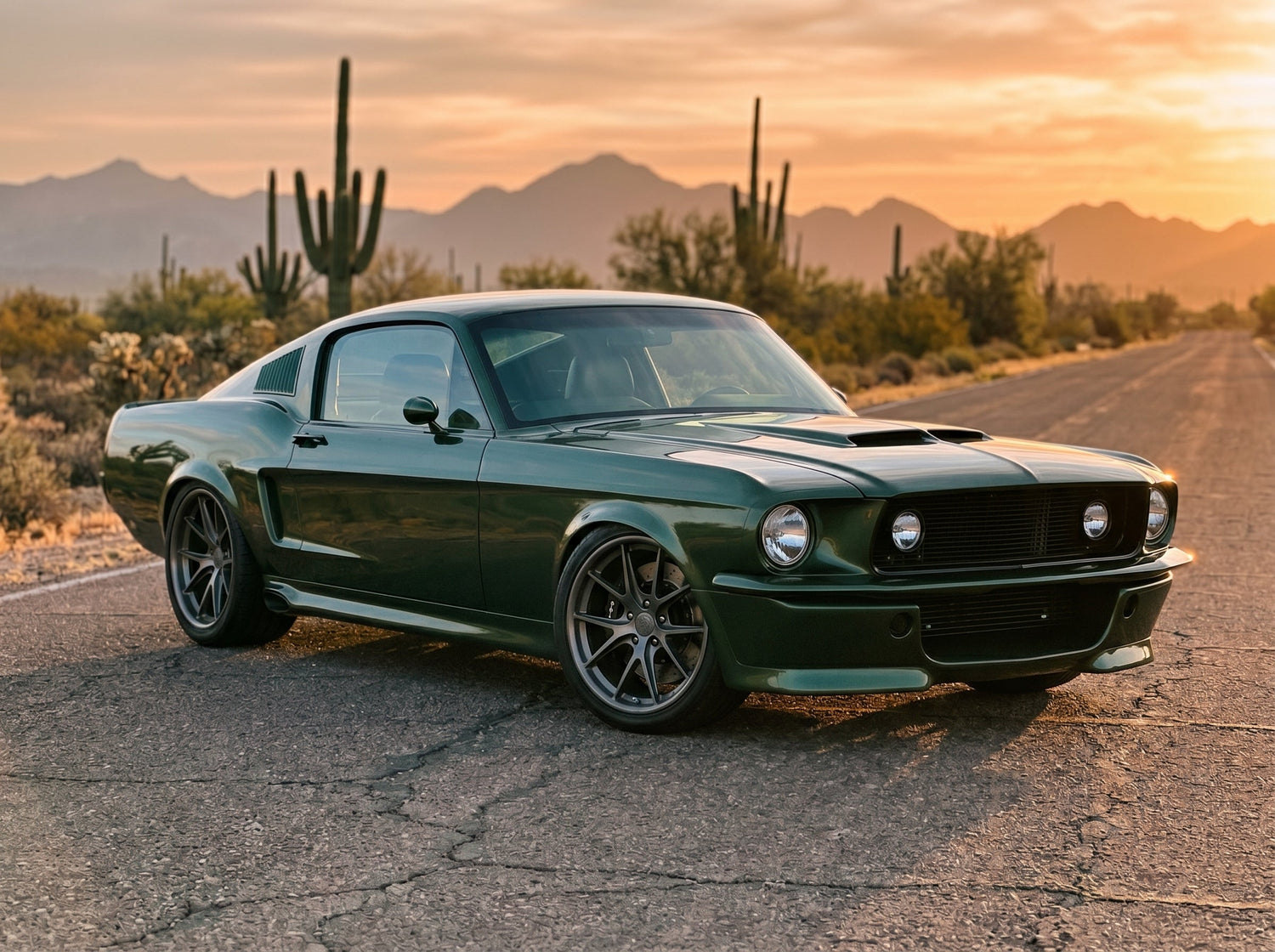
Flush-mount glass is one of the most visually impactful upgrades you can make to a 1964.5-70 Ford Mustang. The classic chrome reveal trim on the windshield and rear backlite is replaced with structural urethane-bonded glass that sits level with the body, eliminating the trim entirely and letting the iconic Mustang lines flow uninterrupted. On a fastback in particular, the change to the rear glass is the single most dramatic visual upgrade available for the dollar. This is the complete guide to what flush mount looks like on every generation and body style of classic Mustang, what fits what, how the install differs from a Camaro or C10, and which builds it is right for.
Fesler manufactures DOT-certified flush-mount glass kits for every body style of 1964.5-70 Mustang. Every piece is produced through our partnership with Pilkington, etched with a current DOT manufacturer code, and manufactured to FMVSS 205. For background on what DOT certification actually means, see DOT certified glass for classic cars. For the head-to-head comparison against trim ring and polycarbonate options, see flush-mount vs trim ring vs polycarbonate.
Why the Mustang is built for flush mount
The classic Mustang silhouette is defined by long, flowing lines. The fastback roofline, the long hood, the clean bodyside. The OEM chrome reveal trim around the windshield and rear glass was period-correct for 1965, but it visually interrupts the very lines that define the car.
On a fastback in particular, the rear backlite is the largest piece of glass on the car and the most visible single piece of trim on the bodyside. The original chrome reveal stops the eye exactly where the iconic fastback roofline is supposed to flow into the deck. Flush mount eliminates that break entirely and lets the fastback shape read as the single sculpted form Ford’s designers actually intended.
The first-generation Mustang is one of the strongest flush-mount candidates in the entire classic car market for exactly that reason. The visual payoff is bigger than on any other classic platform we ship glass for.
Mustang flush-mount kits by generation
1964.5-66 Mustang
The original first-generation Mustang, sold from April 1964 through August 1966. Available as a coupe (hardtop), convertible, and fastback (introduced late 1964 for the 1965 model year). The earliest 1964.5 cars had distinct mechanical features like generator vs alternator and different driveline parts, but the body openings and glass dimensions are functionally identical across the 1964.5-66 run.
Fesler manufactures DOT-certified flush-mount glass for all three body styles in this generation. The windshield is shared across coupe, fastback, and convertible. Door glass is shared. Quarter glass and rear glass differ by body style.
One platform-specific note: the 1964.5-66 cars use a vent window assembly that is mechanically tied to the door glass frame. The flush-mount door kit replaces the vent window setup entirely, which gives the door a single continuous side glass that reads correctly with the rest of the conversion.
Browse the 1964.5-66 Mustang collection for available kits.
1967-68 Mustang
The second body iteration of the first-generation Mustang. Significantly different from 1965-66: longer, wider, more aggressive proportions, larger glass openings, more sculpted bodywork. Same three body styles (coupe, fastback, convertible) plus the GT, GT/CS California Special, and Shelby GT350 / GT500 variants. The 1968 fastback in Highland Green is the Bullitt car and arguably the most iconic American muscle silhouette ever produced.
Flush-mount glass fits all body styles. The 1967-68 windshield is unique to these years and not interchangeable with 1965-66 or 1969-70. Door glass is shared across body styles within the generation. Quarter and rear glass differ by body style, with the fastback’s long sloped backlite being the marquee piece of the entire kit.
Browse the 1967-68 Mustang collection for available kits.
1969-70 Mustang
Third body iteration of the first-generation Mustang. Larger again, with the SportsRoof fastback (Ford renamed the fastback for 1969) sitting differently than the 1967-68 fastback. The Mach 1, Boss 302, Boss 429, and Grande luxury coupe all belong to this generation. The 1969 Mach 1 SportsRoof is the second-most recognizable Mustang silhouette behind the 1968 Bullitt car.
Flush-mount glass fits the coupe, SportsRoof, and convertible. The 1969-70 windshield is unique and not interchangeable with 1967-68. Door glass is shared within the generation. Quarter and rear glass differ by body style.
Browse the 1969-70 Mustang collection for available kits.
Glass positions and fitment by body style
| Generation | Body | Windshield | Doors | Quarter glass | Rear glass |
|---|---|---|---|---|---|
| 1964.5-66 | Coupe | Available | Available (no vent) | Available (fixed) | Available (vertical) |
| 1964.5-66 | Fastback | Available | Available (no vent) | Available (fixed) | Available (sloped fastback backlite) |
| 1964.5-66 | Convertible | Available | Available (no vent) | Available (roll-down) | N/A (soft top) |
| 1967-68 | Coupe | Available | Available | Available (fixed) | Available (vertical) |
| 1967-68 | Fastback | Available | Available | Available (fixed) | Available (sloped backlite) |
| 1967-68 | Convertible | Available | Available | Available (roll-down) | N/A (soft top) |
| 1969-70 | Coupe | Available | Available | Available (fixed) | Available (vertical) |
| 1969-70 | SportsRoof (fastback) | Available | Available | Available (fixed) | Available (sloped SportsRoof backlite) |
| 1969-70 | Convertible | Available | Available | Available (roll-down) | N/A (soft top) |
Glass shares within a generation. Windshields do not interchange across generations.
The fastback rear backlite: the killer Mustang upgrade
If you only do one flush-mount conversion on a fastback or SportsRoof Mustang, do the rear backlite.
The OEM rear glass on a 1965-70 fastback is a large sloped pane held in by a thick rubber gasket and a stainless reveal trim that wraps the entire perimeter. The trim was designed to hide the gasket seam and give the rear opening a finished look, but the visual result is a hard chrome line stopping the eye exactly where the iconic fastback roofline is supposed to flow into the trunk.
Flush-mount conversion replaces all of that with one continuous piece of bonded glass sitting level with the body. The roofline now reads as a single unbroken curve from windshield header to rear deck. On a Bullitt-style 1968 or a 1969 Mach 1, the change is the single most impactful visual upgrade a builder can make for the dollar.
The functional improvements stack on top. Cured urethane eliminates the long-standing leak path through the corners of the original rubber gasket, which is a problem nearly every 50-year-old fastback eventually develops. It eliminates the moisture trap against the upper deck pinch weld, which is a leading cause of trunk corrosion on long-stored fastbacks. And it adds measurable torsional rigidity to the body shell, which on a fastback with a huge rear opening makes a real difference in how the car drives.
Shelby, Mach 1, Boss, and concours considerations
This question comes up on every high-value Mustang variant. The honest answer:
If the car is being judged in a strictly OEM-correct concours class, flush mount disqualifies it. Any class requiring period-correct external trim and original gasket appearance is the wrong home for a flush-mount conversion. That includes Mustang Club of America (MCA) Concours Trailered and similar strict-original judging classes that apply to Shelby GT350, Shelby GT500, Boss 302, Boss 429, and original Mach 1 cars.
If the car is being driven, shown in modified or pro touring classes, or built for street use with a modernized aesthetic, flush mount is one of the highest-value upgrades available. MCA Modified and Touring classes generally accept flush mount. Pro touring and restomod shows reward it.
The rule of thumb: numbers-matching Boss 429 going to an auction-grade restoration leaves the trim rings. A 1969 Mach 1 pro touring build does flush mount. Match the choice to the build.
Mustang-specific pinch weld and cowl preparation
Mustang openings are not Camaro openings. Three things change about flush-mount install on a classic Mustang that matter.
Cowl rust
The cowl panel under the windshield on a 1965-70 Mustang is a known rust point. The original drain design captures moisture between the upper and lower cowl panels, and after 50+ years many cars have rust-through somewhere in that area. The flush-mount install does not cause cowl rust, but it does demand a clean pinch weld at the lower windshield, and that is exactly where pre-existing cowl rust shows up.
Address cowl rust before glass goes in. Period. Cutting and welding cowl repair panels after the urethane has cured is a much harder job than doing it first.
Lower windshield corners
The lower windshield corners on a classic Mustang collect water under the original gasket and rust from the inside out. Inspect carefully before install. Surface rust on the pinch weld is acceptable if cleaned to bare metal and sealed with epoxy primer compatible with the urethane chemistry being used. Through-rust requires a repair panel before the glass goes in.
Vent windows on 1964.5-66
The 1964.5-66 Mustangs use a vent window assembly that is mechanically tied to the door glass frame. The flush-mount door kit replaces the vent window assembly entirely with a single curved piece of bonded glass. The original vent post comes out, the door window regulator is reused with the new glass, and the door reads as a single uninterrupted side window. The 1967-70 cars eliminated the vent window from the factory, so this only applies to 1964.5-66 conversions.
What changes about the finished Mustang
Wind noise at speed
A 1968 Mustang fastback with original rubber gaskets and trim rings is one of the louder American classics at highway speed. The fastback shape creates significant turbulence around the rear backlite, and 50-year-old rubber gaskets do not seal well anymore. Flush-mount conversion cuts wind noise noticeably, especially around the rear glass on fastbacks and SportsRoofs.
Water sealing
Cured urethane seals the entire perimeter as a single continuous gasket. There is no leak path through the corners of the rubber, no failure point at the trim ring joints, no place for water to find its way past the seal. For a daily-driven Mustang or one stored outdoors, the sealing improvement alone justifies the conversion.
Chassis stiffness
The Mustang body shell benefits significantly from bonded glass. Convertibles see the biggest gain because the soft top contributes nothing structurally. Fastbacks and SportsRoofs also gain meaningful torsional rigidity because the huge rear opening is now structurally tied to the body shell through the urethane bond. Hardtop coupes gain less but still measurably.
Weight
A complete Mustang flush-mount kit saves roughly 12 to 20 lbs depending on body style. Coupes and convertibles save less because they have less total glass area. Fastbacks save the most because the large rear backlite plus its stainless reveal trim is the heaviest single trim assembly on the car.
Aesthetic
The single biggest reason builders do this. The Bullitt look. The Mach 1 look. The clean modernized restomod look. Removing the trim is what every magazine cover Mustang of the last fifteen years has done.
Install timing for a Mustang build
If the car is going through paint or body work, install flush-mount glass after the body and paint are fully cured but before final interior reassembly. The right sequence:
- Complete all body work, cowl repairs, and welded panels
- Full prime, color, and clear coats applied and fully cured (30+ days for full chemical cure on most two-stage automotive systems)
- Pinch weld scuffed and prepped with urethane-compatible primer
- Dry-fit glass, mark setting block positions, verify reveal gaps
- Apply urethane bead, set glass, hold setting blocks
- One hour minimum cure before any vehicle movement
- 24 to 72 hours full cure before installing weatherstripping, interior trim, or driving in rain
The single most common Mustang flush-mount install mistake is glassing in before paint has fully cured. Outgassing from undercured paint can compromise the urethane bond. Wait the 30 days.
What is and is not currently in the Mustang program
Fesler flush-mount glass currently covers the first-generation Mustang only. The following are not in current production:
- 1971-73 Mustang (second-generation big Mustang): Different body, different opening dimensions, not in current production
- Mustang II 1974-78: Different platform, not in current production
- Fox-body Mustang 1979-93: Different platform, not in current production. Note that 1987-93 Fox-body Mustangs left the factory with bonded windshields, so a full aftermarket conversion is not necessary on those cars
- SN95 Mustang 1994-2004: Came with bonded windshields from the factory. No conversion needed
- S197 2005-14, S550 2015-23, S650 2024+: All came from the factory with bonded flush glass
If there is a fitment you want us to develop, reach out through the shop. Demand drives the platform roadmap.
The Pilkington-backed Fesler standard
Every piece of Mustang glass we ship is manufactured through our partnership with Pilkington, one of the largest and most respected automotive glass manufacturers in the world. Pilkington invented the float glass process in 1959, holds active US DOT manufacturer codes, and is an OEM supplier to Ford, GM, Toyota, Honda, Mercedes-Benz, BMW, and most of the global auto industry. Founded in 1826, the company is now part of NSG Group with US production in Rossford, Ohio.
What that means for a Mustang owner: the windshield going into your 1968 fastback is manufactured to the same federal standard as the windshield in a current Ford production vehicle. Same chemistry, same lamination process, same quality system, same DOT manufacturer code. Etched into the corner of every piece is the Pilkington mark, the DOT code, the AS designation (AS1 for windshield, AS2 for tempered side and rear), the model number, and the date code.
For the deep dive on why supplier matters, see our flush-mount glass comparison guide.
See the full flush-mount catalog across all platforms: Fesler flush-mount DOT glass collection.
Frequently asked questions
What is flush-mount glass for a Mustang?
Flush-mount glass is automotive glass that is bonded directly to a Mustang body with structural urethane and sits level with the surrounding sheet metal. There is no exterior chrome trim or visible rubber gasket. The system replaces the original rubber-and-trim retention used on every 1964.5-70 Mustang from the factory.
Does Fesler make flush-mount glass for my year Mustang?
Fesler manufactures DOT-certified flush-mount glass for every body style of 1964.5-70 first-generation Mustang. The lineup covers coupe, fastback (and SportsRoof for 1969-70), and convertible across three generation cuts: 1964.5-66, 1967-68, and 1969-70. Mustang II, 1971-73 big Mustang, Fox-body, and later platforms are not currently in production.
Is Fesler Mustang flush-mount glass DOT certified?
Yes. Every piece is manufactured through our partnership with Pilkington and carries the Pilkington manufacturer mark, a current DOT manufacturer code, the correct AS designation (AS1 for windshield, AS2 for side and rear), a model number, and a date code. All glass is produced to FMVSS 205.
Does flush-mount glass work on a Mustang convertible?
Yes. The windshield, door glass, and roll-down quarter windows are all available as flush-mount kits for convertible Mustangs in all three generation cuts. Rear glass is not applicable because convertibles do not have a fixed rear backlite. Convertibles see the largest chassis rigidity gain from flush-mount conversion because the soft top contributes nothing structurally.
Does flush-mount glass work on a Mustang fastback?
Yes, and the fastback rear backlite is the marquee piece of the entire kit. Flush-mounting the rear glass on a 1965-68 fastback or 1969-70 SportsRoof produces the single most dramatic visual change available on a classic Mustang. The original chrome reveal that interrupts the iconic fastback roofline is removed entirely, letting the shape read as one continuous form.
Will flush-mount disqualify my Shelby or Boss from concours judging?
In strict OEM-correct concours classes, yes. MCA Concours Trailered and similar strict-original judging categories require period-correct external trim. In MCA Modified, MCA Touring, and most pro touring or restomod judging, flush mount is accepted and often rewarded. Match the conversion to the build intent.
Can I keep my original Mustang vent windows with flush-mount door glass?
The 1964.5-66 Mustangs are the only generation with factory vent windows. The Fesler flush-mount door kit for 1964.5-66 cars replaces the vent window assembly entirely with a single curved piece of bonded glass, which is what gives the door its clean uninterrupted appearance. The original vent post comes out, the regulator is reused. The 1967-70 cars eliminated vent windows from the factory.
Does flush-mount glass fit a 1971-73 Mustang?
No. The 1971-73 second-generation Mustang has a different body, different opening dimensions, and is not currently in the Fesler production lineup. Reach out through the shop if you want us to develop the platform.
Does flush-mount glass fit a Mustang II, Fox-body, or later Mustang?
No to Mustang II and Fox-body in the Fesler lineup. The later platforms (SN95 1994-2004, S197 2005-14, S550 2015-23, S650 2024+) all came from the factory with bonded glass, so no aftermarket conversion is needed.
Will flush-mount glass affect my Mustang’s resale value?
For a pro touring, restomod, or modernized street Mustang, flush-mount glass is a positive value signal that demonstrates a thorough build. For a numbers-matching concours-class restoration (Shelby, Boss, original Mach 1), the conversion would generally lower value because it disqualifies the car from period-correct judging. Match the choice to the build and the buyer.
How much weight does a flush-mount kit save on a Mustang?
Roughly 12 to 20 lbs across a complete Mustang flush-mount kit, depending on body style. Fastbacks and SportsRoofs save the most because the large rear backlite plus its stainless reveal trim is the heaviest single trim assembly on the car. Coupes and convertibles save less because they have less total glass area and trim.
Does flush-mount glass fix Mustang cowl rust?
No. Flush mount eliminates the moisture trap against the lower windshield pinch weld going forward, but it does not repair existing cowl rust. Address cowl rust before glass goes in. Cutting and welding cowl repair panels after the urethane has cured is a much harder job than doing it first.
Is the 1967-68 Mustang windshield the same as 1969-70?
No. The 1967-68 windshield is unique to those years. The 1969-70 windshield is also unique. Neither interchanges with 1965-66 or with each other. Each generation needs its specific kit.
Can I install flush-mount glass myself on a Mustang?
It is doable for an experienced builder with the right tools, primers, and patience. The substrate prep, urethane primer system, urethane application, and the lift-and-set step all have to be correct the first time. For first-time installs, a glass shop that has done flush-mount work or a builder who has shadowed a previous install is recommended. Every kit ships with full installation documentation.
How long does it take to install a complete Mustang flush-mount kit?
A complete fastback kit (windshield, two doors, two quarters, rear backlite) typically takes 6 to 10 hours for an experienced installer with a helper, plus the 24 to 72 hour full cure window before the car can go back into service. A coupe is faster because the rear glass is smaller and easier to set. A convertible is the fastest because there is no rear backlite to handle.
What urethane do you recommend for a Mustang flush-mount install?
A high-modulus structural automotive urethane rated for windshield retention to FMVSS 212. Brands like Dow Betaseal, Sika Sikaflex, and 3M Window-Weld are all suitable when paired with their matched primer system. Always use the manufacturer’s matched primer for the urethane chemistry being used. Mixing systems is the most common cause of bond failures.
Does flush-mount glass leak on a Mustang fastback?
A properly installed flush-mount kit does not leak. The urethane seals the perimeter as a single continuous gasket with no joints. Leaks on a flush-mount install are almost always traceable to substrate prep, contaminated bonding surfaces, undercured paint, or skipped primer steps. Done right, the seal outlasts every other rubber gasket on the car.
Will flush-mount glass help me get the Bullitt look on my 1968 fastback?
Yes. The Bullitt aesthetic is built on the unbroken fastback line, Highland Green paint, American Racing wheels, and minimal exterior trim. Removing the chrome reveal trim around the windshield and rear backlite is the single biggest move available toward that look. It is the change that lets the iconic 1968 fastback silhouette read the way the movie car does.
What about the rear quarter windows on a fastback Mustang?
The rear quarter windows on fastback and SportsRoof Mustangs are small fixed glass panels behind the doors. Fesler offers flush-mount kits for these as part of the complete glass package. On coupes the rear quarter windows are similar. On convertibles the quarter glass rolls down and is part of the door glass mechanism.
Does flush-mount affect Mustang chassis stiffness?
Yes, measurably. Structural urethane bonds the glass to the body in a way the original rubber gaskets do not. The effect is largest on convertibles (the soft top contributes nothing structurally), significant on fastbacks and SportsRoofs (the huge rear opening becomes structurally tied to the body), and smaller but still measurable on hardtop coupes.
Do you ship Mustang flush-mount glass internationally?
Yes. Crating and freight is handled case by case depending on destination. Contact the shop for international quoting. Note that DOT certification is a US standard, and while our glass exceeds the equivalent requirements in most international markets, importing countries may have their own glazing certification rules that apply to the import.


Leave a comment
This site is protected by hCaptcha and the hCaptcha Privacy Policy and Terms of Service apply.