

Pro touring and restomod are two of the most-used terms in the modern classic car world, and they get mixed up constantly. Pro touring is a performance-driven build philosophy: take a classic muscle car shape and engineer it to drive, brake, and corner like a modern performance car. Restomod is broader and aesthetic-driven: a restored classic car modified with modern conveniences (air conditioning, fuel injection, sound system, modern suspension) while keeping the period-correct look largely intact. Every pro touring car is a restomod. Not every restomod is pro touring.
The differences affect every decision a builder makes: drivetrain, suspension, wheels, brakes, interior, glass, trim, paint, judging class, insurance valuation, and resale. Here is the complete builder's guide to what each term actually means, where they overlap, where they diverge, and which Fesler products fit which build style.
Pro touring vs restomod at a glance
| Category | Pro touring | Restomod |
|---|---|---|
| Core philosophy | Drive like a modern performance car | Daily-usable classic with modern conveniences |
| Drivetrain | LS, LT, Coyote, Hellcat, or built small-block with EFI | Period-correct engine with EFI or modern crate |
| Suspension | Modern coilover or air, often Detroit Speed or RideTech | Modernized stock geometry with QA1, CPP, or similar |
| Stance | Slammed, negative fender gap, function over factory | Lowered but closer to factory ride height |
| Wheels | Large diameter (18-20"+), forged, modern multi-spoke | Period-correct or period-inspired (15-17") |
| Brakes | Big Brembo, Wilwood, or Baer six-piston | Power disc upgrade, often four-piston |
| Exterior trim | Often shaved or smoothed, minimal brightwork | Period-correct trim retained or refinished |
| Glass | Flush-mount DOT certified, no exterior trim | Flush-mount or refinished OEM trim ring |
| Interior | Modern bolstered seats, digital dash, billet | Restored or premium-upgraded period interior |
| Audio / climate | Hidden modern stereo, full A/C, sound deadening | Period-style head unit, A/C usually retrofit |
| Judging class | Pro touring class, Modified, Street Machine | Modified, Touring, sometimes original-class shows |
| Concours eligibility | No | No |
| Build budget range | $120k-$500k+ for full build | $60k-$250k for full build |
| Insurance | Agreed-value collector required | Agreed-value collector recommended |
Where the two philosophies come from
Pro touring origins
Pro touring traces directly to the late 1980s and early 1990s. The pioneers were builders like Mark Stielow (later GM Engineering), Lateral-G, and a small circle of magazine-feature builds that asked one question: what if a 1969 Camaro could keep up with a Porsche 911 on an autocross course?
That question is the entire philosophy. Pro touring is performance engineering applied to a classic muscle shape. The drivetrain has to make modern power and run modern emissions where applicable. The suspension has to handle modern lateral G loads. The brakes have to stop the car from triple-digit speeds repeatedly without fade. The aerodynamics have to be cleaner than the factory ever intended. The interior has to support the driver and the passenger through real performance driving.
Pro touring is what happens when you commit to driving a classic the way a modern sports car was built to drive.
Restomod origins
Restomod is older and broader. The term combines "restoration" and "modified" and was used loosely through the 1970s and 1980s for any classic car that retained its period look while gaining modern upgrades. A restored 1957 Bel Air with a modern crate engine, power steering, disc brakes, and air conditioning is a restomod. A 1965 Mustang with a 351W swap and a five-speed manual is a restomod.
The defining feature of restomod is daily usability. The owner wants to drive the car like a modern vehicle: turn the key, run the A/C, listen to the stereo, brake confidently, cruise the highway at 75 mph without drama. Restomod prioritizes everyday function while preserving the visual heritage of the original car.
If pro touring is about driving the way a modern sports car drives, restomod is about driving the way modern cars in general drive.
The visual difference
Both build styles modify a classic car, but the visual outcomes are distinct enough to identify at a glance.
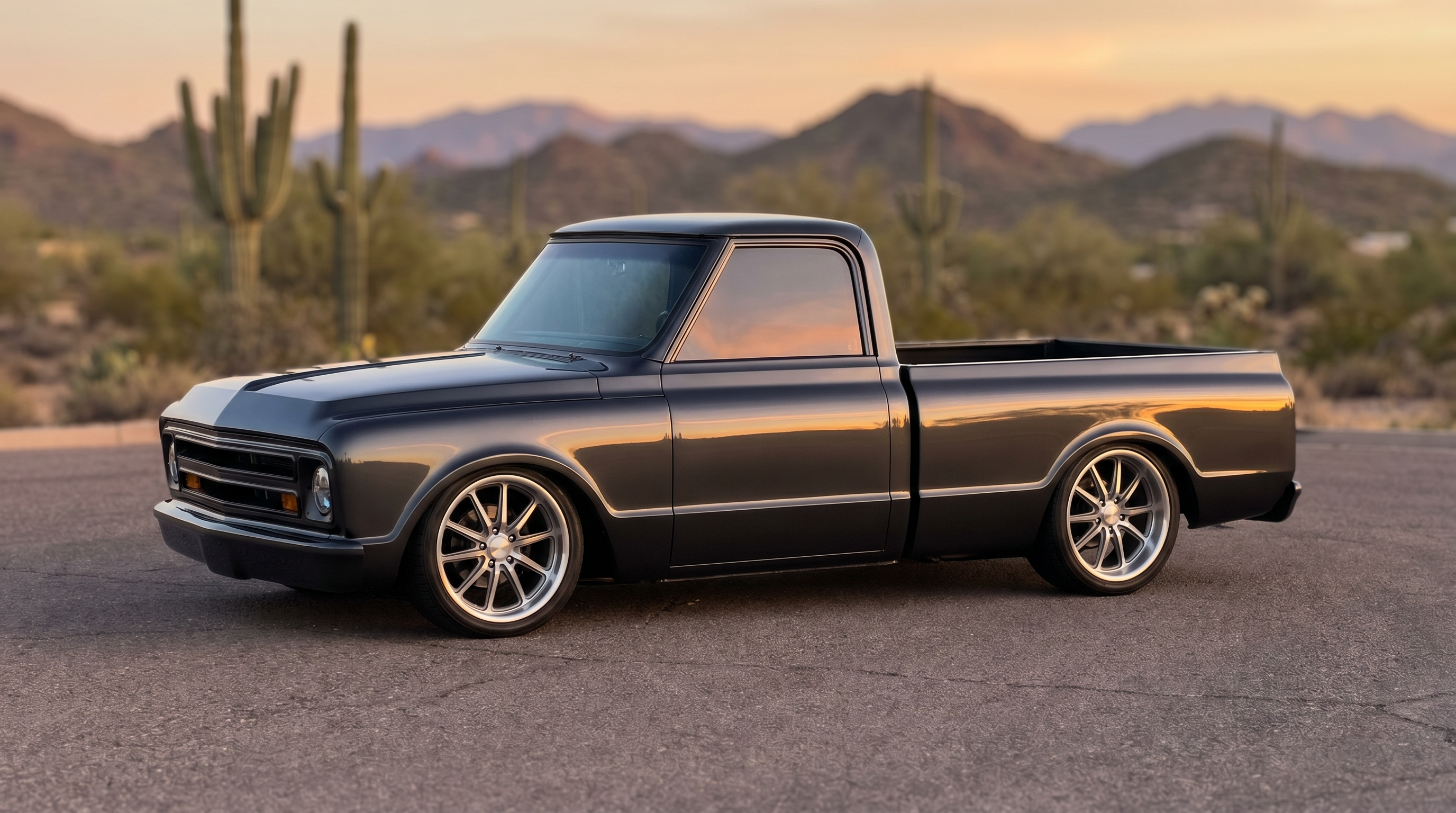
Pro touring looks like
- Aggressive slammed stance with little to no fender gap
- Large diameter (18", 19", or 20") forged multi-spoke wheels with low-profile performance tires
- Big visible brake calipers and rotors behind the wheels
- Smooth bodywork with shaved emblems, smoothed cowl, shaved drip rails, or other clean-up modifications
- Flush-mount glass with no exterior chrome reveal trim
- Tucked or shaved bumpers, or fully redesigned bumper treatment
- Modern paint finishes including matte, satin, and complex multi-stage colors
- Cleaned-up engine bays with hidden wiring and modern engine covers
Restomod looks like
- Lowered but closer to factory ride height with visible fender gap
- Period-correct or period-inspired wheels (American Racing Torq Thrust, Cragar SS, Magnum 500, Halibrand) in 15" to 17" diameters
- OEM-style brake calipers, often hidden behind the wheel
- Stock or restored exterior trim retained: chrome bumpers, emblems, reveal trim, factory body lines
- Period-correct paint colors and finishes
- Subtle drivetrain upgrades hidden under period-looking valve covers and air cleaners
The crossover zone is large. A car can sit lower, run 18" wheels, keep its factory chrome bumpers, and live happily in either category depending on which features dominate.
The mechanical difference
Drivetrain
Pro touring almost always involves a modern engine swap. The most common pro touring drivetrains today are the GM LS / LT series, the Ford Coyote 5.0, and the Mopar Hellcat or Hemi family. These engines make 450 to 1000+ horsepower in factory-crate form, run modern fuel injection, fit pre-existing classic engine bays with the right swap kit, and produce drivability that the original carbureted small-block never could.
Restomod drivetrains are more varied. Common choices: a rebuilt original engine with bolt-on EFI conversion (Holley Sniper, FAST EZ-EFI, Edelbrock Pro-Flo), a modern small-block crate engine (GM 350/383/427) with carb or EFI, or a more conservative engine swap (LS3, Coyote with a factory-look intake). The goal is modern reliability and emissions compliance without the visual statement of an exposed Hellcat under the hood.
Suspension
Pro touring suspension is purpose-built for performance handling. Detroit Speed full subframe and rear suspension packages, RideTech coilover systems, Speedtech, and Roadster Shop chassis are common builds. The geometry is corrected for modern tire widths, the spring rates are calibrated for autocross or road course duty, and the dampers are valved for real performance driving. Many pro touring cars run air suspension with on-the-fly ride height adjustment for stance vs drive height.
Restomod suspension upgrades the factory geometry without replacing it. Common upgrades: tubular control arms, urethane bushings, upgraded sway bars, and adjustable coilover or shock systems from QA1, Hotchkis, or Classic Performance Products. The car drives noticeably better than factory but does not pretend to be a modern sports car.
Brakes
Pro touring runs the biggest brakes that will fit. Brembo, Wilwood, and Baer six-piston front and four-piston rear calipers with two-piece slotted rotors are standard. The brakes have to stop a car repeatedly from triple-digit speeds without fade.
Restomod usually runs a power disc conversion at minimum, often a four-piston front upgrade. The goal is confident street braking, not road course capability.
Wheels and tires
Pro touring wheels run large: 18" minimum, more commonly 19" or 20", with low-profile performance tires (Michelin Pilot Sport, Nitto NT01, Falken Azenis). Forged construction is the norm. Brands like Forgeline, HRE, BBS, and Rocket Racing dominate the category.
Restomod wheels stay closer to period: American Racing Torq Thrust, Cragar SS, Magnum 500, Halibrand, Foose Legend, or modern reproductions of period designs. Diameters run 15" to 17" with period-correct tire profiles.
The interior philosophy
This is where the two styles diverge most sharply, and where Fesler interior parts come into play differently for each.
Pro touring interiors
Pro touring interiors look modern. Bolstered sport seats (Recaro, Sparco, Procar, or custom upholstered seats designed around a modern frame), digital instrument clusters (Dakota Digital HDX or RTX), billet aluminum trim, hidden modern audio, full sound deadening, and clean wire management. The dash is often shaved of factory chrome and reupholstered or refinished. Steering wheels are smaller diameter performance designs.
Common Fesler interior products in pro touring builds:
- Fesler custom seats with modern bolster geometry on a classic-compatible frame
- Hand-laid fiberglass door panels for clean, smooth modern aesthetics
- Fesler smooth cowl panels for OBS and squarebody trucks (eliminates the factory cowl seam)
- Fesler kick panels in fiberglass for clean lower interior lines
- Fesler carpet kits in premium materials
For more on the modern dash treatment, see dash planning 101: how to get a Tesla-clean dash in a classic.
Restomod interiors
Restomod interiors look period-correct with modern hidden upgrades. Original seat shapes reupholstered in premium leather or vinyl, restored or refinished dashes with bolt-in modern gauge upgrades hidden in the original cluster (Dakota Digital VHX), modern A/C controls disguised behind period-style knobs, and original carpet patterns in modern materials. The visual reads as the original car restored to a higher level.
Common Fesler interior products in restomod builds:
- Fesler carpet kits in original-pattern molded carpeting
- OEM-style door panels reupholstered to original spec
- Premium automotive leather for seat reskinning
- Factory-style interior trim retained and refinished
For the deep dive on interior material choices, see interior materials guide: vinyl vs leather vs alcantara.
The glass and trim choice
This is one of the cleanest pro touring vs restomod decision points, and it is a Fesler home turf.
Pro touring glass
Pro touring builds almost universally run flush-mount DOT-certified glass. The aesthetic case is conclusive: flush mount eliminates the chrome reveal trim that interrupts the bodyline, which is exactly the visual modernization pro touring is built around. The functional case stacks on top: cured urethane outperforms aged rubber gaskets on sealing, wind noise, and chassis rigidity.
Browse the Fesler flush-mount DOT glass collection for kits across every major American pro touring platform. For background on DOT certification, see DOT certified glass for classic cars: what it actually means. For the full comparison against trim ring and polycarbonate options, see flush-mount vs trim ring vs polycarbonate.
Restomod glass
Restomod glass goes either direction. Builds leaning toward period-correctness retain the original chrome reveal trim with refinished stainless and new rubber gaskets. Builds leaning toward modernization run flush-mount for the visual cleanup and the long-term sealing advantages. Either is correct restomod.
Either way, the glass itself should be DOT certified. Fesler's OEM windshield program covers factory-correct replacement glass for restomod builds that retain the original trim, while the flush-mount collection handles modernized builds.
Build budget and timeline
Pro touring is the more expensive build. Realistic full-build budgets for a turn-key pro touring car in 2026 run $120,000 on the low end (donor car already mechanically sound, owner doing significant work) to $500,000+ on the high end (full custom chassis, Hellcat or LS9 power, paint and bodywork to magazine-cover standard).
Restomod budgets run lower (usually). A full restomod in 2026 typically lands in the $60,000 to $250,000+ range depending on the platform, the engine choice, and the interior level. The savings come from keeping more of the factory geometry, running smaller wheels and brakes, and retaining more of the original trim.
Timeline is similar in both cases: a serious full build, whether pro touring or restomod, typically takes 18 to 36 months from rolling shell to finished car, depending on parts availability and shop schedule.
For the right order to spend a build budget, see the 2026 build order: what to buy first. For choosing the right donor car, see choosing the perfect car for your pro touring build.
Value, insurance, and resale
Both pro touring and restomod builds command real money in the modern collector market. Auction trends from Barrett-Jackson Scottsdale, Mecum, and RM Sotheby's over the past five years show steady appreciation in both categories, with pro touring cars often setting the headline hammer prices for non-numbers-matching cars.
Insurance has to be agreed-value collector coverage for either category. Standard auto policies treat a modified classic at depreciated book value, which on a $200,000 pro touring Camaro means a total-loss payout in the $30,000 range. Agreed-value coverage (Hagerty, Grundy, American Collectors, J.C. Taylor) pays the agreed amount regardless of book value, which is the only correct approach for a serious build.
For the full conversation on agreed-value coverage and build appraisal, see what your custom car is actually worth: a professional appraiser's guide to build cost, fair market value, and agreed-value insurance.
Resale follows the build philosophy. A pro touring car sells to a pro touring buyer who values aggressive performance and modern look. A restomod sells to a buyer who wants daily usability with the classic look. Trying to sell a pro touring car to a restomod buyer (or vice versa) leaves money on the table. Build for one audience and finish to that audience's standard.
Best Fesler products by build style
| Build need | Pro touring pick | Restomod pick |
|---|---|---|
| Glass | Fesler flush-mount DOT glass | Fesler OEM windshields or flush mount |
| Cowl panel (OBS / squarebody) | Fesler smooth cowl panel | Restored OEM cowl |
| Door panels | Fesler hand-laid fiberglass door panels | Reupholstered OEM-pattern panels |
| Kick panels | Fesler fiberglass kick panels | OEM-style refinished kick panels |
| Seats | Fesler custom bolstered seats | Reupholstered OEM seats in premium leather |
| Carpet | Fesler carpet kit, premium material | Fesler carpet kit, OEM-pattern |
| Gauges | Dakota Digital HDX or RTX | Dakota Digital VHX |
| Sound deadening | Full multi-layer treatment | Targeted floor and door treatment |
Browse the full Fesler catalog for everything that fits both build philosophies.
How to decide which build style is right for you
Ask yourself five questions:
- How do you want to drive it? If the answer involves autocross, road course days, or aggressive canyon runs, pro touring. If the answer is highway cruises, weekend shows, and easy daily use, restomod.
- What's the budget ceiling? If $250,000+ is realistic, both are open. If the ceiling is closer to $100,000, restomod is the honest answer.
- How important is the period look? If you want it to read as a classic with subtle upgrades, restomod. If you want it to read as a modernized statement, pro touring.
- What's the engine you actually want? Hellcat, LS9, Coyote with a supercharger: pro touring. Built small-block, mild LS swap, EFI conversion of the original: restomod.
- What show audience do you want to win? Goodguys pro touring class, OPTIMA Search for the Ultimate Street Car, SEMA category builds: pro touring. Cruise nights, regional shows, MCA Modified or Touring class: restomod.
If three or more of those answers point one direction, that is the build style for you. If they split evenly, you are in the crossover zone, which is a perfectly legitimate place to build from.
The Fesler standard for both philosophies
Every Fesler product (glass, interior components, hardware) is built to a single standard: better than factory, designed for the modern builder. Pro touring or restomod, the parts have to fit, last, and look right.
Glass is DOT-certified through our partnership with Pilkington, the OEM supplier to most of the global auto industry. Interior fiberglass parts are hand-laid in Phoenix, Arizona, designed to OEM tolerances. Hardware is precision-machined billet aluminum. The full catalog ships from Phoenix.
Whether the build is heading for the OPTIMA Search course or a weekend cruise, the parts list is the same: glass that seals and certifies, interior parts that fit on the first attempt, and a finished result that holds value.
Browse the full Fesler catalog by platform, or start with the flush-mount DOT glass collection if glass is first on the build list. For the right order to spend the build budget, see the 2026 build order guide.
Frequently asked questions
What is pro touring?
Pro touring is a classic car build philosophy that takes a muscle car shape and engineers it to drive, brake, and corner like a modern performance car. The defining elements are a modern engine swap (LS, LT, Coyote, Hellcat), modern coilover or air suspension, large diameter forged wheels with low-profile performance tires, big-brake conversion, modernized interior, and a slammed aggressive stance.
What is a restomod?
Restomod combines "restoration" and "modified." A restomod is a restored classic car modified with modern conveniences like air conditioning, EFI, modern suspension, disc brakes, and a modern stereo, while keeping the period-correct look largely intact. The goal is daily usability with the classic aesthetic.
What's the difference between pro touring and restomod?
Pro touring is a performance-driven subset of restomod. Every pro touring car is a restomod, but not every restomod is pro touring. Pro touring prioritizes modern performance handling and a modernized aesthetic. Restomod prioritizes daily usability and a period-correct look with modern hidden upgrades. The biggest visual tells are stance, wheel diameter, and exterior trim treatment.
Is pro touring the same as resto mod?
Pro touring is a type of restomod, not a synonym. Pro touring is performance-focused and modernized in look. Generic restomod can be performance-focused or comfort-focused, with a more period-correct look. The terms overlap but are not interchangeable.
What makes a car pro touring?
A pro touring car has a modern engine swap, modern coilover or air suspension geometry, large forged wheels (18"+), big-brake conversion, slammed aggressive stance with negative fender gap, smoothed exterior bodywork, flush-mount glass, and a modernized interior with bolstered seats and digital instrumentation. Any car with most of those traits reads as pro touring.
What year did pro touring start?
Pro touring as a defined build philosophy emerged in the late 1980s and early 1990s, with builders like Mark Stielow and a small group of magazine-feature builders asking what a 1969 Camaro would need to keep up with a modern sports car on an autocross course. The term spread through the 1990s and became mainstream in the 2000s.
Is my car a restomod or pro touring?
Look at three things. First, the stance: slammed with negative fender gap is pro touring, lowered but visible fender gap is restomod. Second, the wheels: 18" or larger forged multi-spoke wheels with low-profile tires is pro touring, 15" to 17" period-correct wheels is restomod. Third, the exterior trim: shaved or smoothed bodywork with flush-mount glass is pro touring, retained chrome reveal trim and factory body lines is restomod.
Can a pro touring car still be a daily driver?
Yes, with the right build choices. Many pro touring cars run air suspension for on-the-fly ride height, full A/C, modern stereo, and full sound deadening, which makes them genuinely streetable. The trade-off is that low-profile tires and aggressive alignment make them less forgiving on rough roads than a restomod.
How much does a pro touring build cost?
A turn-key pro touring car in 2026 runs $120,000 on the low end to $500,000+ on the high end. The big budget drivers are the chassis or subframe upgrade (often $20,000-$60,000), the engine and transmission (often $25,000-$80,000), the paint and bodywork ($25,000-$100,000), and the interior ($15,000-$60,000). Doing significant work yourself can cut totals significantly.
How much does a restomod build cost?
A full restomod in 2026 typically runs $60,000 to $250,000 depending on the platform, engine choice, and interior level. Restomod budgets stay lower than pro touring because they retain more of the factory geometry, run smaller wheels and brakes, and keep more of the original trim.
Does pro touring or restomod hold value better?
Both categories have appreciated steadily in the modern collector market. Pro touring cars frequently set the headline hammer prices for non-numbers-matching builds at Barrett-Jackson and Mecum. Restomod values are more accessible at entry and middle pricing tiers. Both are positive value choices when built to a coherent standard and sold to the right audience.
What insurance do I need for a pro touring or restomod car?
Agreed-value collector insurance through carriers like Hagerty, Grundy, American Collectors, or J.C. Taylor. Standard auto policies pay depreciated book value on a total loss, which on a six-figure build means recovering a small fraction of build cost. Agreed-value coverage pays the agreed-upon valuation regardless of book value.
Can a pro touring car be judged in concours?
No, in strict original concours classes. Pro touring is built specifically to be modernized, so it disqualifies in classes that require period-correct drivetrain, suspension, and trim. Pro touring cars compete in pro touring class, Modified, Street Machine, OPTIMA Search for the Ultimate Street Car, and Goodguys events.
Can a restomod be judged in concours?
Not in strict original-correct concours. Some Modified or Touring classes accept restomods that retain enough period appearance. MCA Modified and Touring, AACA Modified, and similar classes are typical homes for high-quality restomods.
What engines work best for pro touring?
The dominant choices are GM LS / LT series (LS3, LS7, LT1, LT4, LSA, LS9), Ford Coyote 5.0 (factory or supercharged), Mopar Hellcat and Hellephant, and built modern small-block crate engines. Each offers modern fuel injection, high power output, modern reliability, and proven swap kits for popular classic platforms.
What engines work best for restomod?
Restomod engine choices vary by builder priorities. Common picks: rebuilt original engine with EFI conversion (Holley Sniper, FAST EZ-EFI, Edelbrock Pro-Flo), modern small-block crate (350/383/427) with carb or EFI, conservative LS swap (LS3 with factory-look intake), or Coyote with a period-style top end. The goal is modern reliability without the visual statement of an exposed modern engine.
What wheels work best for pro touring?
Large diameter (18" minimum, more commonly 19" or 20") forged multi-spoke wheels with low-profile performance tires. Top brands include Forgeline, HRE, BBS, Rocket Racing, Schott, and Bonspeed. The wheel-to-tire ratio prioritizes modern handling geometry over period correctness.
What wheels work best for restomod?
Period-correct or period-inspired wheels in 15" to 17" diameters. Classic choices include American Racing Torq Thrust, Cragar SS, Magnum 500, Halibrand, Foose Legend, and modern reproductions of period designs.
Should I do flush-mount glass on a restomod?
It depends on how period-correct the build is. Restomods leaning toward original aesthetic retain the chrome reveal trim with refinished stainless and new rubber gaskets. Restomods leaning toward modernization run flush-mount glass for the visual cleanup and the long-term sealing advantages. Both are correct restomod choices.
Do all pro touring cars run flush-mount glass?
Almost universally, yes. Flush-mount glass eliminates the exterior chrome reveal trim that interrupts the bodyline, which aligns perfectly with the pro touring aesthetic of clean, modernized exterior design. The functional benefits (better sealing, reduced wind noise, increased chassis rigidity) reinforce the choice.
What is the best classic platform for a pro touring build?
The most popular pro touring platforms are 1967-69 first-gen Camaro, 1968-72 Chevelle, 1967-72 C10 truck, 1968-70 Charger, and 1965-70 Mustang. Each has strong aftermarket support, proven engine swap paths, and established pro touring style precedent. For a deeper conversation on platform choice, see Fesler's guide on choosing the perfect car for your pro touring build.
What is the best classic platform for a restomod build?
Restomod is more platform-agnostic because the goal is daily usability with period look. Any classic with reasonable aftermarket parts availability works. Popular choices: 1965-70 Mustang, 1967-72 C10, 1957-60 Chevy Bel Air and pickup, 1968-72 Chevelle, 1955-57 Chevy Tri-Five, and any first or second-generation Camaro or Firebird.


Leave a comment
This site is protected by hCaptcha and the hCaptcha Privacy Policy and Terms of Service apply.