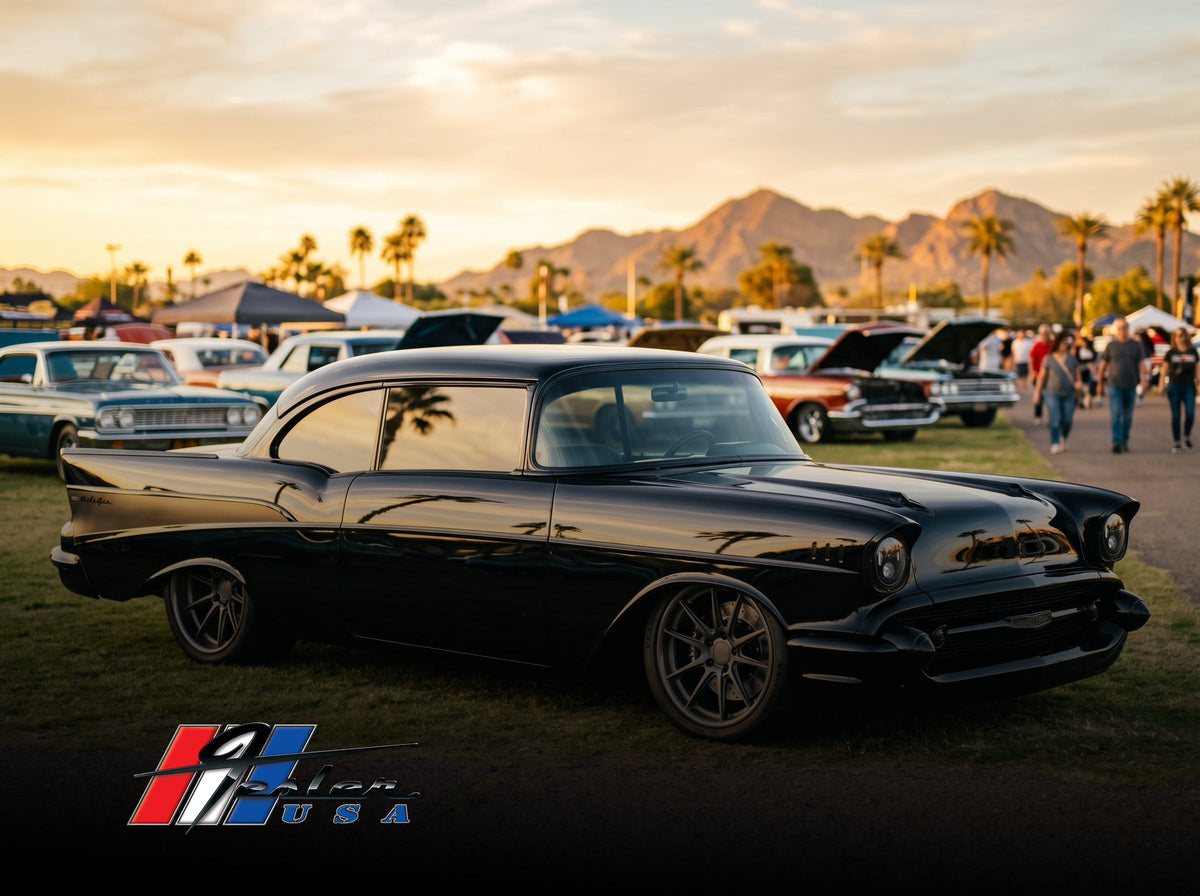
The 1955 Chevrolet did not invent the wraparound windshield. GM had already put one on three limited-production cars in 1953, and the idea itself came off a 1951 show car. What the 1955 Chevy did was put that windshield in front of nearly 1.8 million ordinary buyers in a single year. That is the real story, and it is a better one than the myth.
It is also a story you can read off your own car. Open the door on any 1955, 1956, or 1957 Chevy and look at the shape of the opening. The A-pillar stands nearly vertical, then kicks forward at the bottom in a dogleg. That dogleg is there for one reason: to let the glass wrap past the pillar and around the corner of the body. Every decision about that windshield is visible in that one shape.
Where did the wraparound windshield come from?
From Harley Earl, and from jets. Earl ran GM Styling, and by 1951 he had his team build the Le Sabre and the Buick XP-300, two concept cars with a curved windshield that swept around the sides of the cockpit like a fighter canopy. Both were finished in 1951 and shown at the 1953 GM Motorama, the traveling show GM used to test public reaction to its ideas.
The public reaction was strong enough that GM moved fast. The wraparound windshield went into production for 1953 on three limited cars: the Cadillac Eldorado, the Oldsmobile Fiesta, and the new Corvette. Those were low-volume halo cars, and the Eldorado cost nearly twice what a regular Cadillac convertible did. Then GM rolled the design across its 1954 Buick, Oldsmobile, and Cadillac lines, and for 1955 every new GM car and truck had it. Ford and Chrysler followed within a year or two.
So when a 1955 Chevrolet ad talked about the Sweep-Sight windshield, it was selling a feature that had already been proven on the most expensive cars GM built. The genius was not the invention. It was putting a Cadillac idea on a car a schoolteacher could afford.
What is the Sweep-Sight windshield?
Sweep-Sight was Chevrolet's marketing name for the wraparound glass on the 1955 to 1957 passenger cars. It was planned from the start of the 1955 program, and early on it was going to be a two-piece design, because bending one large sheet of laminated safety glass into a compound curve was still difficult in the early 1950s. Glass forming had improved enough by 1948 that GM could put curved panes into split windshields, and one-piece curved windshields reached the 1950 Oldsmobile 98. Bending the corners of a one-piece windshield around to the sides of the car was the next step, and the 1955 Chevy got it as a single piece.
The result was a car that looked lower and lighter than the 1954 it replaced, mostly because there was so much more glass and so much less metal above the beltline. That is the instant recognition people talk about with a Tri-Five. Before you register the badge or the stance, your eye picks up the proportions, and the proportions come from the greenhouse.
Why does a Tri-Five have a dogleg A-pillar?
Because the glass had to go somewhere. A conventional windshield ends at the A-pillar, and the pillar leans back. A wraparound windshield keeps going past where the pillar would normally be, so the pillar has to move out of its way. GM's answer was to stand the pillar nearly vertical and bend its base forward, which is the dogleg you see in the door opening.
The dogleg is also the wraparound's most famous problem. Get into a Tri-Five with the seat forward and you will find the corner of the door opening exactly where your knee wants to be. Period road tests complained about it, and the nickname knee-knocker stuck. It made getting in and out harder, and it is the first thing you notice if you drive one after a modern car.
What was wrong with the glass itself?
Distortion. When you bend laminated glass through a tight radius at the corners, the view through those corners bends with it. Look through the edge of a Tri-Five windshield at a straight telephone pole and watch it curve. It is the same effect you get from a convex side mirror, and 1950s glass technology could not eliminate it. Drivers learned to look through the flat center and ignore the edges.
The wraparound also let in a great deal of sun. More glass meant a hotter cabin, and factory air conditioning in 1955 was heavy, noisy, expensive, and rare. In Phoenix that is not an abstract complaint. A Tri-Five in July with the original glass is a greenhouse in the literal sense.
The last problem was structural. The more glass you have above the beltline, the thinner the pillars must be, and the steel available at the time did not give a thin pillar much rollover strength. That is part of why the wraparound disappeared so quickly. Ford dropped it for 1960, GM for 1961, and by 1963 nearly every domestic car was back to a one-piece curved windshield with a conventional rear-leaning A-pillar. The whole wraparound era lasted about ten years.
Did the 1955 Chevy really have the small-block and fuel injection?
Yes, and that is the other half of why the Tri-Five matters. The same 1955 program that brought the Sweep-Sight windshield brought the 265 cubic inch small-block V8, the engine Chevrolet advertised as The Hot One. For 1957 it grew to 283 cubic inches, and the top version, with solid lifters, the Duntov cam, and Rochester Ramjet fuel injection, was rated at 283 horsepower. One horsepower per cubic inch, for a $500 option.
Two corrections to the story you usually hear. First, Chevrolet was not the first to hit one horsepower per cubic inch. Chrysler's 1956 300B was rated at 355 horsepower from 354 cubic inches a year earlier, so the 1957 Chevy was the first GM car to do it, not the first car. Second, you did not need a Corvette to get it. 1957 was the first year Chevrolet offered fuel injection as an option, and it was available on the passenger cars, so a fuel-injected Bel Air or 210 was a real thing you could order. Very few people did, which is why those cars bring the money they do today.
Chevrolet built 1,775,952 cars for 1955, 1,623,376 for 1956, and 1,555,316 for 1957. That volume is why there is a Tri-Five at every show. The small-block is why so many of them are still running, and why GM passed 100 million small-blocks built in 2011.
What does this mean for a Tri-Five build today?
The windshield is the one part of a Tri-Five you cannot modernize with flush glass, at least not from us. We do not make flush-mount glass for the 1955 to 1957 Chevrolet passenger car. The wraparound shape, the dogleg, and the stainless reveal molding are the car, and replacing that glass is a job for a shop that specializes in bent 1950s windshields.
What we do make is flush glass for the truck that shared the 1955 design wave. The second-series 1955 Task Force pickup got its own wraparound windshield the same year, and our 1955 to 1959 Chevy truck flush-mount glass guide covers how that cab works with modern DOT laminated glass. If you want to understand what flush glass changes on any classic, start with flush-mount versus trim-ring glass. And if you are chasing an original Tri-Five windshield and hitting dead ends, our guide to discontinued classic car windshields explains where the supply went.
Inside the car, the dash is where a Tri-Five can move forward without touching the glass. Dakota Digital's GRFX systems drop full-color TFT displays into a direct-fit bezel for the 1955 to 1956 Chevy and the 1957 Chevy, and we stock both. From three feet away the dash looks like 1957. When you turn the key it reads like a new car, which is the spirit the 1955 program had in the first place.
Quick answers
Did the 1955 Chevy invent the wraparound windshield? No. It came from the 1951 GM Le Sabre concept and went into production on the 1953 Cadillac Eldorado, Oldsmobile Fiesta, and Corvette. The 1955 Chevy was the first time it reached a high-volume, low-priced car.
What is a Sweep-Sight windshield? Chevrolet's name for the one-piece wraparound windshield on the 1955 to 1957 passenger cars.
Why does a Tri-Five have a dogleg A-pillar? The glass wraps past where a normal pillar would sit, so GM stood the pillar up and bent its base forward. That corner is the knee-knocker.
Why did wraparound windshields go away? Edge distortion, cabin heat, hard entry and exit, and thin pillars with poor rollover strength. Ford dropped them for 1960 and GM for 1961.
Was the 1957 Chevy the first car with one horsepower per cubic inch? No. Chrysler's 1956 300B did it first. The 283 horsepower fuel-injected 283 was the first GM production engine to do it.
Does Fesler make flush glass for a 1955 to 1957 Chevy car? No. We make flush-mount DOT glass for the 1955 to 1959 Chevy truck and stock Dakota Digital GRFX dashes for the 1955 to 1957 Chevy car.
Browse every Fesler flush-mount DOT glass kit or shop Dakota Digital gauges for your Tri-Five.

Leave a comment
This site is protected by hCaptcha and the hCaptcha Privacy Policy and Terms of Service apply.