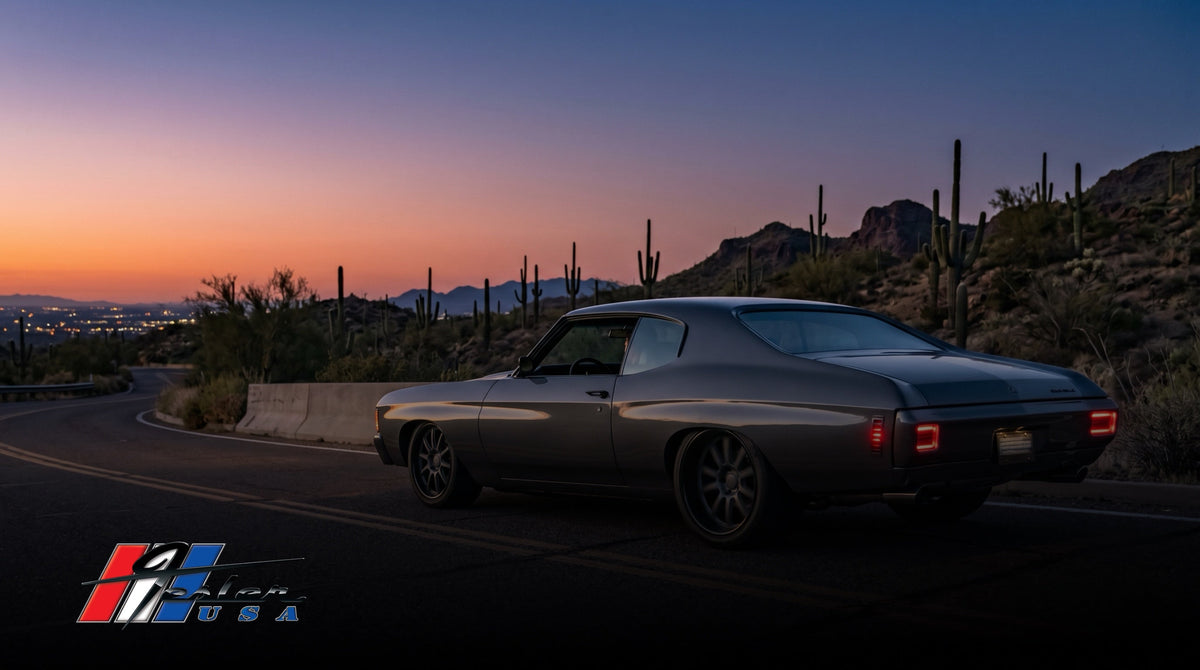
A "day two" car is a muscle car modified the way its first owner would have modified it: bolt-on speed parts that were on the shelf within a few years of the build date. Day one, you bought the car. Day two, you drove it to the speed shop for wheels, headers, a shifter, and a tach. The term comes from the collector world, and the Muscle Car and Corvette Nationals outside Chicago now judges day two cars as their own class with written rules.
The reason the idea matters is that it corrects a myth. The muscle car most people picture, factory-correct and untouched, is the version almost nobody saw in 1969. Here is what day two actually meant, how to spot it on your own car, and why the pro-touring build in our shop today is the same instinct with better parts.
What does "day two" mean on a muscle car?
The hobby's working definition, as Summit Racing's Tom Lynch put it to OnAllCylinders, is upgrades the owner started making soon after delivery: bolt-on parts that could be installed in a driveway over a weekend. Not a re-engineered car. Not a race car. A street car made personal with the parts a kid with a paycheck could afford.
The typical list looked like this:
- Wheels and tires. Almost always first, because they changed the look for the least money.
- Headers and louder exhaust.
- A floor shifter if the car came with a column shift or a weak factory unit.
- A tachometer clamped to the steering column or bolted to the dash, because most base cars did not have one.
- Traction bars, air shocks, and a rake from taller rear tires or extended shackles.
- Underhood dress-up: finned valve covers, an open-element air cleaner.
- Decals on the quarter glass from whichever speed brands the owner bought.
None of it was exotic, and that is the point. The factory car was the starting point, not the finish line.
Which brands defined the day two era?
The dates matter, because they are what make a part "period correct."
Cragar S/S. Roy Richter's Cragar Industries announced the S/S in 1964 after about two years of design and testing. Chrome steel rim, cast aluminum center, and a deeper spoke section near the hub that solved the cracking problem earlier mag wheels had. It became the default street wheel of the late 1960s.
American Racing Torq Thrust. Older than the Cragar. American Racing was started in 1956 by Romeo Palamides and Jim Ellison to build lightweight race wheels, and the Torq Thrust five-spoke arrived around 1962 as a magnesium drag wheel that quickly crossed over to the street.
Hooker Headers. Founded in 1962 in Southern California. By the time the big-block Camaros and Chevelles showed up, Hooker tube headers were the first thing under the hood to change.
Hurst shifters. George Hurst and Bill Campbell started the company in 1958. Hurst shifters were already the drag racing standard by the early 1960s, the 1964 GTO came with one from the factory, and formal co-branding with GM, Ford, Chrysler, and AMC began in 1965. A Hurst shifter was the rare day two part that Detroit itself endorsed.
Sun tachometers. Sun started in 1935 in Crystal Lake, Illinois, making industrial tachometers, and pivoted to enthusiasts in the 1950s and 1960s. The Super Tach, with its chrome ring and blue line, was in every speed shop by 1970. A Sun tach in a chrome cup on the column is the most recognizable day two part there is.
Did dealers really sell day two cars off the lot?
Yes. A handful of dealerships built modified cars in their own service departments and sold them on the same paperwork as the car. Nickey Chevrolet in Chicago. Don Yenko's dealership in Canonsburg, Pennsylvania. Royal Pontiac in Royal Oak, Michigan. Mr. Norm's Grand Spaulding Dodge in Chicago. Baldwin-Motion on Long Island, where Baldwin Chevrolet sold the cars and Motion Performance built them.
Hagerty has profiled several survivors, including a 1969 Baldwin-Motion Phase III Camaro in Hugger Orange with 739 miles on it, and the 1969 COPO Camaros that went through Queen City Chevrolet in Cincinnati. Those cars were modified before the first owner ever drove them. Day two happened before day one.
Why did the hobby erase day two history?
Because the money went the other way. When muscle cars became collectible in the 1980s and 1990s, value tracked originality. Numbers-matching engines, factory paint codes, correct hose clamps. Restorers pulled the Cragars, the headers, and the column tach, and rebuilt the car to match the showroom floor, the one place almost nobody had seen it.
The correction started in the collector world itself. The Muscle Car and Corvette Nationals in Rosemont, Illinois now runs a "Day 2, aka Period Correct Concours" class. The rules are specific: a minimum of three period-correct modifications, using parts, colors, and equipment that were available within three years of the car's production, with period parts, not current reissues of old speed parts, and no car with a replacement or questionable VIN plate. The hobby has decided, on paper, that the modified version is a legitimate version of history.
How do you know if your own car was a day two car?
Go look. Most of these cars carry the evidence, even after a restoration.
- Extra holes in the dash or under it. A column-clamp tach left nothing behind, but a dash-mounted tach or gauge pod left a drilled hole, often patched with a plug or hidden under a later pad.
- Header marks on the block and the floor. Look at the exhaust flange face on the heads and the underside of the floor near the frame rails. Tube headers leave heat marks and scraped paint that cast iron manifolds never do.
- Holes in the leaf spring plates or frame. Bolt-on traction bars left extra holes in the spring plates or the frame rails that a factory car will not have.
- A shifter hole that does not match the console. Aftermarket floor shifters needed their own opening. Many cars have a second cut in the tunnel hidden under carpet.
- Wheel weights and lug seats. Mag wheels used different lug nuts. Chewed-up stud threads and a mismatched lug set are a common sign.
Is pro-touring just day two with better parts?
Yes, in spirit. The 1969 kid with a Cragar catalog wanted the car to look faster, sound faster, and feel like his. The 2026 builder wants the same three things. Aluminum wheels with modern tires instead of chrome steel and bias-ply. A full suspension instead of air shocks. A programmable digital dash instead of a Sun tach on the column. Flush-bonded glass instead of gasketed glass with stainless trim.
The difference between day two and pro-touring is not the impulse. It is how far you go and what you keep. Day two kept the factory car intact under the bolt-ons. Pro-touring changes the car's chassis, brakes, and drivetrain so it drives like a modern car. If you are deciding which lane you are in, pro-touring vs restomod, the builder's guide lays out the line, and the best pro-touring platforms for 2026 ranks the cars that take the treatment best. The same cars that filled the speed shops the first time are all on it.
What does the modern day two look like in our shop?
Nobody brings a car to Phoenix to keep it showroom stock. They bring it because they want it to be theirs.
The tach becomes a dash. A Dakota Digital HDX in a Fesler-exclusive bezel does what the Sun tach did, gives the driver information the factory did not, without a chrome cup on the column. Our Dakota Digital gauges guide covers how to spec one.
The trim comes off. Flush-mount DOT glass deletes the stainless windshield and backlight moldings and bonds the glass level with the body. On a 1967 to 1969 Camaro or a 1968 to 1972 Chevelle, that single change does for the profile what a set of Cragars did in 1969.
The interior closes up. Hand-laid fiberglass door panels, kick panels, A-pillars, and a hard headliner give the cabin one continuous surface. Same instinct as day two. Better parts.
Quick answers
What is a day two muscle car? A muscle car modified the way its first owner would have, with bolt-on speed parts that were available within a few years of when the car was built: wheels, headers, shifter, tach, traction bars.
What are the MCACN Day 2 class rules? A minimum of three period-correct modifications, using parts and colors available within three years of the car's production, with period parts rather than current reissues, and no replacement or questionable VIN plates.
When did the Cragar S/S come out? Cragar announced the S/S in 1964, after about two years of design and testing by founder Roy Richter.
Were Hurst shifters factory equipment? Sometimes. The 1964 Pontiac GTO came with a Hurst shifter, and Hurst co-branding with GM, Ford, Chrysler, and AMC began in 1965.
What is the difference between day two and pro-touring? Day two kept the factory car intact under bolt-on parts. Pro-touring changes the chassis, brakes, drivetrain, glass, and interior so the car drives and feels modern.
How can I tell if my car was modified in period? Look for extra holes in the dash, tunnel, spring plates, or frame, header heat marks on the heads and floor, and mismatched lug nuts from mag wheels.
Shop Fesler parts for the 1967 to 1969 Camaro or browse the 1968 to 1972 Chevelle lineup.

Leave a comment
This site is protected by hCaptcha and the hCaptcha Privacy Policy and Terms of Service apply.