
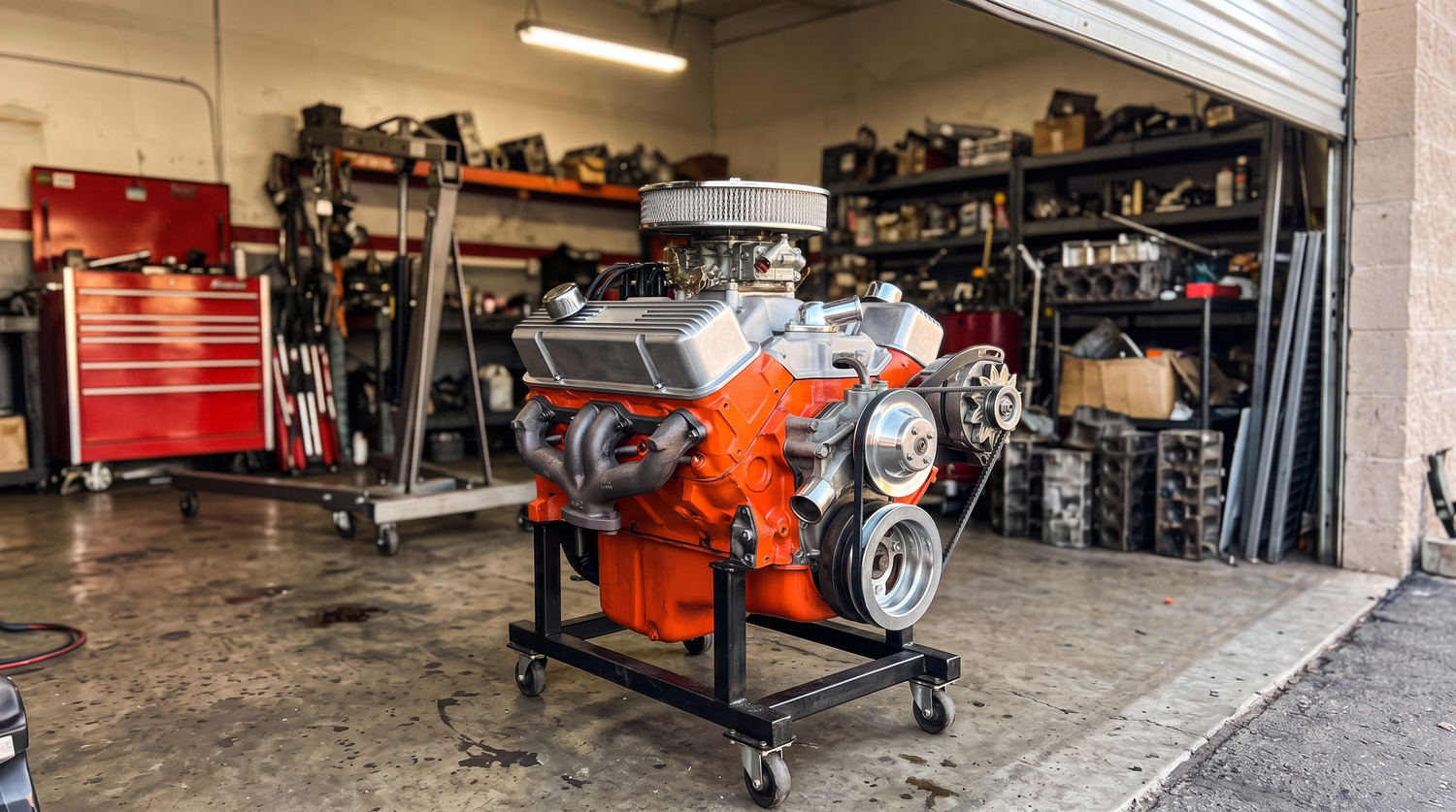
Ask a room full of Chevy people what a 427 is and you will get one answer. Ask them which 427 and the room splits.
Between 1966 and 1969, Chevrolet sold six meaningfully different 427 cubic inch big blocks. One of them was a mild hydraulic cam engine you could order in a station wagon. One of them had an aluminum block and cost more than the car it went in. They shared a displacement and almost nothing else, and the gap between the cheapest and the most valuable is now measured in millions of dollars.
Two more engines wore the 427 badge before the big block ever existed, and one wore it again forty years later. This is the whole family, what each one actually was, and how to figure out which one is bolted to the stand in front of you.
What is a Chevrolet 427?
The 427 is a Mark IV big block Chevrolet V8 displacing 427 cubic inches from a 4.251 inch bore and a 3.760 inch stroke. It arrived for the 1966 model year and was the top of Chevrolet's passenger car engine range until the 454 replaced it for 1970.
Architecturally it sits in the middle of the Mark IV family. The 396 came first, in 1965. Bore that 396 out and you get the 427. Take the 427 and stretch the stroke from 3.760 to 4.000 and you get the 454. All three share 4.840 inch bore spacing and, in standard deck form, a 9.800 inch deck height.
Why the 427 revs
The 427's bore to stroke ratio is about 1.13, which makes it oversquare: the bore is meaningfully larger than the stroke. That short stroke means lower mean piston speed at any given rpm, and the large bore leaves room for big valves. Both of those things favor breathing and rpm.
Be careful with how you say this, because a common version of it is wrong. The 454 is also oversquare, at a ratio of about 1.06. The 427 is not oversquare where the 454 is undersquare. It is simply more oversquare, with a shorter stroke, so it trades some low end torque for the ability to keep pulling. That is the real difference in character between the two, and it is why the 427 is the one people build for road racing and the 454 is the one people build for torque.
The two 427s that came before the big block
Two earlier Chevrolet engines displaced 427 cubic inches and neither one is a Mark IV. Both get confused with it constantly.
The 1963 Z11. A W-series engine, derived from the 409, using the 409's bore with a longer stroke: 4.3125 by 3.65. It ran 13.5:1 compression, twin Carter AFB four barrels on a two piece high rise intake, and was rated 430 horsepower. Chevrolet built 57 of them as part of a lightweight drag package with aluminum body panels. Real output is widely estimated well north of the rating. The block casting is 3830814. It shares nothing with the Mark IV except the displacement.
The 1963 Mystery Motor. The Mark II. A race only engine, same 4.3125 by 3.65 dimensions, but with conventional 90 degree decks and canted "porcupine" valves, and 4.84 inch bore spacing. It appeared at Daytona in February 1963, where Johnny Rutherford set a closed course qualifying record at 165.183 mph before reliability problems ended the weekend. GM shut the program down on January 21, 1963. Parts existed for as many as 60 engines and somewhere between roughly 16 and 48 were actually assembled, depending on which account you believe. That range is genuinely contested and anyone quoting a precise number is guessing.
The Mystery Motor is often described as a prototype Mark IV. It is more accurate to call it a conceptual ancestor. No major components interchange between the two.
The 427 RPO codes, decoded
Every horsepower figure below is SAE gross, the standard in use through 1971. They are not comparable to modern net ratings.
| RPO | Rating | Comp. | Cam | Induction | Heads | Where you could get it |
|---|---|---|---|---|---|---|
| L36 | 390 hp (385 in full size) | 10.25:1 | Hydraulic | Quadrajet 4-bbl | Iron, oval port | Corvette and full size, 1966-69 |
| L68 | 400 hp | 10.25:1 | Hydraulic | Tri-power, 3x2 Holley | Iron, oval port | Corvette only, 1967-69 |
| L71 | 435 hp | 11.0:1 | Solid | Tri-power, 3x2 Holley | Iron, rect port | Corvette only, 1967-69 |
| L72 | 425 hp | 11.0:1 | Solid | Single Holley 4-bbl | Iron, rect port | Corvette 1966 only; full size 1966, 1968-69; COPO 1969 |
| L88 | 430 hp (deliberately understated) | 12.5:1 | Solid, aggressive | Holley 850 cfm | Aluminum, rect port | Corvette only, 1967-69. 216 built. |
| ZL1 | 430 hp (published) | 12.0-12.5:1 | Solid, very aggressive | Holley 850 cfm | Aluminum, open chamber | 1969 only. 69 Camaros, 2 Corvettes. 182 engines built. |
| L89 | No change (435) | 11.0:1 | Solid (L71 spec) | Tri-power | Aluminum | Aluminum head option on L71, 1967-69 |
The two ratings that were never honest
The L88 and the ZL1 were both published at 430 horsepower, which put them below the 435 horsepower L71 on paper. That was deliberate. Chevrolet did not want street buyers ordering either engine, so it rated them conservatively and buried them behind a list of mandatory deletions: no radio, no air conditioning, no power steering, a heater and defroster delete on the 1967 and 1968 cars, mandatory heavy duty transmission, suspension, brakes, transistor ignition, and a decal specifying 103 octane fuel.
Actual L88 output is genuinely contested. Estimates commonly land somewhere between 500 and 580 horsepower depending on year, headers, and who is measuring. Chevrolet's own engineering figures for the ZL1 have been cited at 376 net and 524 gross. Treat all of these as ranges, not facts.
Where the L72 story usually goes wrong
The L72 has the most confused availability record of the group, and almost every article gets some part of it wrong.
It was a Corvette option in 1966 only. It was not available in the 1967 Corvette. Eleven L72 engines were built for 1967 and none of them were installed in a car. It came back for 1968 and 1969 in the full size Chevrolets, and in 1969 it became the engine behind the COPO Camaros and Chevelles.
Also: it debuted in 1966 advertised at 450 horsepower and was quietly re-rated to 425 shortly after release, with no meaningful hardware change.
The COPO story is its own piece of history, and we have written it up separately: how a Chevy dealer used the taxicab ordering system to get 427s into Camaros.
Which 427s went in which cars?
- Corvette only: L68, L71, L88, L89, and the ZL1 in 427 form
- Corvette and full size Chevrolet: L36 and L72
- Camaro and Chevelle: only the L72, and only in 1969, and only through COPO
- Trucks, buses, and marine: the tall deck 427, a 10.200 inch deck version used in medium duty Chevrolet and GMC trucks from 1966 into the 1990s, in transit buses to around 1995, and in marine service as the MerCruiser 325 from 1968 to 1974
Two corrections worth planting here, because they circulate widely. The L36 was not Corvette only. And there was no 425 horsepower 427 in a 1967 full size Chevrolet. The L36, at 385 horsepower, was the only 427 offered in a passenger car that year.
427 versus 454: what is actually different?
Same bore, different stroke. The 454 adds .240 inch of stroke, which is where the extra 27 cubic inches come from. Same 4.840 inch bore spacing, same 9.800 inch standard deck, same 2.750 inch main journals.
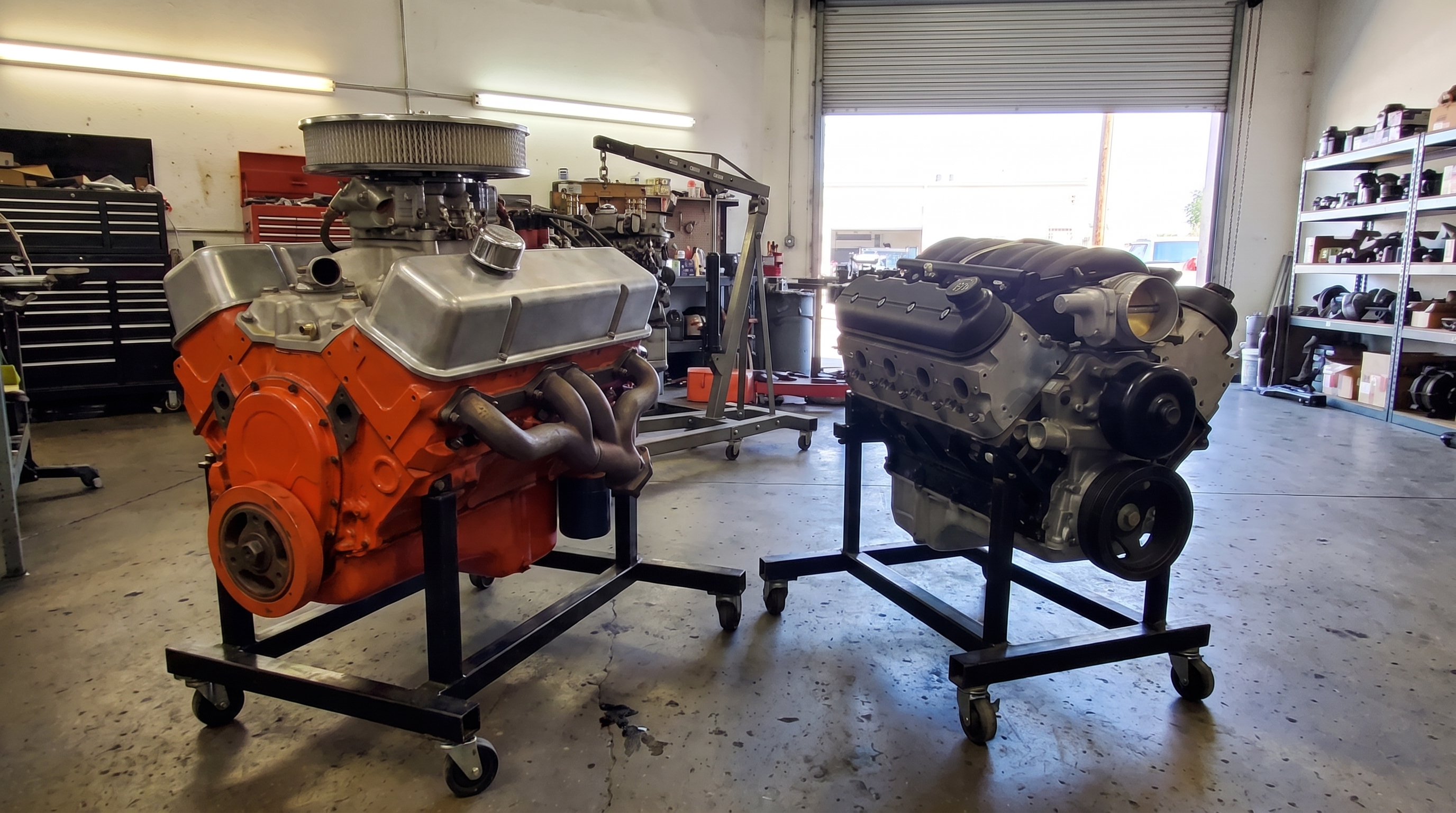
In practice the 454 makes more torque lower down and the 427 is happier being wound out. The 454 is also far more common and far cheaper, which is why a great many "427" cars on the road are running 454s, and why block identification matters as much as it does. We compared the 454 against its modern namesake in 454 vs. LSX454.
How do you identify a 427?
This is where money changes hands and where most of the bad information lives. Start with the fact that there are five different numbers on a big block Chevy and they do five different jobs.
| Number | Cast or stamped | Applied by | What it proves |
|---|---|---|---|
| Casting number | Cast, raised | The foundry | The block design and rough era. Nothing about the car. |
| Casting date code | Cast, raised | The foundry | When the iron was poured. Must predate assembly. |
| Assembly stamp | Stamped | The engine plant | Plant, month, and day the engine was built. |
| Suffix code | Stamped | The engine plant | The RPO, transmission, and application combination. |
| Partial VIN | Stamped | The vehicle plant | That this block went into one specific car. The only one that does. |
Federal regulation required the partial VIN stamp from January 1, 1968. That is why authentication of a 1968 or 1969 car is a different exercise than authentication of a 1966.

Where to look
The block casting number is cast into the rear ledge of the block near the bellhousing flange, usually on the driver's side, though some 1960s big blocks carry it on the passenger side. The casting date code is also cast, on the rear ledge toward the passenger side near the distributor boss.
The stamped numbers are the ones that move around. On a small block, the assembly stamp and partial VIN both live on the front passenger side deck pad. On a big block the Camaro Research Group notes the two locations are effectively reversed, so the pad ahead of the passenger head is typically the partial VIN. Location varies by plant and by year, and 1969 V8s frequently moved the partial VIN down near the oil filter because the alternator had been relocated. If you do not find what you expect where you expect it, that alone is not evidence of anything.
427 block casting numbers
| Casting | Application |
|---|---|
| 3855961 | 1966 427, two bolt main |
| 3869942 | 1966-67 427, two or four bolt |
| 3904351 | 1967 427 |
| 3916321 | Late 1967 into 1968 427 |
| 3935439 | Late 1968-69 427, including L88 applications |
| 3955270 | 1969 427, two or four bolt |
| 3963512 | 1969 427 and 1970-76 454, including the LS6. Two or four bolt. |
| 3946052 | 1969 aluminum ZL1, four bolt. The real one. |
| 3946053 | Aluminum ZL1 second version, cast 1997 and later. A GM service and reproduction block, not 1969 production. |
Those last two rows are one digit apart and about two orders of magnitude apart in value. Read carefully.
Cylinder head castings are worth knowing too: 3919840 is the iron rectangular port head used on the L71 and L72, 3904392 and 3919842 are the aluminum heads used on the L88 and L89, and 3946074 is the ZL1 head.
Why a casting number proves almost nothing
Look at 3963512 in that table again. It is a correct 1969 427 casting, including for COPO engines. It is also the block Chevrolet used for 454 production from 1970 into the mid seventies, including the LS6. Hundreds of thousands of them were poured.
Which means a 3963512 block sitting on a stand is statistically far more likely to be a 454 than a 427. The casting number is a part design number. It identifies a mold, not a car, and it was never intended to do anything else.
What actually authenticates a car is a chain of four things that have to agree with each other:
- The partial VIN stamped on the block matching the car's VIN
- The suffix code matching the correct RPO and transmission combination
- A casting date and assembly date that form a plausible sequence ending before the car's build date
- Documentation: build sheet, Protect-O-Plate, window sticker, dealer invoice, or a Corvette tank sticker
One widespread piece of bad advice to ignore: the cowl or trim tag does not identify the engine on a Camaro or Chevelle. It gives you body style, plant, build date, paint, and trim. Anyone telling you to check the cowl tag for an engine code is going to get corrected, loudly.
Two bolt or four bolt mains?
There is no reliable way to tell from outside the engine. Chevrolet did not mark the exterior of the block, and the same casting number was routinely poured both ways. Look at the table above: 3869942, 3904351, 3916321, 3955270, and 3963512 are all listed as two or four bolt.
The practical answers are a borescope through the oil drain plug or dipstick tube, or pulling the pan. The one safe inference is that all factory tall deck truck blocks were four bolt.
While we are here: the old story that an "010" or "020" casting mark means high nickel content and four bolt mains is not true. Those blocks came both ways.
Reading the casting date code
A letter for the month, a number for the day, a single digit for the year. A is January through L is December, which uses all twelve letters, including I for September. C129 reads as March 12, 1969.
That single year digit is the problem. It could be 1959, 1969, 1979, 1989, or 1999. You resolve it against the casting number and the block architecture, not on its own.
What a restamped pad looks like
The stamped numbers are the ones worth forging, which is exactly why the Camaro Research Group warns that partial VINs can be restamped after machining off the original. Experts look for:
- Missing or misaligned broach marks. Factory pads carry fine parallel machining striations. Grinding the pad destroys or reorients them.
- Wrong pad height relative to the deck. Decking a block lowers the deck relative to the pad, and the relationship is measurable against known good examples.
- Font and character geometry. Factory dies have specific stroke shapes and spacing, and the assembly stamp and the partial VIN were applied with different tools in different fonts. Forgers usually get one of the two wrong.
- Inconsistent depth or a wandering baseline. Factory gang stamps hit all at once, so characters share depth and sit on one line. Hand stamped characters drift.
- Surface finish that does not match. A bead blasted or unnaturally flat pad on an otherwise as cast block.
- Dates that contradict each other. An assembly date preceding the casting date, or a build date that sits implausibly far from the car's.
When did the 427 end, and did it come back?
1969 was the last model year for the 427 in a United States Chevrolet passenger car. The 454 replaced it for 1970 once GM lifted the displacement cap on intermediates. The tall deck truck, bus, and marine versions carried on for decades after that, which is why "the 427 died in 1969" is only half true.
The number returned in 2006, attached to something completely different. The LS7 in the C6 Corvette Z06 displaces 427.6 cubic inches, or 7.0 liters, from a 4.125 inch bore and a 4.000 inch stroke. It made 505 horsepower and 470 lb-ft, ran a dry sump, and used titanium rods and intake valves. It powered the Z06 from 2006 to 2013, the 2013 Corvette 427 Convertible Collector Edition (2,552 built), and the 2014-15 Camaro Z/28.
Two things to be precise about. The LS7 is a small block, not a big block: LS architecture, 4.400 inch bore spacing. And it is not exactly 427 cubic inches. Calling it a returning 427 is a marketing lineage claim rather than an engineering one. Separately, the C6 ZR1's LS9 is a supercharged 6.2 liter, not a 427, and gets miscategorized constantly.
What 427s are worth in 2026
Cars first, because that market is documented. All figures below reflect recent public results and market benchmarks, and the top of this market moves on very thin sample sizes.
- 1966 Corvette L72 427/425: benchmark around $112,000, with recent results including $176,000 at Mecum Glendale in March 2026 and $173,500 on Bring a Trailer that same month
- 1967 Corvette L71 427/435: benchmark around $168,000
- 1967 Corvette L88: benchmark around $1.4 million. The high water mark is $3.85 million, set at Barrett-Jackson Scottsdale in January 2014. Hagerty's April 2026 range for a 1967 is $1.3 million to $2.6 million, dropping to roughly $262,000 to $563,000 for 1968 and 1969 cars
- 1969 COPO Camaro: benchmark around $187,000, with $440,000 achieved at Barrett-Jackson Scottsdale in January 2026
- 1969 Camaro ZL1: benchmark around $895,000, with $1,430,000 at Mecum Indianapolis in May 2026
Loose engines are much harder to pin down because most of them trade privately. A bare, correctly dated iron 427 block generally runs somewhere between $1,500 and $5,000. A documented, complete L72 with correct heads, intake, and carburetor is a five figure proposition. Original ZL1 aluminum blocks rarely surface publicly at all.
The spread between an undated bare block and a documented assembly is an order of magnitude, which is the entire argument for learning to read the numbers before you write the check.
Frequently asked questions
What is the difference between a 427 and a 454?
Same 4.250 inch bore. The 454 has a 4.000 inch stroke against the 427's 3.760 inch stroke. Everything else about the architecture, including bore spacing and deck height, is shared. The 427 revs more freely and the 454 makes more low end torque.
Which 427 was the most powerful?
The ZL1 and L88 were the most powerful, though both were published at 430 horsepower, deliberately understated to discourage street orders. Of the honestly rated engines, the L71 at 435 horsepower was the highest.
Does a casting number prove I have a real 427?
No. Casting numbers were shared across applications and across displacements. The 3963512 casting was used for both 1969 427 production and 1970 to 1976 454 production. Only the stamped partial VIN links a block to a specific car.
What years did Chevrolet make the 427?
The Mark IV 427 ran in passenger cars from 1966 through 1969. Tall deck truck, bus, and marine versions continued for decades after. Two unrelated 427 cubic inch engines preceded it in 1963, and the 7.0 liter LS7 revived the number from 2006 to 2015.
How can I tell if a big block has four bolt mains?
Not from the outside. The same casting numbers were poured both ways. Use a borescope through the oil drain plug or dipstick tube, or drop the oil pan. Factory tall deck truck blocks were always four bolt.
Was the L88 a street engine?
Technically it was available to anyone who ordered it, but Chevrolet made that as unappealing as possible: no radio, no air conditioning, no power steering, mandatory heavy duty equipment, and a requirement for 103 octane fuel. Only 216 L88 Corvettes were built across three model years.

Build yours
Fesler USA manufactures DOT certified flush mount glass kits and hand laid fiberglass interior components for the cars these engines went into. Everything above is about verifying what is under the hood. We make the parts you see and touch every time you get in.
- 1967-69 Camaro Flush-Mount Glass Kit
- 1968-72 Chevelle Flush-Mount Glass Kit
- 1968-69 Camaro Door Panels
- Shop all 1st gen Camaro parts
- Shop all Chevelle parts
Questions about fitment, shipping, or builds? Contact us or call and text 480-748-2000. We are here Monday through Thursday, 8am to 5pm.
Further reading: The COPO story, First generation Camaro history, and The Chevelle Story.

Leave a comment
This site is protected by hCaptcha and the hCaptcha Privacy Policy and Terms of Service apply.