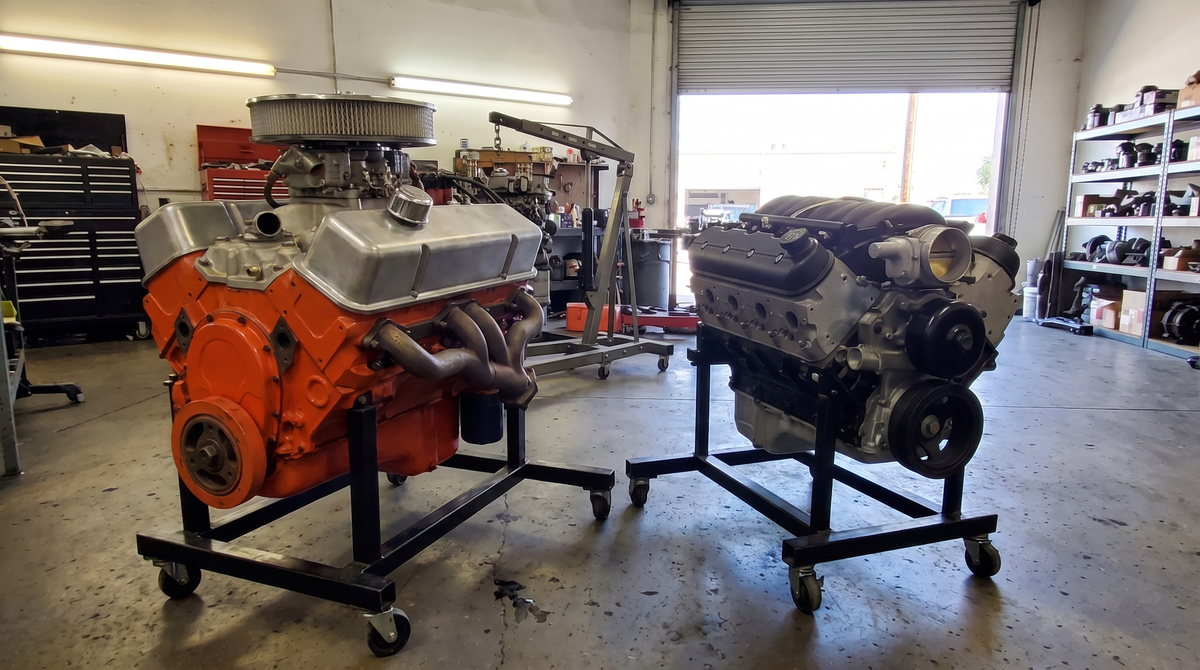
The badge said 454. It was cast into an iron block that weighed as much as a small motorcycle, sat in the engine bay of a Chevelle, and made 450 horsepower on a rating scale that no longer exists.
Today Chevrolet Performance will sell you a crate engine displacing the same 454 cubic inches. It makes 627 horsepower, it is built on small block architecture, and it bolts to the same bellhousing as the 5.3 liter truck engine sitting in half the wrecking yards in America.
Same number. Same displacement, near enough. Almost nothing else in common.
Here is what actually separates them, what each one is really worth to a build, and how to figure out which 454 is sitting on the stand in your shop.
What is a Chevy 454?
The 454 is a Mark IV big block Chevrolet V8 displacing 454 cubic inches, built from a 4.250 inch bore and a 4.000 inch stroke. Chevrolet introduced it for the 1970 model year. It is a stroked version of the 427: same bore, with the stroke pushed from 3.760 inches out to a full four.
That is the short answer. The longer answer is that "454" covers engines separated by three decades and a complete change in how power was measured.
Where the 454 came from
For 1970, General Motors dropped the corporate rule that had capped intermediate and pony cars at 400 cubic inches. Chevrolet responded immediately. The 454 arrived that year in the Chevelle, the El Camino, the Monte Carlo, the Corvette, and the full size cars.
It did not arrive in trucks until 1973, with the square body C and K series, initially rated at 240 horsepower. That truck lineage ran a long time. The square body derived R and V line carried it through 1991, the 454 SS pickup ran from 1990 to 1993, and the GMT400 trucks and Suburbans kept a 7.4 liter on the order sheet as the Vortec 7400 until roughly 2001.
LS5, LS6, and the truck 454: one badge, very different engines
Three RPO codes account for most of the 454s people actually care about, and they are not close to each other.
LS5. The volume engine. In the 1970 Chevelle, Monte Carlo, and El Camino it was rated 360 horsepower and 500 lb-ft. In the 1970 Corvette it was rated 390. For 1971 it dropped to 365. For 1972, under the new measurement standard, it was rated 270.
LS6. The famous one. In the 1970 Chevelle SS 454 and El Camino SS 454 it was rated 450 horsepower at 5,600 rpm and 500 lb-ft at 3,600, on 11.25:1 compression. It is the number everyone quotes, and it deserves a caveat that most people skip. See the next section.
The truck and marine 454. Same displacement, completely different tune. Long duration was traded for low end pull and durability, and by the late seventies the output figures had come down to earth.
Two footnotes worth knowing, because they get repeated wrong constantly. The 1970 Corvette had both the LS6 and the LS7 in its option catalog, and neither one was actually sold. The only big block in a 1970 Corvette was the LS5. And the 1971 LS6 shows up in GM's own fact sheet for the Chevelle, but there is no proof one was ever delivered to a customer in that car. All 188 LS6 engines built for 1971 went into Corvettes, rated 425 gross and 325 net.
How much horsepower does a 454 actually have?
It depends entirely on which 454 and which year, because the measuring stick changed in the middle of the engine's life.
- LS5, 1970: 360 hp gross in the Chevelle, 390 hp gross in the Corvette
- LS6, 1970: 450 hp gross
- LS5, 1971: 365 hp gross
- LS6, 1971 Corvette: 425 hp gross, 325 hp net
- LS5, 1972: 270 hp net
- Truck and marine 454s, 1973 onward: roughly 230 to 290 hp net depending on year and application
- LSX454 crate engine, current: 627 hp net
Gross versus net, and why the numbers collapsed without anyone touching the engine
Through 1971, American manufacturers published SAE gross horsepower: an engine on a stand, no air cleaner, no exhaust system, no alternator, no water pump load, timing and jetting optimized for the dyno pull. From 1972 they published SAE net: the engine as installed, with everything hanging off it that would hang off it in the car.
That is the whole reason the LS5 went from 365 horsepower in 1971 to 270 in 1972. Nothing meaningful changed inside it. The rules changed.
This matters for the comparison at the heart of this article. The 1970 LS6's 450 is a gross figure. The LSX454's 627 is a net figure. They are not the same currency, and the real gap between the two engines is wider than the raw numbers suggest, not narrower.
One more thing worth saying plainly: GM never published an SAE net rating for the 1970 LS6. Any net figure you see quoted for it is an enthusiast estimate, not a factory number.
What is the LSX454?
The LSX454 is a Chevrolet Performance crate engine displacing 453.9 cubic inches, or 7.4 liters, from a 4.185 inch bore and a 4.125 inch stroke. It is rated 627 horsepower at 6,300 rpm and 586 lb-ft at 5,100 rpm. The current part number is 19417357.
It is built on the cast iron LSX Bowtie block, with siamesed cylinder bores, thicker decks, billet steel main caps, priority main oiling, and six head bolts per cylinder instead of the production LS engine's four. Compression is 11.0:1. The heads are aluminum LSX-LS7 raised rectangular port castings with titanium intake valves and sodium filled exhaust valves. The camshaft is a hydraulic roller at 236 and 246 degrees duration at .050 inch, with .648 inch lift through 1.8:1 rockers.
Note that the 4.185 bore and 4.125 stroke get to 454 cubic inches by a completely different route than the big block's 4.250 by 4.000. Neither engine is exactly 454. Run the math and the Mark IV comes out at 454.0 cubic inches and the LSX at 453.9. Two unrelated sets of dimensions, rounded onto the same badge.
Is the LSX454 a big block or a small block?
The LSX454 is a small block. Despite displacing 454 cubic inches, it uses Chevrolet's Gen IV LS architecture: 4.400 inch bore spacing and a 9.240 inch deck height, the same core dimensions as a 5.3 liter truck engine. A Mark IV big block uses 4.840 inch bore spacing and a 9.800 inch deck. GM's own drag race specification sheet for the engine calls it a "7.4 Liter (454 c.i.) Gen IV Small Block."
The nuance worth understanding: the LSX block is not architecturally larger than a production LS. Its bore spacing and deck height are identical. What is different is metal. Thicker walls, siamesed bores, a beefier cam tunnel, extra head bolt bosses. The bare LSX iron block weighs around 230 pounds against roughly 216 for a production 6.0 liter iron block and 107 for an aluminum LS7. It is a heavier, stronger casting of the same shape, not a bigger one.
LSX454 versus LSX454R: which one was discontinued
This causes real confusion, so it is worth being direct. There were two.
The LSX454R was the drag racing version, part number 19260835, rated 776 horsepower and 649 lb-ft. Chevrolet Performance discontinued it in July 2018.
The LSX454, the 627 horsepower engine described here, is a separate product and is still listed by Chevrolet Performance as of August 2026. If someone told you the LSX454 was killed off, they were thinking of the R.
454 versus LSX454: the spec comparison
| Spec | Mark IV 454 (LS6, 1970) | LSX454 (current) |
|---|---|---|
| Family | Mark IV big block | Gen IV LS small block |
| Displacement | 454.0 cu in | 453.9 cu in (7.4L) |
| Bore x stroke | 4.250 x 4.000 in | 4.185 x 4.125 in |
| Bore spacing | 4.840 in | 4.400 in |
| Deck height | 9.800 in | 9.240 in |
| Block material | Cast iron | Cast iron (LSX Bowtie) |
| Heads | Cast iron, rectangular port | Aluminum LSX-LS7, raised rect port |
| Compression | 11.25:1 | 11.0:1 |
| Rated power | 450 hp gross | 627 hp net |
| Rated torque | 500 lb-ft gross | 586 lb-ft net |
| Induction | Single Holley 4-barrel | Carb or EFI, intake not included |
| Fuel | Leaded premium (period) | 92 octane minimum |
| Approx. dressed weight | 675 to 700 lb in iron | Not published by GM (see below) |
Does the LSX454 fit where an LS fits?
Mostly yes, and that is the genuinely interesting part of this engine. The LSX block accepts Gen I through Gen IV engine mounts, keeps the standard LS bellhousing pattern, and uses the standard 9.240 inch deck height. In packaging terms it occupies the same space as the 5.3 or 6.0 liter engine your chassis was probably set up for. The mounts, the crossmember, the transmission, the headers you already researched: all of that carries over in principle.

Which is not the same as saying you can swap it in over a weekend. There are real gotchas, and they cost money.
- It is a long block, not a complete engine. No intake manifold, no oil pan, no pickup, no starter, no flexplate, no accessory drive. Sellers differ on exactly what else is in the crate, so check the current Chevrolet Performance spec sheet for part number 19417357 before you build a budget around it.
- The crank flange is 8-bolt, the LS7 and LSA pattern. Your 6-bolt flexplate or flywheel from a truck engine will not bolt up.
- It needs an LS7 pattern intake. LS3 and truck intakes will not fit. Different port shape, different bolt locations.
- The exhaust ports are LS7 style raised rectangular. Truck manifolds and LS1 or LS3 headers do not match.
- There are no coil mounts on the valve covers. Coils have to be relocated.
- The water pump is specified for a 2009 rear wheel drive car. A truck pump requires a different balancer.
- Chevrolet lists LSX parts as intended for competition use. This is not a legal street swap in California or other emissions inspection states. If that is your situation, look at the E-Rod family instead.
Weight, and what each engine does to your front end
Here is where we have to be honest instead of quotable. GM has never published a weight for the LSX454. It is a long standing unanswered question in the forums, and anyone giving you a precise figure is estimating.
What we can say with confidence: a fully dressed iron Mark IV big block with iron heads and iron intake runs roughly 675 to 700 pounds, with the bare block alone around 235 to 250. The bare LSX iron block has been measured at about 230 pounds. Published estimates put a dressed LSX454 somewhere in the 550 to 575 pound range, which would make it something like 100 to 125 pounds lighter than the big block it is named after.
That is a meaningful difference in a car with 1960s front suspension geometry. It is not the dramatic figure that gets shared around, and it is worth remembering that the LSX454 is still an iron block engine. An aluminum LS3 crate engine is roughly another 100 pounds lighter than the LSX454. If your only goal is getting mass off the front wheels, the 454 badge is not the way to do it.
Which one belongs in your build?

When the original 454 is the right answer
When the car is documented, when the drivetrain is original to it, or when the value of the finished car depends on it staying that way. A numbers matching LS6 Chevelle is worth what it is worth precisely because nobody improved it. There is also a category of build where the sound, the shake, and the sheer visual presence of an iron big block filling an engine bay is the entire point. That is a legitimate reason and no spreadsheet argues it away.
When the LSX454 is the right answer
When you want big block torque with modern part support, a real warranty path, current fuel tolerance, and the packaging flexibility of the LS platform. When you are building a car to drive hard and often rather than to show. When you want 627 horsepower without a build sheet full of custom machine work.
The third option most people actually land on
Neither. Most builders who start this conversation end up in a 6.0 or 6.2 liter LS, because it delivers most of the practical benefit at a fraction of the cost and complexity. We wrote a full guide to that decision: LS Swap or Keep It Original works through the tradeoffs honestly, including the ones that hurt resale.
How do I identify the 454 I already have?
Start by understanding that there are several different numbers on a big block and they tell you different things. People conflate them constantly and it leads to expensive mistakes.
Casting number versus stamped code
| Number | Cast or stamped | What it tells you |
|---|---|---|
| Casting number | Cast, raised | The block design and rough era. Not the specific car. |
| Casting date code | Cast, raised | When the iron was poured. |
| Assembly stamp | Stamped | Engine plant plus the month and day it was assembled. |
| Suffix code | Stamped | The RPO, transmission, and application combination. |
| Partial VIN | Stamped | The one number that links this block to one specific car. |
454 block casting numbers
| Casting | Application |
|---|---|
| 3963512 | 1969 427 and 1970 to 1976 454, including the LS6. Two or four bolt main. |
| 3999289 | 1971 to 1979 454 |
| 10114182 | Gen V 454, 1991 onward, four bolt |
| 10184299 | Gen VI 7.4L truck, 1996 onward |
Look closely at that first row. The 3963512 casting was used for 1969 427 production and for 454 production well into the seventies. On its own it does not even tell you the displacement, let alone the car. That is the whole lesson of block identification in one line.
One neighbor worth not confusing: casting 10114184 looks almost identical to the Gen V 454 casting above, but it is the Gen V tall deck 427 truck block. Read all eight digits.
Reading the casting date
The date code is a letter for the month, a number for the day, and a single digit for the year. A is January through L is December, which uses all twelve letters, including I for September. So C129 reads as March 12, 1969.
The catch is that single year digit. It could be 1959, 1969, 1979, 1989, or 1999. You resolve it by cross referencing the casting number and the block architecture. And the casting date always has to precede the engine assembly date. If it does not, something is wrong with the story you are being told.
Is it a Mark IV, or something later?
Any 7.4 liter from 1991 onward is not a Mark IV. Gen V blocks, from 1991 to 1995, have a one piece rear main seal and no mechanical fuel pump boss. Gen VI blocks, 1996 to 2001, add a hydraulic roller cam and multi port injection. Calling a Vortec 7400 a Mark IV in front of the wrong person will get you corrected.
One more identification trap: the RPO codes repeat
Chevrolet reused option codes across eras, which produces genuine confusion in search results and forum threads. LS6 is both the 1970 454 and the 5.7 liter engine in the 2001 to 2004 Corvette Z06. LS3 is both the 1970 402 big block and the 6.2 liter engine from 2008 onward. LS4 is both a 1973 to 1975 454 and the 5.3 liter front wheel drive V8. Always say which era you mean.
Frequently asked questions
Is the LSX454 a big block?
No. It displaces 454 cubic inches but uses LS small block architecture, including 4.400 inch bore spacing, a 9.240 inch deck height, and the standard LS bellhousing pattern. GM's own documentation calls it a Gen IV small block.
Is the LSX454 discontinued?
No. The race only LSX454R was discontinued in July 2018. The 627 horsepower LSX454, part number 19417357, is still offered by Chevrolet Performance as of August 2026.
How much horsepower does a 454 big block have?
Between 360 and 450 horsepower gross in 1970 and 1971 muscle car applications, and roughly 230 to 290 horsepower net in later truck and marine use. The ratings are not directly comparable because the industry switched from SAE gross to SAE net measurement in 1972.
What year did the Chevy 454 come out?
The 454 was introduced for the 1970 model year in the Chevelle, El Camino, Monte Carlo, Corvette, and full size Chevrolets. It did not appear in Chevrolet trucks until 1973.
Does an LSX454 fit where an LS fits?
It shares LS engine mount locations, bellhousing pattern, and deck height, so it packages like a standard LS. Plan on an LS7 pattern intake, an 8-bolt flexplate, matching headers, and relocated coils, none of which are included with the long block.
What is the difference between a 454 and a 502?
Both are Mark IV family big blocks. The 502 is a bored 454: it keeps the same 4.000 inch stroke and opens the bore up to roughly 4.470 inches. Chevrolet Performance sells it as a crate engine rather than as an original production engine.
How do I tell what year my 454 is?
Use the block casting number together with the cast date code and the stamped assembly code. No single one of those is conclusive on its own, and the casting number in particular was shared across both 427 and 454 production.
Build yours
Fesler USA builds DOT certified flush mount glass kits and hand laid fiberglass interior components for the platforms these engines went into. The engine is the part everybody argues about. The glass and the interior are the parts you look at every time you get in the car.
- Shop all Chevelle parts
- 1968-72 Chevelle Flush-Mount Glass Kit
- 1967-69 Camaro Flush-Mount Glass Kit
- Shop all 1967-72 Chevy truck and Blazer parts
- Shop all squarebody truck parts
Questions about fitment, shipping, or builds? Contact us or call and text 480-748-2000. We are here Monday through Thursday, 8am to 5pm.
Further reading: LS Swap or Keep It Original, The Chevelle Story, 1964 to 1972, and Pro Touring vs Restomod.

Leave a comment
This site is protected by hCaptcha and the hCaptcha Privacy Policy and Terms of Service apply.