History & Camaro
GM had nothing to put against the Mustang. What they rushed out the door under a code name became the most copied canvas in the restomod world. Here is how that happened.
In the spring of 1964, Ford did something that rattled the largest car company on earth. It launched the Mustang, and the thing sold like nothing Detroit had seen. Inside two years Ford moved more than a million of them. It did not just sell cars, it proved there was a giant, untapped appetite for an affordable, sporty, personal car, a market segment that barely had a name yet.
And General Motors, the company that was supposed to have an answer for everything, had nothing to put against it. The car that would become the first-generation Camaro did not start as a grand vision. It started as a scramble, a code name, and a corporate case of nerves. What is remarkable is where it ended up. Six decades later, that rushed, catch-up car is the single most popular canvas in the entire restomod world. This is the story of how a panic became an icon.
The car GM did not have
When the Mustang hit, Chevrolet's closest thing to a sporty car was the Corvair Monza, a sporty version of its compact rear-engine economy car. It was never going to answer the Mustang. The rear-engine layout could not take the full range of Chevy's engines, sales were sliding, and the Corvair was carrying a cloud of bad press from Ralph Nader's book on automotive safety. Chevrolet executives understood quickly that the Monza could not generate Mustang-level volume, and that they needed a conventional front-engine, rear-drive car built on the same formula Ford had used.
The clever part of Ford's playbook was that the Mustang was not built from scratch. It was grafted onto the bones of the humble Falcon. That kept it cheap and got it to market fast. Chevrolet decided to run the same play, and it had the perfect donor sitting in the lineup already.
Panther
By around August 1964, GM had committed to building a Mustang fighter, and it was a rush job on a tight budget. The program ran under the project designation XP-836 and was known internally as the F-body, but for most of its development it went by a code name that has stuck to the car ever since: Panther. Chevrolet even teased the press with the name before the real one was announced.
There was no time to design a new platform, so the engineers reached for the Chevy II Nova, the company's compact economy car, and used it as the foundation. The first Camaros shared a great deal of their chassis design with the Nova, the same way the Mustang borrowed from the Falcon. It was a sporty body grafted onto sensible, existing bones, built fast and built to a price.
A small, vicious animal that eats Mustangs
On June 28, 1966, Chevrolet general manager Pete Estes made the announcement over a coast-to-coast conference call to roughly 200 reporters gathered in cities across the country. He opened with a joke, telling the assembled press they were all charter members of the Society for the Elimination of Panthers from the Automotive World, and that this would be its first and last meeting. Then he revealed the real name, chosen to keep with Chevrolet's habit of names that start with C: Camaro.
Reporters naturally asked the obvious question. What is a Camaro? Chevrolet product men gave the answer that became legend: it was a small, vicious animal that eats Mustangs. The shot at Ford could not have been clearer. Ford fired right back, even running a mocking ad in which a panther fails to catch a Mustang, and Ford reps liked to point out to anyone who would listen that a similar word referred to a type of shrimp. The rivalry that still defines both cars was loud from the very first day.
The Camaro arrived two years late to a fight Ford started. It has been picking that fight ever since.
Late, but loaded
The Camaro went on sale in September 1966 as a 1967 model, in two body styles, a coupe and a convertible. It arrived two years behind the Mustang, and the first-year numbers reflected that head start: Chevrolet sold somewhere around 220,000 Camaros that first year, roughly half of what the Mustang did. But the race was on, and the car was anything but a stripped-down also-ran.
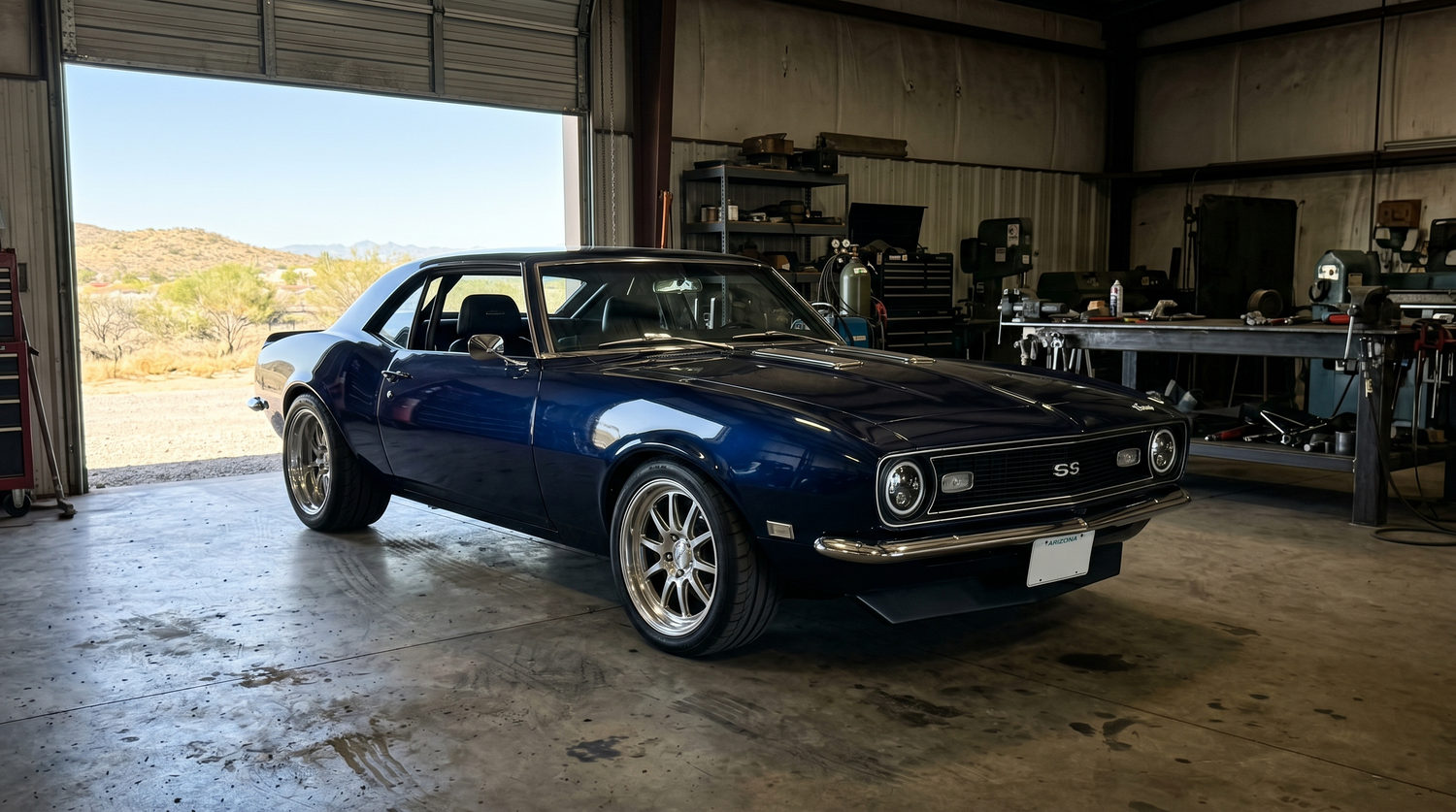
Chevrolet threw the full options book at it. There were nearly eighty factory options. The Rally Sport package, RS, was an appearance upgrade best known for its hideaway headlights that disappeared behind motorized panels in the grille. The Super Sport, SS, brought the muscle, with a 350 small-block and access to the big-block 396. You could stack RS and SS together, and that combination became one of the most iconic first-gen Camaros of all. From base six-cylinder commuter to big-block brawler, the first-gen could be almost any car you wanted, which is a big part of why it caught on.
The skunk-stripe special
The most important Camaro of the era was one most buyers never even knew they could order. The Z/28 option code was introduced in December 1966 for the 1967 model year, and it was barely mentioned in the sales literature. It was the brainchild of Chevrolet engineer Vince Piggins, who wanted to build a virtually race-ready Camaro you could buy from any dealer.
The reason was racing. The SCCA's new Trans-Am series for 1966 capped engine size at five liters, roughly 305 cubic inches, and required a minimum number of street cars be built to qualify. So Piggins and his team built a special 302-cubic-inch V8 to slot just under the limit, created by combining a 327 block with the shorter-stroke crankshaft from the old 283. It was a high-revving, solid-lifter engine that loved to spin, fed by a big four-barrel and backed by a four-speed and a heavy-duty chassis. The car wore wide racing stripes down the hood and trunk that could be deleted at no charge, and it rolled on 15-inch wheels when the rest of the line ran 14s.
Chevrolet rated the 302 at 290 horsepower, a number almost everyone agrees was deliberately underrated, with real output widely believed to be comfortably north of 350. The Z/28 went racing and won, taking Chevrolet's first Trans-Am title, and it built exactly the performance image Piggins was after. Ford did not field a true head-to-head answer, the Boss 302 Mustang, until 1969. The Z/28 had a two-year head start on the track, which is a satisfying reversal for a car that showed up two years late to the showroom.
The rule that wrote a legend
One more piece of the era is worth knowing, because it sets up another great chapter in Camaro history. GM had a corporate rule that forbade its divisions from dropping engines larger than 400 cubic inches into midsize and smaller cars, which is exactly the class the Camaro lived in. That rule is the whole reason a handful of dealers and engineers had to get creative to build the wildest big-block Camaros ever made. If you want that story, we told it in how a Chevy dealer used the fleet ordering system to build the fastest Camaros ever. It is the perfect companion to this one.
The second-generation Camaro arrived in February 1970 and ran all the way through 1981, eventually outselling the Mustang during the seventies. But the 1967 to 1969 cars, the originals, the ones born out of the scramble, are the shape that launched everything.
Why first-gen became the restomod default
Here is the part that connects 1967 to today. Walk any major show, scroll any builder's feed, and the 1967 to 1969 Camaro is everywhere, more heavily built and reimagined than almost any other car. There are a few reasons it became the blank canvas of the restomod world.
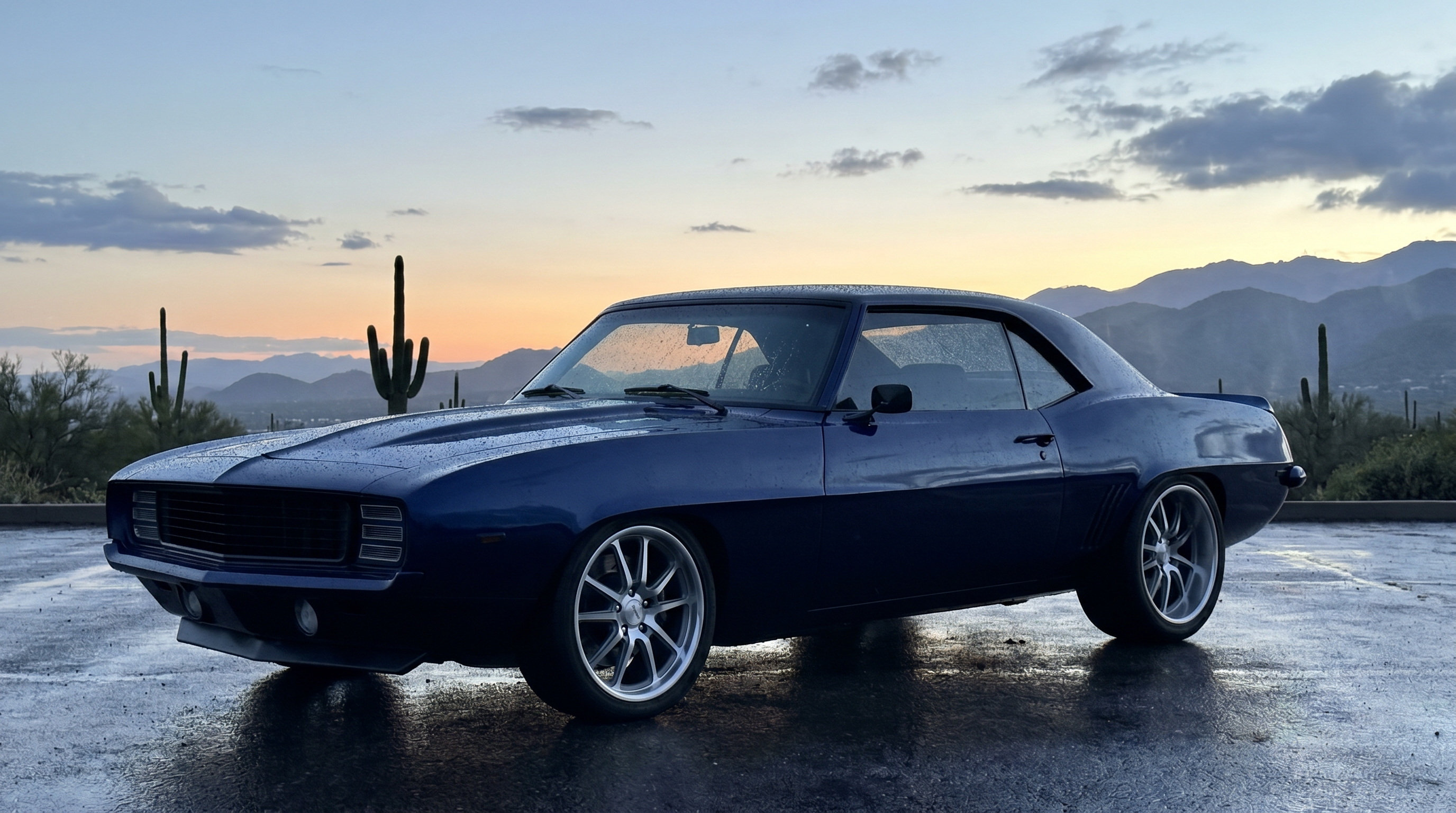
The proportions are right. It is small enough to look athletic, with a long hood and short deck that still reads as aggressive sixty years later. The aftermarket is bottomless, deeper than for almost any classic, so anything you can dream up for the car already exists or can be made. And it landed at the center of the pro-touring movement, the wave of builders who took these old shapes and gave them modern suspension, brakes, power, and grip. Once a generation of builders proved the first-gen could be made to drive like a modern performance car, it became the default starting point for anyone building a muscle car to actually use.
In other words, the car that was rushed and compromised by the suits turned out to be the perfect base for builders to perfect. The bones were good. The shape was timeless. It just needed the things the factory could not give it.
Building one today
That is where a modern build comes in. The goal of a first-gen restomod is to keep everything that made the car an icon and quietly fix everything the era forced it to compromise. You keep the shape and you delete the dated details. That means clean, frameless flush-mount glass in place of the chrome trim rings, a cabin built to a standard the factory never offered, and the modern stance and hardware that the pro-touring world made the standard. If you are sorting out exactly where your build should sit on that spectrum, our pro touring versus restomod guide lays out the whole map.
The factory built the first-gen Camaro to catch up. You get to build it the way it always should have been.
Build the icon the way it should have left the line
Flush glass, clean interior, modern finish for the 1967 to 1969 Camaro. Engineered and built in Phoenix.
Shop first-gen Camaro Flush-mount glass Camaro interiorKeep reading: Camaro flush-mount glass, the complete 1967 to 1981 guide · The fastest Camaros GM never meant to build · Pro touring vs restomod. Historical details compiled from multiple published automotive histories of the first-generation Camaro.

Leave a comment
This site is protected by hCaptcha and the hCaptcha Privacy Policy and Terms of Service apply.