
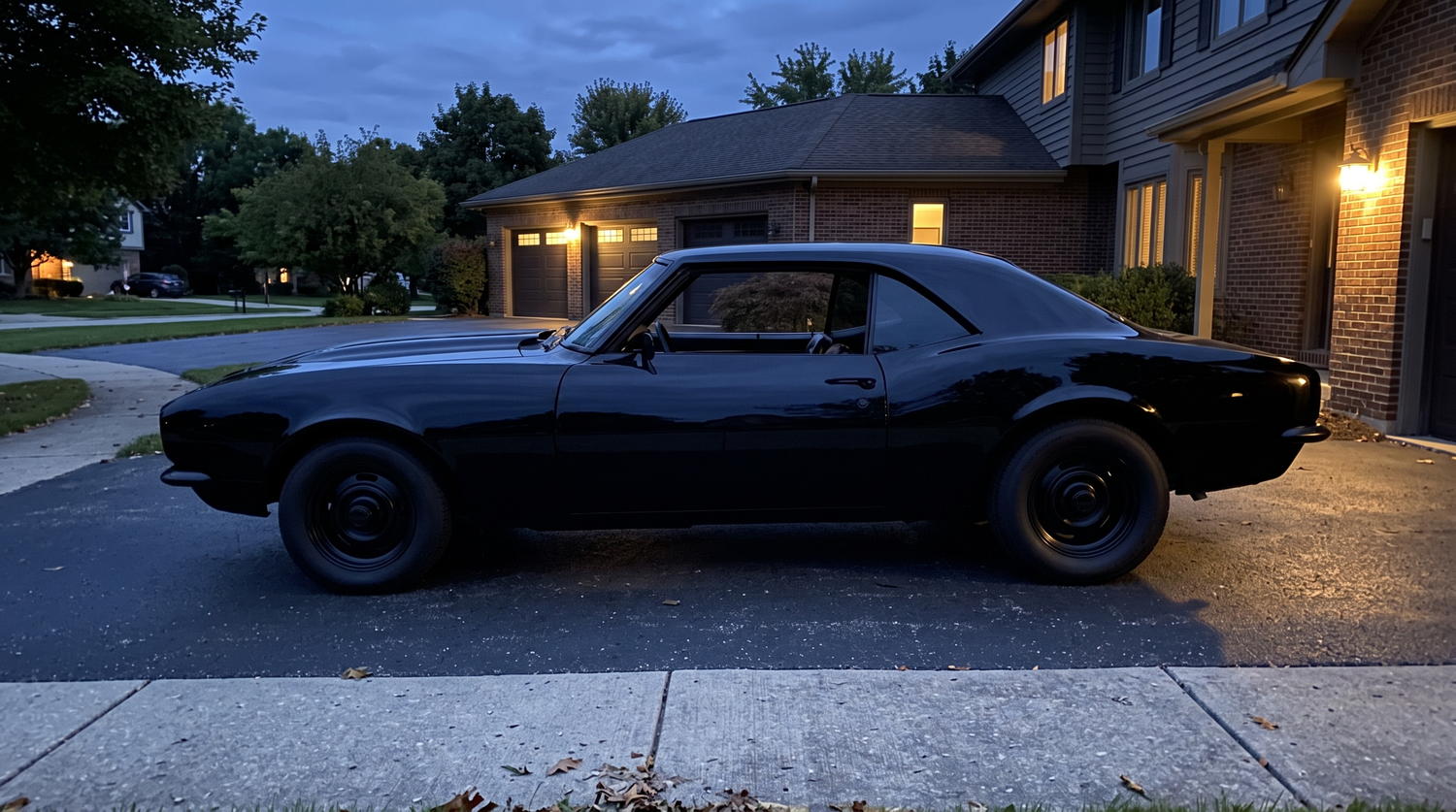
Converting a classic to power windows means replacing the manual regulator in each door with a motorized regulator, running a switched and fused power feed, and mounting a switch somewhere you can reach. On most popular platforms a complete four-window kit runs roughly $580 to $1,300 depending on the car, and a competent installer will have it done in a day or two.
The part nobody tells you up front is that this decision has to be made before you order door panels, not after. Here is the whole picture.
Is a power window conversion worth it on a classic?
For a driver, yes, and the reason has less to do with convenience than with what a manual crank does to the rest of the interior. A crank handle dictates the shape of the door panel around it, forces a hole through whatever material you upholster in, and puts a spinning mechanical object right where your knee lives. Delete it and the panel becomes a clean surface you can actually design.
The second reason is that original manual regulators on a 55 year old car are usually tired. The gears are worn, the glass binds in the channel, and the window goes up crooked. If you are pulling the door apart anyway to fix that, you are already most of the way into the conversion.
Where we would tell you to skip it: a numbers-matching survivor you are keeping original, or a car that genuinely sees a few hundred miles a year on a show field. Originality has value and a power window conversion is not reversible in an afternoon.
What is actually in a power window kit?
A complete kit should include four things. If a listing is missing any of them, you are buying a partial kit and sourcing the rest yourself.
- Regulators. The mechanism that raises the glass. On a four-window car that is two front door regulators and two rear quarter regulators.
- Motors. Ours use new ACI motors, not rebuilt units. This is the part that fails first on cheap kits.
- A switch kit. A 4-way switch runs all four windows from one location.
- A wiring harness. A purpose-built harness is the difference between a two day job and a week of splicing.
Our 1968-69 Camaro and Firebird kit is a good reference for what complete looks like: front and rear regulators, four new ACI motors, a 4-way switch kit, and a custom harness, one box, $1,144, fits hardtop, coupe, and convertible with no separate part numbers to sort out.
Where should the switches go?
Three options, and the right one depends on whether you are running a console.
- Console. Our harnesses route here by default. It is the cleanest look, it keeps the door panel completely uninterrupted, and it works with our consoles and most aftermarket ones.
- Door panel. Split the harness and run it into the driver door. Most familiar to modern drivers, puts the switch under your hand.
- Dash. For builds with no console. Works fine, just plan the location before the dash is finished.
Decide this early. Moving a switch after the interior is trimmed means cutting into finished material.
The mistake: ordering door panels before you decide
This is the one that costs people money. Fesler fiberglass door panels are designed for power windows. Manual window mechanisms are not accommodated without modification. If you are running our panels, plan on running power windows.
It is not an upsell, it is geometry. A panel molded to sit flat and tight against the door, with a structural armrest and a real speaker baffle, does not have a place for a crank shaft and escutcheon to pass through. Building it both ways would compromise both.
So the order of operations is: decide on power windows, then order panels and the kit together. If you already have panels on the shelf and manual cranks in the doors, call us before you cut anything.
What does a power window conversion cost?
Kit pricing across our lineup gives you a real range:
- 1973-91 Squarebody Truck, from $581
- 1967-72 C-10 Truck, from $598
- 1967 Camaro, from $1,130
- 1970-72 Chevelle, from $1,137
- 1968-69 Camaro and Firebird, $1,144
- 1968 Chevelle, from $1,185
- 1969 Chevelle, from $1,218
- 1963-67 Nova, from $1,232
- 1968-70 Dodge Charger, from $1,290
Trucks are cheaper because there are two windows instead of four. Add labor if you are not doing it yourself. This is an intermediate to advanced job, and most shops will quote a day or two depending on how cooperative the doors are.
What goes wrong on a power window install?
Four things, in the order we hear about them.
- Undersized wiring or no fuse. Window motors pull real current, especially at stall when the glass reaches the top. Run the gauge the harness calls for and fuse it properly.
- Binding glass. A motor will happily destroy itself pushing glass through a dry, misaligned channel. Clean and lubricate the run channels and check that the glass moves freely by hand before you power it up.
- Skipping the ground. A large share of the motor is bad calls we take turn out to be a bad ground. Grind to bare metal.
- Trimming panels before testing. Get all four windows cycling all the way up and down, repeatedly, before anything gets upholstered or screwed down permanently.
Does this work with flush-mount glass and a vent window delete?
Yes, and the three upgrades together are what actually transforms the door. Flush-mount glass removes the trim, a vent window delete turns two panes into one, and power windows remove the crank. The result is a door with one uninterrupted piece of glass, a clean panel, and nothing mechanical to look at.
If you are on a 1967-72 Chevy truck, our C10 vent window delete guide covers how the one-piece door glass works. And if you have not decided on panels yet, why fiberglass door panels are worth it is the companion piece to this one.
Quick answers
Do I need to modify the door to fit a power regulator? On our kits the regulators are designed to use the existing mounting locations. Some cars need minor clearancing, which your installer will handle.
Are the motors new or rebuilt? New ACI motors, four of them, in every kit that covers four windows.
Will one kit cover a convertible? On the 1968-69 Camaro and Firebird kit, yes. One kit fits hardtop, coupe, and convertible.
Can I keep the factory crank as a backup? No. The regulator is replaced, not supplemented.
What happens if the battery dies with the windows down? Same as any modern car. The windows stay down. Plan a jump point if the car is stored with a disconnect.
Can I install it myself? Intermediate to advanced. If you are comfortable inside a door and with basic automotive wiring, yes. If wiring is not your thing, have a shop do the harness and switch.
Shop power window kits, pair them with Fesler door panels, or contact us to plan the interior as one system.

Leave a comment
This site is protected by hCaptcha and the hCaptcha Privacy Policy and Terms of Service apply.