

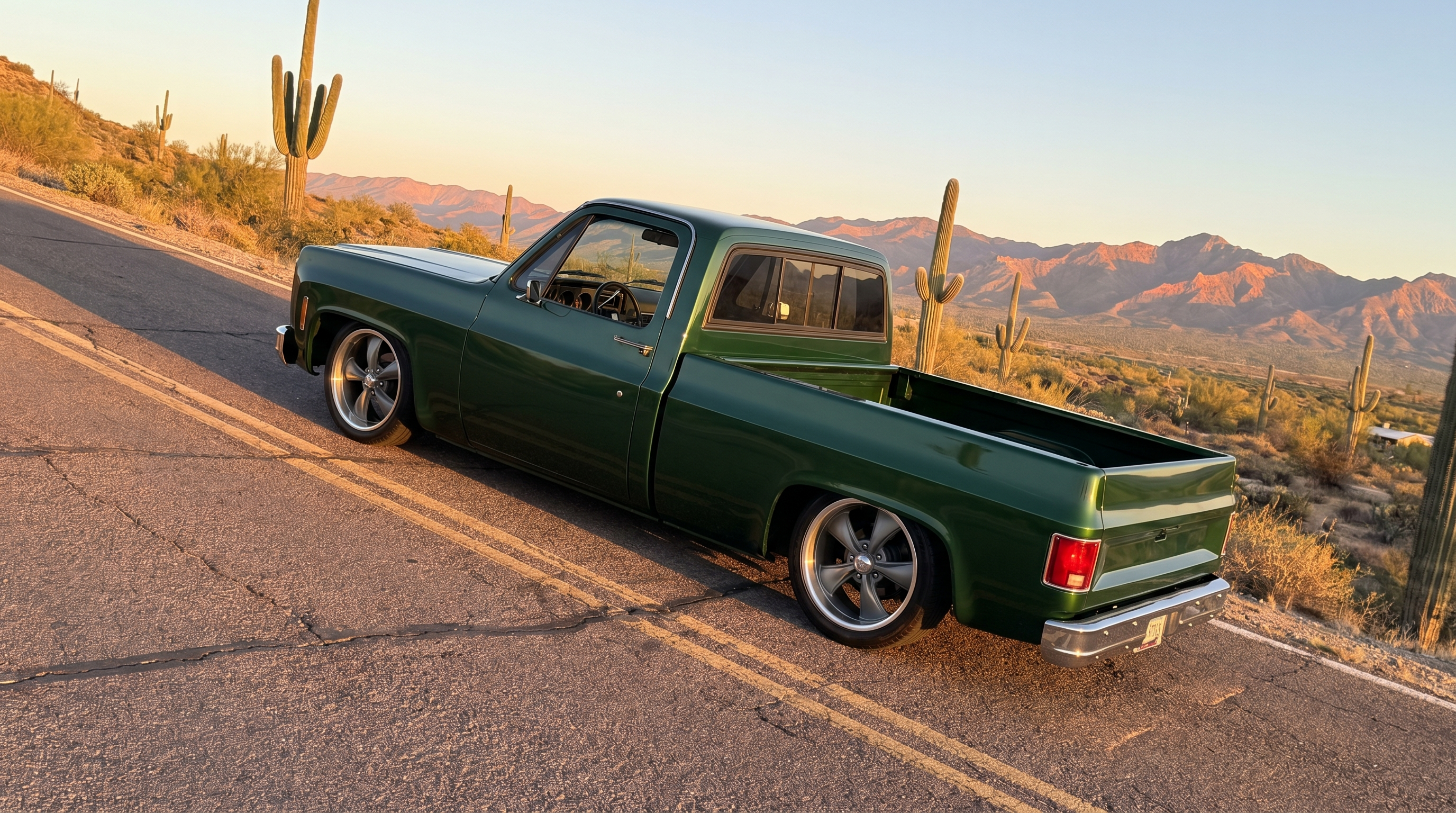
Walk any truck show and watch where eyes land on a clean 1967 to 1972 C10. The stance gets the first look. The paint gets the second. Then people step up to the cab and notice the side glass, because on a stock truck there is a lot going on in that opening. A vent window. A chrome division post. A main pane behind it. Three separate pieces of hardware interrupting what could be one clean line of glass.
That is why the vent window delete has become one of the most requested modifications in the C10 world. It is also one of the most botched. For every truck running one-piece door glass that seals and rolls like it should, there are five running flat glass that whistles at 70, leaks in a car wash, or needs a palm pressed against it to close the last inch.
We have spent a long time engineering a kit that fixes all of that, and as of this week the first complete kits are assembled and production parts are being built. So this is a good moment to walk through the whole subject properly. What a vent window delete actually is. Why the factory built the door the way it did. Why most conversions fail. And what separates a kit you will love from a kit you will fight every time it rains.
The quick answer
A vent window delete removes the factory vent wing assembly and division post from the door of a 1967 to 1972 Chevy or GMC truck and replaces the two-piece side glass with a single full-width pane. Done right, the conversion gives you one uninterrupted sheet of glass from the A pillar to the back of the door, sealed against water and wind, riding on a regulator so it still rolls up and down like a window should. Done wrong, it gives you a fixed or hand-guided slab of flat glass that leaks, rattles, and never quite closes square.
The difference between those two outcomes is not installation skill. It is engineering. Keep that in mind as we go.
Why GM put a vent window there in the first place
The vent window was never a styling decision. It was climate control.
When the Action Line trucks launched in 1967, factory air conditioning was a rare and expensive option, especially on trucks that were bought to work. The vent wing was the ventilation system. Crack it open at speed and it scoops outside air into the cab. Pivot it further and it aims that air right at your chest. On a 110 degree Phoenix afternoon in 1968, that little triangle of glass was the difference between driving and suffering. It also gave smokers somewhere to flick ash and gave the cab a way to breathe at a stoplight without rolling the whole window down.
The vent assembly solved a manufacturing problem too. A shorter main glass is easier to seal, easier to crank, and easier to keep tracking straight over years of use. The division post between the vent and the main glass gives the front edge of the roll-down window a channel to ride in. Every piece had a job in 1967.
Then air conditioning take rates climbed through the early seventies and the math flipped. GM itself reached the conclusion every builder reaches today. When the all-new 1973 trucks arrived, the vent windows were gone and the doors carried one-piece glass straight from the factory. We dug into that whole redesign in our Squarebody history deep dive, and the takeaway for 67 to 72 owners is simple. The company that built your truck looked at vent windows and decided one-piece was the better door. You are not fighting the original design. You are finishing the thought.
Why builders delete vent windows
Four reasons come up over and over in our shop and at every show we attend.
The look. One uninterrupted pane of glass changes the entire character of the cab. The chrome post and the triangle of the vent wing read as 1967. A single clean sheet reads as right now. It is the same visual language as the rest of the flush glass conversation: fewer interruptions, fewer seams, cleaner surfaces. If flush-mount front and rear glass is what modernizes your truck from the front and back, one-piece side glass is what finishes the profile.
The seal. Fifty-year-old vent window assemblies leak. The pivots wear loose, the rubber shrinks and cracks, and the division post channel traps water against bare metal where it quietly eats your door from the inside. Wind noise at highway speed on a stock truck almost always traces back to the vent wing area first. Deleting the assembly removes the leak path entirely instead of chasing it with new weatherstrip every few years.
The redundancy. If your build runs Vintage Air or any modern climate system, the vent window's actual job no longer exists. You are carrying the weight, the seals, and the failure points of a ventilation system you never use.
The door internals. Pulling the vent assembly and division post removes a surprising amount of hardware from inside the door. That opens up real estate for speakers, wiring, and proper sound deadening, which matters a lot on a truck you actually plan to drive.
Why most one-piece conversions fail
Here is the part nobody selling a cheap kit wants to talk about. The concept is simple. The execution is not, and the failures cluster around four predictable problems.
Flat glass in a curved opening. The cheapest route to one-piece side glass is a flat sheet of polished glass cut to the shape of the opening. The problem is that the 67 to 72 cab was not designed around a flat pane. A flat sheet can never follow the contour of the cab, so it either stands proud at the belt line or leans away from the seal at the top of the frame. Either way you get a gap. Gaps whistle at speed and let water in when it rains. There is no weatherstrip thick enough to fix geometry.
No regulator engineering. A full-width pane is bigger and heavier than the factory main glass, and the stock regulator was never designed to lift it, balance it, or keep it from cocking sideways in the channels. A lot of kits dodge the problem entirely. The glass is fixed in place and never opens. Or it slides loose in felt channels and you position it by hand. If you have ever watched someone at a show press a flat palm against their window to walk it closed the last two inches, that is exactly what is happening. The kit shipped without an answer to the hardest question, and the owner became the regulator.
Uncertified glass. Some conversions use glass with no AS marking and no DOT manufacturer number etched anywhere on it. That is a real problem. Side glass in a road vehicle should be certified tempered safety glass, the kind that breaks into dull granules instead of blades. Uncertified flat stock gives you no idea what you are sitting next to at 70 miles per hour, and it can turn a state inspection or an insurance claim into a fight. We broke down the whole certification system in what DOT certified glass actually means if you want the full picture.
The water path nobody planned. A factory door manages water on purpose. Glass sheds it, channels direct it, drains release it out the bottom of the door. Deleting the division post removes part of that management system, and a proper kit has to rebuild it with new channels and seals designed around the new glass. A bad kit just lets water track straight down inside the door and out onto your carpet. If your floor is already wet and you are not sure why, read our windshield leak vs cowl leak guide before you blame the doors, because water travels and the entry point is rarely where the puddle is.
What a proper conversion actually involves
A one-piece conversion done right replaces a system with a system, not a pane with a pane. Here is what has to happen inside that door.
The vent wing assembly comes out, frame and all. The division post comes out with it. What goes back in is a single full-width piece of certified tempered glass shaped for the opening, new run channels at the front and rear edges so the glass tracks straight through its full travel, sealing at the belt line so water stays outside the door skin, and a lift mechanism actually matched to the size and weight of the new glass.
That last point is the one that separates real kits from glass cut to shape. The window has to go up and down under its own power, square in the channels, and land sealed at the top every single time. Not most of the time. Every time, for years, in summer heat and winter cold, on a door that gets slammed.
When every piece is engineered together instead of improvised one part at a time, the result behaves like the truck came from the factory this way. Up with a switch. Down with a switch. Sealed at speed. Quiet in the rain. That was the bar we set for our own kit, and it is why ours took as long as it did.
Factory setup vs typical kits vs the Fesler kit
| Factory 1967 to 1972 | Typical one-piece kit | Fesler one-piece kit | |
|---|---|---|---|
| Glass in the door | Vent wing plus main pane | One pane | One pane, true full width |
| Operation | Hand crank | Often fixed or guided by hand | Rolls up and down with a switch |
| Glass certification | OEM tempered safety glass | Varies, often unmarked flat stock | DOT-approved tempered glass |
| Sealing | Factory channels, 50-year-old rubber | Improvised around flat glass | Engineered for the opening, no water leaks |
| Vent window | Yes | Deleted | Deleted |
| Where it is built | Detroit, decades ago | Varies | American made |
What we built and why it took this long
The one-piece door glass kit for 1967 to 1972 trucks is the most requested product in Fesler history. People have been asking for it at every show, in every comment section, and on the phone for years. We could have shipped flat glass in a box a long time ago. We did not, because we have watched too many of those kits fail on customer trucks, and we were not going to put our name on a window someone has to close with their hand.
So the bar was set early and it never moved. True one-piece side glass. DOT-approved. American made. Sealed so water stays out. And it had to roll up and down with just a switch, like a window in a modern truck, because that is the whole point of modernizing the cab. We announced the program earlier this year, and as of this week the first complete kits are assembled and we are building production parts. The development truck is wearing the glass right now, rolling it up and down on the switch, and it does exactly what five decades of C10 owners have wanted it to do.
It comes from the same DOT-certified American glass program behind our flush-mount kits, the program we built with Pilkington, the people who have been making automotive glass for over a century. That partnership is the reason we can put real certified glass in this kit instead of cut flat stock, and it is the reason the word approved actually means something here.
Is one-piece door glass street legal?
Yes, as long as the glass itself is certified, and this is exactly where cheap conversions get people in trouble.
Federal Motor Vehicle Safety Standard 205 governs glazing in road vehicles. For side windows, that means tempered safety glass carrying an AS-2 marking and a DOT manufacturer number etched into the pane. Tempered glass is the safety piece. When it breaks, it crumbles into small dull granules instead of long blades. The etched markings are the proof. Look at the corner of any modern vehicle's door glass and you will find them.
Unmarked flat glass cut to shape gives you none of that. No certification, no known impact behavior, and a potential problem at inspection time depending on your state. If you are going to open up your doors and re-engineer the glass, do it once with certified material. Our full breakdown of what DOT certification actually means for classic car glass covers the marking system, the testing behind it, and why we refuse to sell anything without it.
What changes inside your door
Plan a vent window delete as a door project, not a glass swap, because the inside of that door is going to be open and mostly empty for the first time in fifty years.
The vent assembly and division post come out, which clears a surprising amount of metal from the front third of the door. New channels and the new lift hardware go in. While everything is apart, you have the easiest access you will ever have for the rest of the door's to-do list. Run your speaker wiring. Lay sound deadening on the inner and outer skins, which transforms how solid the door sounds when it closes. And if your door panels are tired, cracked, or just original, this is the natural moment to step up to our hand-laid fiberglass 1967 to 1972 C10 door panels, which are built in our Phoenix shop to finish the inside of the door as cleanly as the new glass finishes the outside.
Doing it all in one teardown saves you from opening the door twice, and the finished result is a door that looks, sounds, and operates like it belongs on a modern truck.
The full glass picture
One-piece side glass finishes what flush-mount glass starts.
Our 1967 to 1972 C10 flush-mount kit brings the windshield and rear window out to the body line, deletes the trim, and gives the truck the smooth glass surfaces you see on a new vehicle. We walked through that whole transformation in our C10 flush-mount guide. But on a truck with flush front and rear glass, the stock side glass becomes the last old thing your eye can find. The vent wing and chrome post stand out more, not less, once everything around them goes smooth.
Put the two together and the cab reads as one continuous design from any angle. Flush windshield, flush rear glass, one clean pane in each door. On a shaved truck with the right stance, that combination is what makes people walk across a parking lot, and it is why we built the side glass program to the same standard as the flush kits instead of treating it as an accessory.
A note for the numbers-matching crowd
If your truck is a low-mile survivor or a factory-correct restoration, this conversion is not for that truck, and we will be the first to say so. Original vent window assemblies in good shape are getting harder to find, so if you pull yours, box them, label them, and store them dry. Future you, or the next owner, may thank you. Most of the trucks we serve are builds meant to be driven, and for those trucks this is one of the highest-impact changes you can make. Know which truck you have and build accordingly.
Questions builders keep asking
Do one-piece door windows leak?
Bad ones do, constantly, and they are the reason this conversion has a mixed reputation. Flat glass that cannot follow the cab contour will always have a gap somewhere, and water finds gaps. A kit engineered around the actual opening, with proper channels and belt line sealing, does not leak. Keeping water out was a non-negotiable requirement for our kit from day one, and it is one of the first things we verified on the development truck.
Can you still roll the window down?
With our kit, yes. The glass rolls up and down with a switch, full travel, just like a modern truck. This is the single biggest difference between our kit and most of what is out there, where the glass is either fixed in place or has to be guided up and down by hand.
Is a vent window delete street legal?
Yes, provided the replacement glass is certified tempered safety glass with the proper AS-2 and DOT markings. The legality question is really a glass certification question, which is why we only build with DOT-approved glass.
Will it fit GMC trucks too?
1967 to 1972 Chevy and GMC trucks share the same cab and door structure, so the conversion applies across the family. Check the pre-order page for the current confirmed fitment list as production specs are finalized.
What about 1964 to 1966 trucks, or Squarebodies?
This kit is engineered for the 1967 to 1972 Action Line cab. The 1973 to 1987 trucks already came from the factory with one-piece door glass and no vent windows, which is part of why we point to them as proof of concept. If you have an earlier or later truck and want to be told the moment fitment expands, get on the list and tell us what you drive.
Do I need to already have power windows?
No. The conversion is switch-operated by design, so plan on power operation as part of the project rather than reusing your hand cranks. Full component details and requirements are on the pre-order page and will be in the product listing at launch.
What should I do with my original vent window parts?
Keep them. Complete, working vent assemblies are good cores and getting scarcer every year. Bag the hardware, label the boxes left and right, and store them dry. They cost you nothing to keep and they preserve the option of going back to stock.
When can I actually get one?
The first complete kits are assembled and production parts are being built right now. Pricing and first allocation details go to the pre-order list before anywhere else, so if you want glass from the first run, get your name on the list now.
Get on the list
The one-piece side glass program is the most requested thing we have ever built, and the first run will go to the people who raised their hands early. Join the pre-order list here and you will get pricing, fitment confirmation, and first dibs before anything goes public. While you wait, browse the rest of our 1967 to 1972 Chevy truck catalog or call the shop at 480-748-2000 and talk it through with us. We are in Phoenix, we drive these trucks, and we are happy to tell you exactly where this kit fits in your build order.


Leave a comment
This site is protected by hCaptcha and the hCaptcha Privacy Policy and Terms of Service apply.