
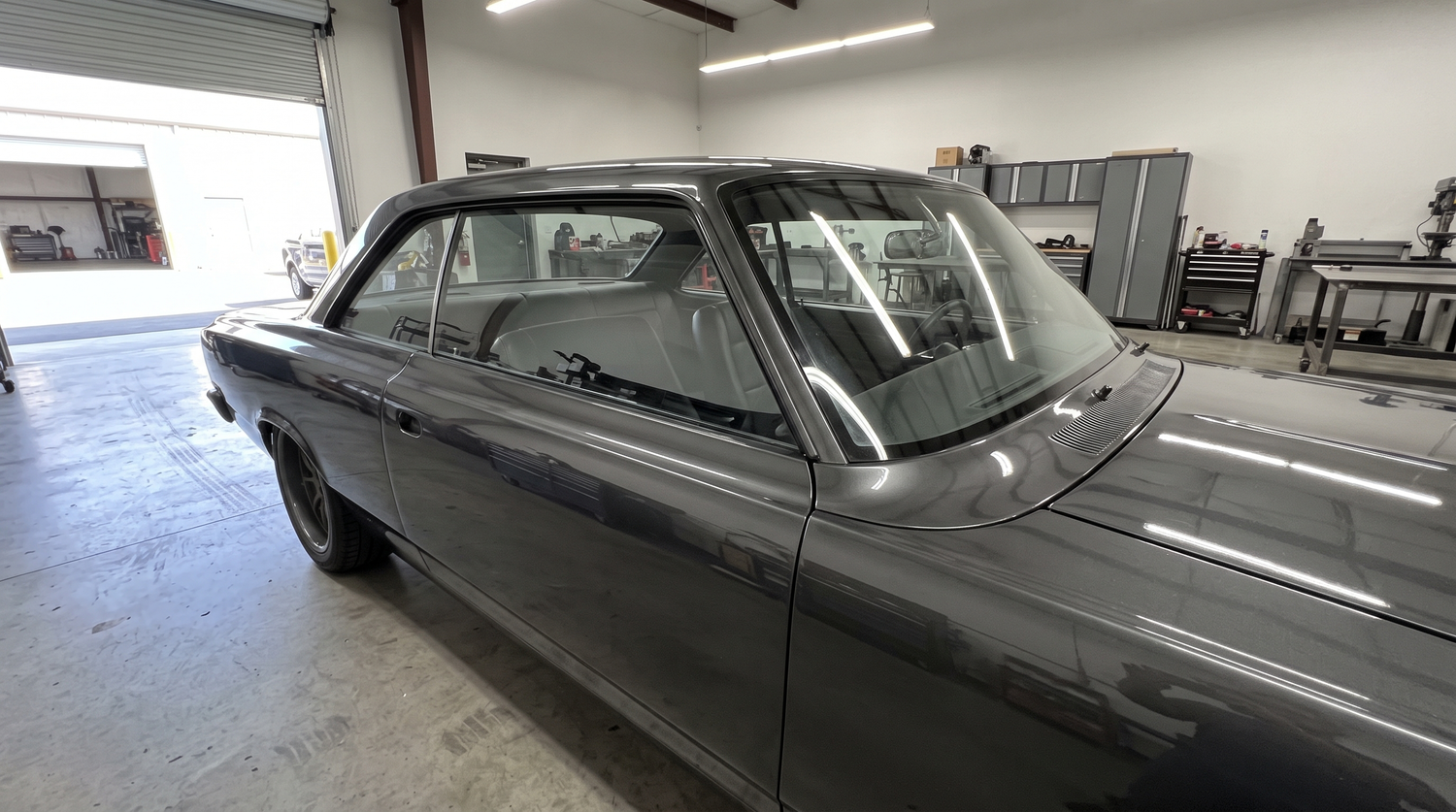
Door panels are the one interior piece you put your hand on every single time you drive the car, and they are the piece most builders try to save money on. Hand-laid fiberglass panels cost more than molded ABS or hardboard-backed reproductions, and the reason comes down to five things: they cut road noise, they stay flat in heat, they give a speaker something solid to mount to, they hold an armrest you can actually lean on, and the door closes with a thud instead of a rattle.
We build door panels in Phoenix, so we see what comes off cars before ours go on. Here is the honest version of why the material matters.
What is the difference between fiberglass and ABS door panels?
Fiberglass door panels are hand-laid in a mold, layer by layer, and cure into a rigid structural shell. ABS panels are a thermoplastic sheet heated and vacuum-formed over a buck, which makes them fast and cheap to produce but leaves them thin and flexible. Hardboard reproduction panels are pressed paper fiber with a vinyl skin, which is what most factory-correct replacements still are.
The practical difference shows up in three places: stiffness, heat tolerance, and what you can attach to the panel. Fiberglass wins all three. ABS is lighter and cheaper. Hardboard is the cheapest and the least durable of the three.
We went deeper on the material science in hand-laid fiberglass vs ABS interior panels if you want the full comparison.
Do fiberglass door panels actually reduce road noise?
Yes, and it is mostly a function of mass and stiffness rather than any special material property. A door is a big hollow steel box with a hole in the middle of it. Whatever covers that hole is the last barrier between you and tire roar, wind, and exhaust. A thin vacuum-formed panel is close to acoustically transparent. It flexes with the pressure wave and passes the noise straight through.
A hand-laid fiberglass panel is several times heavier and dramatically stiffer, so it reflects and absorbs far more of what hits it. It is not a substitute for proper sound deadening inside the door skin, and we would never sell it as one. It is the second half of the job. Deadener on the inner and outer skins handles resonance in the metal, and the panel handles what comes through the opening.
If you are planning this the right way, deadening goes in first. Our sound deadening guide covers the sequence and where the material actually needs to go.
Why do cheap door panels warp?
Cheap panels warp because of water and heat, and classic doors deliver both. Every classic door leaks a little. Water runs down the inside of the glass, past the window felts, and drains out the bottom of the door. Hardboard panels sit right in that path. They wick moisture up from the bottom edge, swell, and start to bow away from the door within a couple of seasons. You have seen it: the bottom corners curling off the door, the vinyl wrinkling.
ABS handles water fine and fails a different way. It is a thermoplastic, so it softens with heat and takes a set. Park a black car in an Arizona parking lot in July and the interior surface temperature climbs well past anything the panel was formed at. Over enough cycles the panel relaxes into a new shape, usually a gentle bow in the middle and pull-away at the mounting points.
Cured fiberglass does neither. It is a thermoset, so it does not re-soften with heat, and it does not absorb water. That is the single biggest reason we build them this way for cars that live in the Southwest.
What makes a door panel better for speakers?
A speaker is only as good as what it is bolted to. When a woofer cone moves forward, the basket pushes backward with equal force. If the mounting surface flexes, that energy goes into moving the panel instead of moving air, and you lose output and gain distortion. It is the same reason a home speaker cabinet is heavy and braced instead of made of cardboard.
Mount a 6.5 inch driver to a thin vacuum-formed panel and the whole panel becomes a passive radiator working out of phase with the speaker. You get the buzzing, boomy, indistinct midbass that everyone blames on the head unit. Mount the same driver to rigid fiberglass and the energy goes where it is supposed to go.
Our door panels are molded with 6.5 inch speaker fitment built into the panel, not cut in afterward, so the mounting area is reinforced and the opening is where it should be. Pair them with fiberglass kick panels and you have four solid mounting locations without cutting a single hole in original sheet metal.
Does the armrest actually matter?
More than almost anything else on the panel, because it is the part your body is in contact with for the entire drive. A factory armrest on most of these cars was a small pad on a bracket, sized for 1968 expectations and 1968 seating position. Reproduction panels copy that, including the flex.
An armrest molded into a rigid fiberglass panel is structural. It does not creak when you put weight on it, it does not deflect when you pull the door shut, and it does not slowly separate from the panel over a few thousand miles. On a long drive that is the difference between a car you take to dinner and a car you take to Colorado.
Why does a solid door close matter?
The sound a door makes when it shuts is the fastest read anyone gets on how a car was built. A hollow, tinny clang says thin panel and empty door. A low, flat thud says mass, deadening, and tight fitment.
It is not just impressions. That same combination of mass and rigidity is what keeps the panel from buzzing at 2,000 rpm, keeps the door card from drumming on a washboard road, and keeps the window mechanism noise inside the door where it belongs. Builders notice the close first. Then they notice they can hold a conversation at 70.
Five reasons builders move to fiberglass door panels
- Noise. Mass and stiffness block far more road and wind noise than a thin formed panel.
- Stability. Thermoset fiberglass does not swell with moisture or take a set in summer heat.
- Speakers. A rigid baffle means real midbass instead of panel buzz.
- Armrest. Structural, not decorative, which matters on every drive over an hour.
- Feel. Tight, quiet, solid, the way a finished car should read.
What do fiberglass door panels cost?
Fesler door panels run from $699 for truck applications up to $1,499 for a full four-panel car set covering fronts and rears. Reproduction hardboard panels can be found for a few hundred dollars a pair, and molded ABS lands in between.
The honest framing: if the car is a driver you plan to keep and you are already investing in glass, seats, and audio, the panel is not the place to save. If you are building a budget car that needs to look correct for a show field and will see 500 miles a year, a reproduction panel is a legitimate choice and we will tell you so.
They ship in raw gel coat, ready for your upholstery shop. That is intentional. You pick the material, the stitch pattern, and the color instead of living with somebody else's idea of your interior. Our leather guide is a good starting point for that conversation with your trimmer.
Which Fesler door panels fit your build?
We build hand-laid fiberglass panels for most of the popular platforms:
- 1968-69 1st Gen Camaro Door Panels, set of four, $1,499
- 1970-81 2nd Gen Camaro Door Panels, set of four, $1,499
- 1968-72 Chevelle Door Panels, set of four, $1,499
- 1966-67 Nova Door Panels, set of four, $1,499
- 1968-70 Dodge Charger Door Panels, set of four, $1,499
- 1967-72 C-10 Truck Door Panels, pair, $699
- 1955-59 Chevy Truck Door Panels, pair, $699
- 1973-86 Squarebody Truck Door Panels, pair, from $775
- 1988-98 OBS Truck and Tahoe Door Panels, pair, $775
- 1988-2000 OBS Crew Cab and Suburban Door Panels, set of four, $1,499
Quick answers
Do fiberglass door panels come upholstered? No. They ship in raw gel coat so your upholstery shop can finish them in the material and pattern you choose.
Are the speaker holes pre-cut? The 6.5 inch speaker fitment is molded into the panel. You are not cutting a hole in a flat surface and hoping.
Do they use the factory mounting points? Yes. They are designed to hang on the original door structure without modifying the door.
Do they work with manual crank windows? This is the one you need to read carefully. Fesler panels are designed for power windows. Manual window mechanisms are not accommodated without modification. If you are running Fesler panels, plan on running power windows too. Our power window kits are built to pair with them.
Do I still need sound deadening? Yes. The panel and the deadener do different jobs. Deadener treats the steel, the panel treats the opening. Do both and the car gets meaningfully quieter.
How long do they take to ship? Most interior parts are stocked in Phoenix and standard orders ship in 1 to 3 business days. Custom work or backorders extend that and we will reach out if there is a delay.
Shop Fesler fiberglass door panels or browse the full interior lineup.

Leave a comment
This site is protected by hCaptcha and the hCaptcha Privacy Policy and Terms of Service apply.