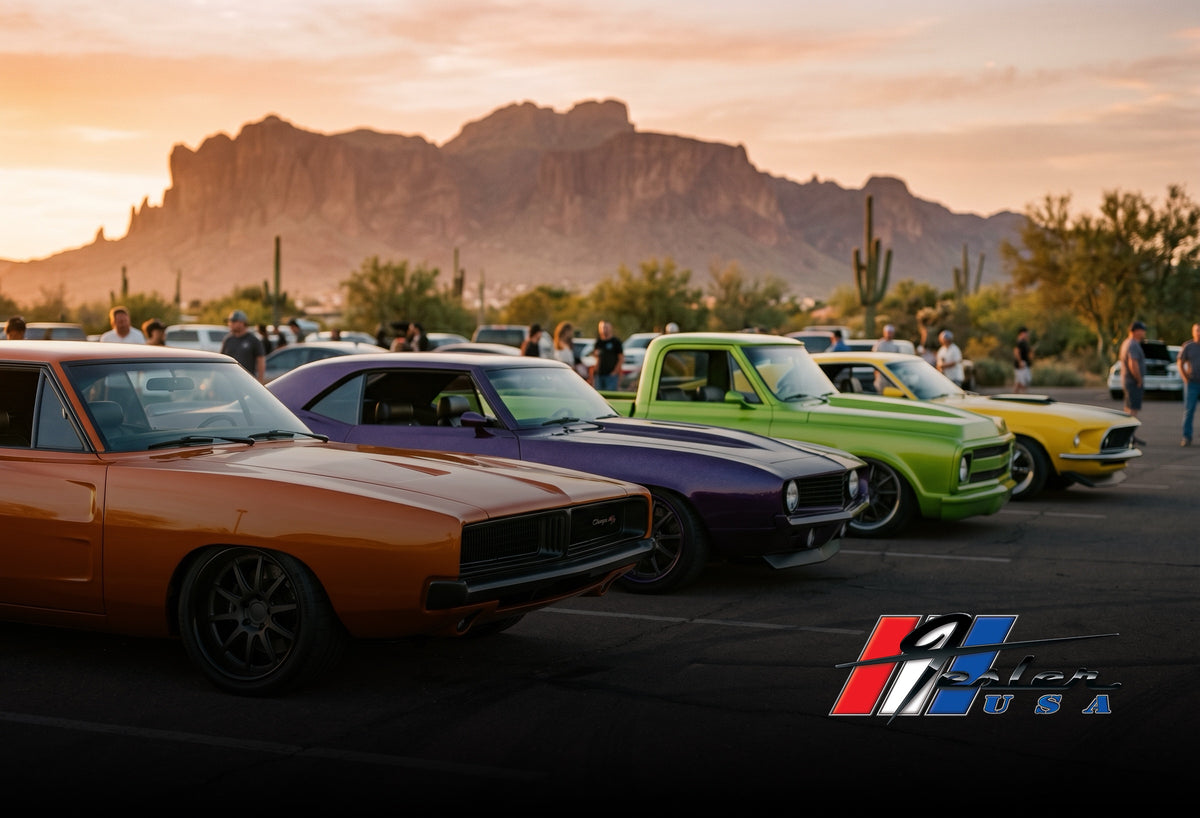
The story everyone tells goes like this: in the spring of 1969 Chrysler dropped Plum Crazy, Sublime, and Go Mango on a sleepy paint chart, Ford and GM scrambled to catch up, and the whole thing was a marketing stunt that hardly anyone actually ordered. We told a version of that story ourselves. Two of the three parts are wrong.
Chrysler did not go first. Chevrolet and Pontiac already had Hugger Orange, Daytona Yellow, and Carousel Red on 1969 order sheets the previous fall, and AMC was selling Big Bad Orange before Chrysler's High Impact colors reached showrooms. And the colors were not a flop. GM's own production data shows that about one in seven 1969 Camaros left the factory in Hugger Orange or Daytona Yellow, and the best-documented estimate for Plum Crazy puts it at roughly 13 percent of 1970 Challenger production. The colors were a minority choice, but not a small one. Here is what the record supports.
Who put loud paint on a muscle car first?
On timing, GM was on the street first. The 1969 Camaro, launched in fall 1968, listed code 72 Hugger Orange and code 76 Daytona Yellow as new colors, and Pontiac launched the 1969 GTO Judge in Carousel Red. Ford's 1969 Shelby Mustangs could be ordered in Grabber Blue, Orange, Green, and Yellow, though Grabber paint did not reach regular production Mustangs until 1970. AMC's Big Bad Orange, Green, and Blue arrived in the 1969 model year as a 34 dollar option on the AMX and Javelin.
Chrysler's High Impact program came in the spring of 1969, later than all of them. What Chrysler did that nobody else did was make it a brand. Ten colors over three years, a matching name on each side of the showroom, and marketing built around the names. That is why "High Impact" became the generic term for the whole era.
So the fair statement is this: GM and AMC went first, Ford went biggest on Mustang, and Chrysler went loudest and named the game.
What were the Chrysler High Impact colors, and when?
Ten colors, each sold under a Dodge name and a Plymouth name. The paint was the same. The names were the marketing.
- EF6 Bright Green (Dodge) / Rallye Green (Plymouth), spring 1969 only
- EK2 Go Mango / Vitamin C, 1969 to 1970
- EL5 Butterscotch / Bahama Yellow, 1969 to 1971
- EV2 Hemi Orange / Tor Red, 1969 to 1972
- FC7 Plum Crazy / In-Violet, 1970 to 1971
- FJ5 Sublime / Limelight, 1970
- FJ6 Green Go / Sassy Grass Green, 1970 to 1971
- FM3 Panther Pink / Moulin Rouge, 1970
- FY1 Top Banana / Lemon Twist, 1970 to 1973
- GY3 Citron Yella / Curious Yellow, 1971
One detail we got backwards in the email: Sassy Grass was the Plymouth name for FJ6. Dodge called it Green Go. And Panther Pink was a 1970 story. FM3 was released on January 28, 1970, and the last regular production cars were built that July, with a few special orders after. The extra cost was about 15 dollars, which matches the number everybody quotes.
What did Ford and GM actually offer?
Ford. Grabber colors ran 1969 to 1971. Blue, Orange, Green, and Yellow on the 1969 Shelby, then Blue, Orange, and Green on 1970 Mach 1 and Boss Mustangs, then Grabber Lime and Grabber Yellow joining Blue and Green for 1971. Ford also hung the Grabber name on a Maverick trim package for 1970.
GM. GM never branded its bright colors as a set, which is why the Chrysler names get the credit. But the list is long. Chevrolet had Hugger Orange and Daytona Yellow in 1969 and 1970, plus LeMans Blue and Rallye Green. Pontiac had Carousel Red in 1969 and 1970 and Orbit Orange on the 1970 Judge. Oldsmobile put Sebring Yellow on the 1970 Rallye 350. Buick did Saturn Yellow and a one-year Apollo White on the 1970 GSX. Hugger Orange gets its own article, so we will leave it there.
Did anybody actually buy these colors?
The "nobody bought them" line gets repeated at every show. The numbers say otherwise, with caveats.
GM data, 1969 Camaro. The Camaro Research Group obtained unpublished GM production percentages by color for the 1969 model year (through September 1969, so the extended run is not included). LeMans Blue was the top color at 12.4 percent. Hugger Orange was 8.5 percent. Daytona Yellow was 6.7 percent. Together the two loud colors took 15.2 percent of production, more than Dover White at 7.9 percent.
Chrysler, 1970. Chrysler's color breakdowns are less official. Nobody has found factory sales records by paint code, and the numbers in circulation come from registries and enthusiast research. The most-cited figures put Plum Crazy at roughly 13 percent of 1970 Challengers, around 10,000 cars, and Lemon Twist above 9 percent of 1970 Barracudas. Panther Pink and Moulin Rouge together came in under half a percent, which is why an FM3 car draws a crowd. Treat the Chrysler percentages as good estimates, not gospel.
AMC. Fewer than 10 percent of 1969 AMX buyers checked the Big Bad box, according to Muscle Car Facts.
Put together: the bright colors were never the majority. But somewhere between 10 and 15 percent of the youth-market cars in 1969 and 1970 went out in a high-impact shade,. That is not a stunt. That is a real product line.
Why did the colors disappear after 1971?
Most of the High Impact chart was gone by the end of 1971. Top Banana hung on through 1973 and Hemi Orange through 1972. Ford's Grabber colors ended with 1971. GM's brights thinned out the same way.
The usual explanation blames the oil embargo and emissions rules, and those did kill the muscle car. But the timing is off. The embargo was October 1973, two years after most of these colors were dropped. What actually hit in 1970 and 1971 was insurance. Surcharges on high-performance cars for young drivers made the Hemi and the 455 hard to justify, buyers moved to smaller engines and quieter cars, and the paint chart followed the customer.
Go look at your own car
If you are not sure whether your car's color is original, the answer is on the body, not in a forum.
- Find the paint code. Mopar fender tag, GM cowl or trim tag, Ford door data plate, AMC door tag. The code tells you what the factory sprayed. A 1970 Challenger with FC7 on the tag was born purple. One without it was painted later.
- Check the primer. Chrysler sprayed its High Impact colors over a white primer so the color would pop. Find an unrestored edge, a door jamb, or under the trunk weatherstrip and look at what is under the top coat.
- Look at the trim. This is the one people skip. A factory bright color had to fight a full set of stainless windshield and backlight moldings, drip rails, and wheel-opening trim. Loud colors look better on modern builds largely because builders take that jewelry off.
What loud paint needs from the rest of the build
That last point is where this story meets our shop. A high-impact color puts every edge on the car under a spotlight. Chrome moldings around the glass break the color into panels. Aging gaskets leave a dark line where the paint should carry through. Against Sublime, all of it shows.
Flush-mount glass removes the interruption. The trim comes off, the clip holes get filled during bodywork, and DOT-certified windshield and rear glass bond flush to the body so the color runs from the hood to the roof to the decklid as one surface. We make those kits for the GM and Ford platforms that wore these colors, including the first-gen Camaro, the Firebird and Trans Am, the Chevelle, and the Mustang. If you are still deciding whether to keep the stainless, flush-mount vs trim ring glass walks through the trade-off.
Pick the loud color, then earn it. The glass and the trim decide whether the paint looks finished.
Quick answers
What were the 1969 to 1971 high-impact colors? Chrysler's ten High Impact colors (Plum Crazy, Sublime, Go Mango, Panther Pink, Top Banana, and the rest), Ford's Grabber colors, AMC's Big Bad colors, and GM's unbranded brights like Hugger Orange, Daytona Yellow, and Carousel Red.
Did Chrysler introduce wild colors first? No. Chevrolet's Hugger Orange and Daytona Yellow, Pontiac's Carousel Red, and AMC's Big Bad colors were on 1969 order sheets before Chrysler's High Impact program launched in spring 1969. Chrysler named and marketed the trend better than anyone.
How much did a High Impact color cost? About 15 dollars extra on a Dodge or Plymouth. AMC's Big Bad colors were a 34 dollar option.
Were the wild colors popular? Yes, as a minority. GM data shows Hugger Orange and Daytona Yellow took about 15 percent of 1969 Camaro production combined. Enthusiast estimates put Plum Crazy at roughly 13 percent of 1970 Challengers. Panther Pink was under half a percent.
Why did the colors go away? Insurance surcharges on high-performance cars in 1970 and 1971 pushed buyers toward tamer cars, and the paint charts followed. Most of the colors were gone before the 1973 oil embargo.
How do I know if my car's color is original? Check the paint code on the fender tag, trim tag, or door plate, and look for the factory primer under the top coat at a door jamb or trunk edge.
Shop Fesler flush-mount DOT glass for Camaro, Firebird, Chevelle, Mustang, and more.

Leave a comment
This site is protected by hCaptcha and the hCaptcha Privacy Policy and Terms of Service apply.