
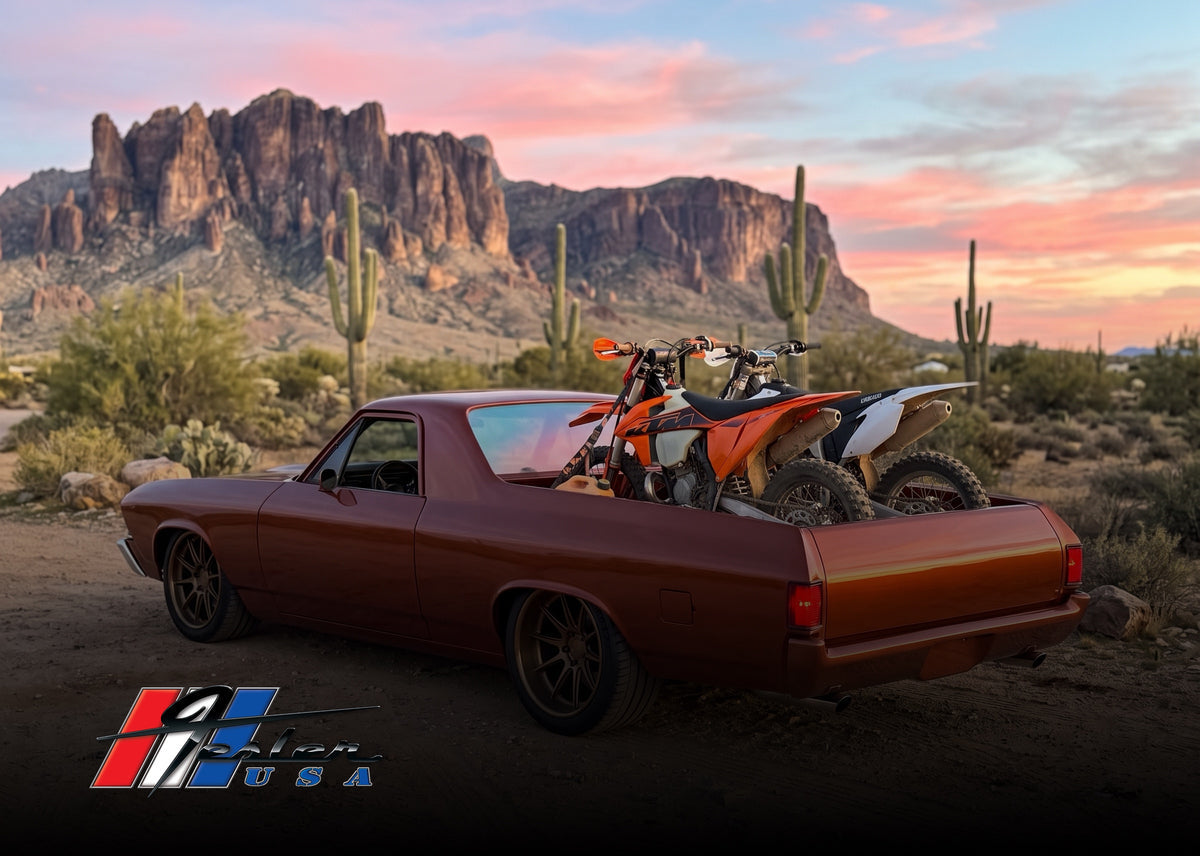
Short version: the El Camino is a car that the government calls a truck. It was engineered from a passenger car every year it was built, first the full-size Chevrolet wagon in 1959 and 1960, then the Chevelle from 1964 on. But because it carries cargo in an open bed, federal fuel economy rules file it under pickups, and most states titled it as a truck. Both sides of the show-field argument are right. They are just answering different questions.
That is the whole fight in two sentences. Here is the record behind it, because the version told at the show is not quite the one that happened.
Was the El Camino the first car-based pickup?
No, and it was not even the first American one. The idea came out of Australia. The often-repeated version says a farmer's wife in Victoria wrote to Ford Australia in 1932 asking for one vehicle that could take the family to church on Sunday and haul the pigs to market on Monday. A young designer named Lew Bandt drew the answer, a Ford V8 coupe with a fixed steel bed grafted on, and it went on sale in 1934. Australians called it the ute and never stopped building them.
One caveat. Bandt confirmed the letter story in a 1987 interview, but the letter has never been found, and a former Ford Australia archivist searched nine decades of company files without turning it up. Treat it as a well-loved origin story, not a documented fact.
What is documented is that Ford brought the concept to the United States first. The Ranchero arrived for 1957, built on the full-size Ford wagon body and sold with the tagline "More than a car! More than a truck!" Ford moved 21,706 of them in year one. GM design chief Harley Earl had suggested a coupe pickup back in 1952, according to Chevrolet stylist Chuck Jordan, and the company shelved it. Ford got to market two years before Chevy answered.
Why did the first El Camino only last two years?
The 1959 El Camino was built off the new Brookwood two-door wagon, with Bel Air exterior trim and a Biscayne interior. It got the full 1959 treatment, batwing fins and cat's-eye taillights, which is why it looks like nothing else Chevrolet ever built. The name is Spanish for "the road" or "the way."
It sold. Chevrolet built 22,246 of them for 1959, beating the Ranchero's first-year number. Then 1960 orders dropped by about a third to 14,163, and Chevrolet killed it after two model years. Ford, meanwhile, had moved the Ranchero down to the compact Falcon for 1960. Chevy had no small-car pickup to answer with, so it went quiet.
When did the El Camino become a Chevelle?
1964. Chevrolet launched the midsize A-body Chevelle that year and put the El Camino back into production on it. That decision is the one that matters if you own one today, because from that point forward the El Camino followed Chevelle sheet metal, chassis, and engine choices generation for generation. We cover the Chevelle side of that story in our 1964 to 1972 Chevelle history. The El Camino timeline lines up with it almost exactly:
- 1964 to 1967. First Chevelle-based generation. Top engine in 1964 was the 300 horsepower 327. No factory SS badge yet.
- 1968 to 1972. All new body. Chevelle coupes moved to a shorter wheelbase, but the El Camino was built on the 116 inch Chevelle wagon and four-door chassis, which is why the bed is so long. The SS396 became an official El Camino model for 1968, and the 1970 SS454 with the 450 horsepower LS6 ran the quarter in the high 13s.
- 1973 to 1977. The colonnade era, and the biggest El Camino ever built at close to 18 feet long. It was also the best seller. 1973 was the peak year at 64,987 units.
- 1978 to 1987. Downsized onto the G-body with Malibu front sheet metal and doors. Production moved to Mexico for 1985. The last one was built in late 1987, with a 4.3 liter V6 or a 305 V8.
GMC sold the same vehicle as the Sprint from 1971 and renamed it the Caballero for 1978, running it to the same 1987 finish. Ford stopped building the Ranchero after 1979. So the El Camino, the answer to the Ranchero, outlived the original by eight years and outlasted the Chevelle name it was built on by a decade.
So is an El Camino legally a car or a truck?
There is a real answer, and it depends on who is asking.
Federal fuel economy rules say truck. The EPA's light-truck definition turns on one question above almost all others: does it carry property on an open bed? If yes, it is a truck for fuel economy and emissions purposes. Go to fueleconomy.gov and look up a 1984 model. It is listed as the "Chevrolet El Camino Pickup." That is not a nickname. That is the government category.
Your state DMV usually says truck, but not always. Most states titled and plated the El Camino as a light truck or pickup because it has a bed. Some states let owners register it as a passenger car, and rules changed over the years, which is why two El Camino owners at the same show can pull out two different registrations and both be right. If you want to know what yours is, do not ask the internet. Go look at your own title. The body type field will say pickup, truck, or something like "PK," and that is the classification your state settled on.
The engineering says car. Every El Camino shares its frame, front sheet metal, suspension, and drivetrain with the passenger car it came from. Nothing under a 1970 El Camino is truck hardware. It is a Chevelle with a different roof and a bed.
Chevrolet built a car. The regulators classified it by what it does, not what it is made of. That is why "car-truck" is not a cop-out. It is the most accurate description anybody has come up with in sixty-five years.
What does the Chevelle connection mean for a 1968 to 1972 El Camino build?
From the windshield forward, a 1968 to 1972 El Camino is a Chevelle. Same front clip, same doors, same A-pillars, same windshield opening. From the cab back it is its own thing, with a short fixed rear window behind the seats and a bed where a Chevelle has a trunk.
Our 1968 to 1972 Chevelle flush-mount glass program is built for the hardtop coupe out of the box: DOT-certified windshield and rear glass bonded flush to the body with the stainless trim deleted. On an El Camino the windshield side of that conversion is the same conversation as the coupe, but the rear glass is a different piece, so we ask El Camino owners to call us at 480-748-2000 before ordering so we confirm the right glass for the body. The Chevelle flush-mount glass guide walks through exactly what the conversion changes and when in the build it should happen.
Inside, it gets simpler. The cab shares its floor and door architecture with the Chevelle, so the 1964 to 1977 Chevelle and El Camino carpet kit, and most of what sits in our 1968 to 1972 Chevelle collection, carries over to the El Camino without drama. Door panels, kick panels, and A-pillars are the ones builders ask about most.
What should you check on your own El Camino?
Three things, in this order.
- The title. Find the body type field. That ends the car-or-truck argument for your car, in your state.
- The cowl tag and VIN. A 1968 to 1972 El Camino carries a Chevelle-family VIN and body code. That is your proof, on the metal, that the front half of your build shops from the Chevelle catalog.
- The rear window. Look at the size and the trim around it. That short backlight is the one piece of glass on the vehicle that is not Chevelle coupe glass, and it is the reason we spec El Camino glass by phone instead of by drop-down menu.
Quick answers
Is the El Camino a car or a truck? Both, depending on who is asking. It was engineered from a passenger car every year it was built, but federal fuel economy rules classify it as a pickup because of the open bed, and most states titled it as a truck.
What was the first El Camino based on? The 1959 and 1960 El Camino was built on the full-size Brookwood two-door station wagon, with Bel Air trim and a Biscayne interior.
Why was the El Camino discontinued in 1960? Sales fell from 22,246 in 1959 to 14,163 in 1960, about a third, while Ford moved the Ranchero to the cheaper compact Falcon. Chevrolet dropped the El Camino until the Chevelle-based version returned for 1964.
Which El Camino years are Chevelle-based? 1964 through 1977. The 1978 to 1987 models were built on the G-body with Malibu front sheet metal and doors.
Did the El Camino come as an SS? Yes. The SS396 became an official El Camino model for 1968, and the 1970 SS454 could be ordered with the 450 horsepower LS6.
Does Fesler flush-mount glass fit an El Camino? The windshield side of the 1968 to 1972 Chevelle conversion applies, but the rear glass is El Camino specific. Call 480-748-2000 before ordering so we confirm the right glass for your body.
Shop 1968 to 1972 Chevelle and El Camino parts or browse the full flush-mount DOT glass lineup.

Leave a comment
This site is protected by hCaptcha and the hCaptcha Privacy Policy and Terms of Service apply.