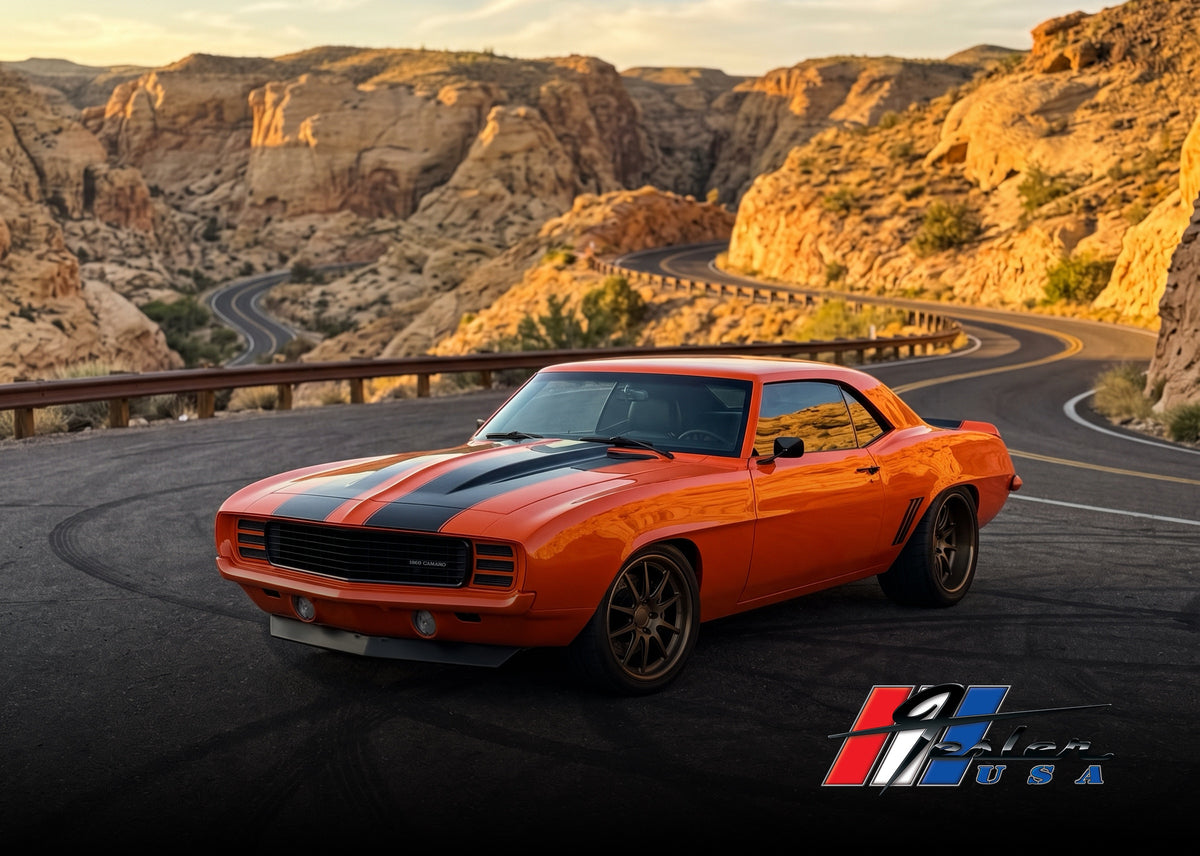
The standard line on 1960s muscle is that it only knew how to go straight. Big engine, skinny tires, drum brakes, hang on for a quarter mile. Then in 1967 Chevrolet built a Camaro with the smallest V8 in the lineup, mandatory front disc brakes, quick-ratio steering, and a suspension tuned for road courses. It sold 602 of them. There was no badge on the car and no name for it beyond the option code you checked to get it: Z28.
That car was built to turn. The idea behind it, that a Camaro should stop and corner as hard as it accelerates, is the exact idea the pro-touring movement runs on today. If you are building a first gen Camaro right now, you are finishing an argument Chevrolet started in 1967. Here is the verified story, and how to tell if the car in your garage is one of them.
Why did Chevrolet build the Z/28 at all?
Because of a rulebook. The SCCA's Trans-Am series raced sedans on road courses, not drag strips, and it capped the big class at 5.0 liters, or 305 cubic inches. The Camaro went on sale in September 1966 and Chevrolet wanted it in the series for the 1967 season. The problem was engines. The 327 was too big. The 283 was legal but not competitive.
Vince Piggins, Chevrolet's manager of product promotion and the man most sources credit as the father of the Z/28, pushed the package through. The engine solution was an old hot rodder's trick: take the 4.00 inch bore of the 327 block and pair it with the 3.00 inch stroke crankshaft from the 283. That combination works out to 302 cubic inches, under the limit with three cubic inches to spare. Short stroke, big bore, forged crank, solid lifters. An engine that wanted to rev, which is exactly what a road course rewards.
To race it, Chevrolet had to sell it. The SCCA required a production version to homologate the car. So the Z/28 was born as a street car that existed to make a race car legal, the same reason Ford later built the Boss 302 and Pontiac tried, and failed, to homologate a 303 for the Trans Am. We told that story in the 1969 Trans Am, 697 cars nobody wanted.
What did the Z/28 package actually include?
For 1967, according to the Camaro Research Group, checking RPO Z28 got you:
- The 302 cubic inch V8, rated at 290 horsepower at 5,800 rpm
- Special suspension, quick-ratio steering, and a heavy-duty radiator
- 12-bolt rear axle and dual exhaust
- 15 inch Rally wheels
- Rally stripes on the hood and deck lid
Two things were required options, not included: the aluminum-case Muncie four-speed and power-assisted front disc brakes. Chevrolet would not sell you the engine without the brakes to match. That detail alone tells you what the car was for.
The 290 horsepower rating was, in the CRG's words, conservative. Actual output was higher, and the number was widely understood at the time to be understated for insurance and racing-class reasons. We are not going to print a "real" figure because the ones floating around are estimates, not tests.
Why was there no Z/28 badge in 1967?
Because the car was not marketed. The Camaro Research Group is direct about it: none of the 1967 Z/28s received a Z/28 emblem or an engine-size emblem. The rally stripes were the only exterior clue. The package was a line on the order form. If you knew what Z28 meant, you ticked the box. If you did not, you bought an SS 350 like everyone else.
That is how a 1967 Camaro that could out-brake and out-corner anything else in the showroom sold just 602 units. For comparison, the 1968 Z/28 sold 7,199 and the 1969 Z/28 sold 20,302. The word got out, but it took a race team to spread it.
How did the Z/28 do in Trans-Am racing?
It dominated. Roger Penske ran the factory-backed effort with Mark Donohue driving the Sunoco blue Camaros. In 1968 Chevrolet won 10 of the 13 races in the over 2.0 liter class, and Donohue put together a winning streak of eight in a row. Chevrolet took the manufacturers' championship. In 1969 Donohue won six of twelve races and Chevrolet took the title again.
Ford's answer was the Boss 302 Mustang, a 1969 model built for the same homologation reason, two model years after the first Z/28. In 1969 Ford built 1,628 Boss 302s. Chevrolet built 20,302 Z/28s. The gap closed in 1970, when Ford built 7,013, but by then the first gen Camaro was already gone.
Is your first gen Camaro a real Z/28?
Go look at your own car, and be ready for an uncomfortable answer. The VIN does not identify a Z/28 on a 1967 or 1968 Camaro. Neither does the trim tag. Those cars were V8 Camaros with an option package, and the only factory evidence is the parts themselves and the paperwork: the Protect-O-Plate, the build sheet if one survived, the dealer invoice.
Things worth checking:
- The engine. A 302 block carries a casting number shared with other small blocks, so look at the stamped suffix code on the pad in front of the passenger side cylinder head. The CRG publishes the correct codes by year.
- The brakes. Front discs were mandatory. A drum-brake "Z/28" is not one.
- The transmission. A four-speed was mandatory. No automatic Z/28 left the factory in 1967 to 1969.
- The badge. If someone tells you a 1967 is original because it has Z/28 emblems, that is a problem, not proof.
Most first gen Camaros are not Z/28s, and that is fine. The idea is what matters, and the idea transfers to any 1967 to 1969 shell.
Why the first Z/28 is the original pro-touring car
Strip the racing history away and look at the spec. Smallest engine, biggest brakes, quickest steering, stiffest springs, widest wheels the factory offered. Nothing on the option sheet was there to win a quarter mile. Everything was there to win a road course.
That is the pro-touring formula, forty years before anyone used the phrase. Modern builds run bigger brakes, better tires, and coilovers instead of leaf springs, but the priority order is the same: stop, turn, then go. We break down where that thinking sits against the resto side of the hobby in pro-touring vs restomod, a builder's guide, and the first gen's year-by-year details are in first gen Camaro history for restomod builders.
What Fesler makes for a corner-carving first gen
A car built to turn should look like it. The one thing a 1967 to 1969 Camaro cannot hide is the chrome trim around the windshield and rear glass, which breaks up the roofline and dates the car instantly. Our 1967 to 1969 Camaro flush-mount glass kit deletes the trim entirely. The windshield is DOT-certified laminated glass, the rear is tempered, both bond into the stock opening with urethane, and there is no sanding to fit. It is the same glass on Goodguys Street Machine of the Year builds, and it fits the Firebird too.
Inside, the hand-laid fiberglass interior is where the cabin catches up to the chassis. Door panels, A-pillars that are cut longer to hide the flush glass adhesive line, kick panels, dash, and console are all designed together in Phoenix. The full interior kit covers 1968 and 1969 cars. If you are building a 1967, call the shop and we will spec it piece by piece, since the 1967 doors use different hinges.
Quick answers
Why is it called the Z/28? Z28 was the RPO order code for the package. There was no other name and no badge on 1967 cars.
How many 1967 Camaro Z/28s were built? 602. Production rose to 7,199 in 1968 and 20,302 in 1969.
Why was the Z/28 engine 302 cubic inches? The SCCA Trans-Am series capped engines at 305 cubic inches. Chevrolet paired the 327's 4.00 inch bore with the 283's 3.00 inch stroke to land at 302.
Who created the Camaro Z/28? Vince Piggins, Chevrolet's manager of product promotion, is generally credited as the father of the Z/28.
Did the Z/28 win in Trans-Am? Yes. Chevrolet won the over 2.0 liter manufacturers' championship in 1968 and 1969, with Mark Donohue driving for Roger Penske.
Can you tell a real 1967 Z/28 from the VIN? No. The VIN and trim tag do not identify a Z/28 in 1967 or 1968. Documentation and correct components are the only proof.
See the 1967 to 1969 Camaro flush-mount glass kit or browse everything Fesler makes for the first gen Camaro.

Leave a comment
This site is protected by hCaptcha and the hCaptcha Privacy Policy and Terms of Service apply.