
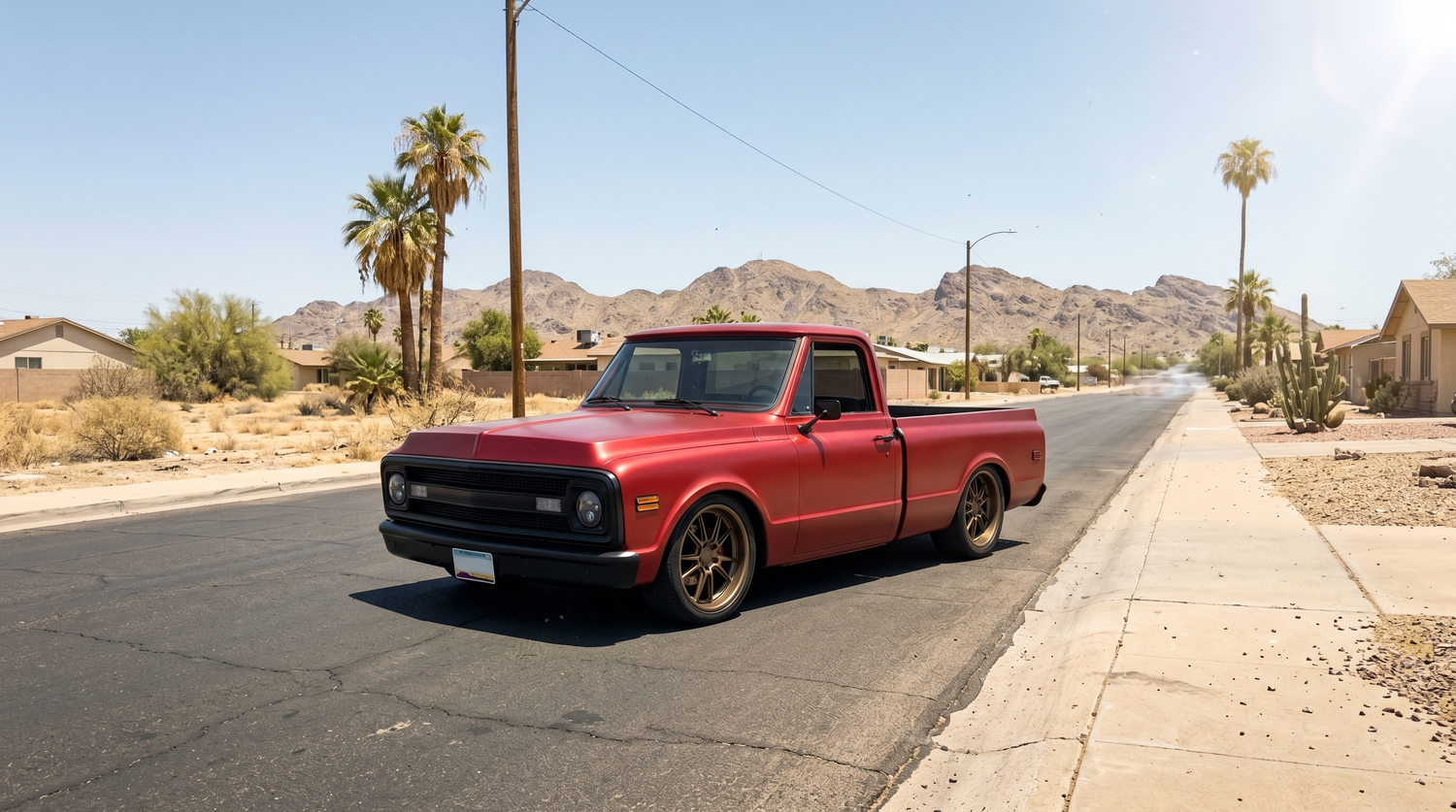
Climate & interior
The honest answer from a shop that lives in the heat, plus the cabin decisions that decide whether your build gets driven in July or sits under a cover until October.
It is the third week of July. The bank sign on the corner says 112. A guy rolls into the shop in his daily, and we ask him where the classic is. Same answer we hear every summer. It is at home, in the garage, with a cover on it. Has been since May. It will come back out in October.
Five years and a serious pile of money went into that build. It is gorgeous. And for roughly a third of the year, he does not drive it, because the second he opens the door the cabin hits him like an oven and the seat is too hot to touch. That is the part nobody tells you when you start a build in the desert. A beautiful car you cannot stand to sit in is a very expensive piece of garage art.
So here is the honest answer to the question every classic owner in Arizona eventually asks. Yes, you can absolutely drive a classic through a Phoenix summer and enjoy it. People do it every day. But it is not luck and it is not toughness. It is a series of decisions you make about the cabin, and most of them have to happen before the fun parts of the build are finished.
Why a classic turns into an oven
Start with the bad news, because it explains everything that follows. The cars we love were built in an era when air conditioning was a luxury option and desert heat was somebody else's problem. The cabin was never engineered to stay livable in 110-degree sun, and a few things stack up against you all at once.
There is a lot of glass. A first-gen Camaro or a C10 has a big greenhouse relative to its size, and every square inch of windshield and side glass is a solar panel pointed at your lap. There is almost no insulation. Factory floor coverings were thin, the firewall was bare metal, and the only thing between your feet and the exhaust and transmission was sheet steel. There is heat soak from the drivetrain, a V8 and a transmission that dump warmth straight up into the cabin in stop-and-go traffic. And the interiors people love, deep black leather and dark carpet, drink in sun and hold it.
None of that is a flaw in the car. It is just what the car is. The job of a good build is to quietly engineer around all of it so the driver never feels any of it.
What factory air conditioning was, and what it was not
If your car came with factory air, do not assume that solves it. Original systems from the sixties and seventies were marginal when they were brand new. They used old refrigerant, the components were small, and the output was modest by any modern standard. Decades later most of those systems are tired, leaking, or simply gone, and even a faithfully restored original setup will struggle to win a real fight against Arizona afternoon heat.
That is not a knock on originality. If you are building a numbers-correct concours car, you keep the period system and you accept the trade. But if the goal is a car you drive, in summer, on real streets, the factory climate system is usually the first thing builders move past.
What a modern climate system actually changes
This is where most desert builds make their leap. A modern aftermarket air conditioning system, the kind you see in serious restomods, is a different animal from what these cars left the factory with. The compressors are more efficient, the refrigerant is current, and the output is built for actual comfort rather than a faint cool breeze. The difference between a marginal system and a strong modern one is the difference between surviving a drive and looking forward to one.
We are not here to sell you a compressor. Plenty of good systems exist and the right one depends on your car, your engine bay, and your budget. The point worth burning into your brain is simpler, and it is the part that costs people real money when they get it wrong.
The climate decision is not a late add-on. It is a dash decision, and the dash is one of the first things you commit.
The decision has to come before the dash
Here is the trap. A modern climate system does not just live under the hood. The evaporator, the vents, and the controls all live behind and inside the dash, in the exact same real estate as your gauges, your screen, and your switches. If you finalize the dash layout, mount your gauges, and lock your panel before you have decided whether you are running air and which system, you will be tearing it apart later to make room. That is the definition of paying twice.
The right order is to plan the cabin as one system. Decide on climate early, lay out the vents where they will actually move air across the driver and not just fog the windshield, leave room behind the dash for the evaporator, and place the controls before you commit the panel. We walk through how to plan a clean, modern dash without regret in our guide to dash planning for a Tesla-clean classic, and the climate question belongs at the very front of that conversation.
Do it in that order and the air system disappears into a finished, intentional dash. Do it backwards and you have a beautiful panel with no good place to put the parts that keep you cool.
Glass is half the battle
You can have the strongest air conditioning on the market and still cook if the sun is pouring in faster than the system can pull it out. Glass is not a side detail in a hot climate. It is a major part of the thermal equation.
Two things matter here. First, the glass itself. Proper laminated automotive glass with a correct factory-style shade band across the top of the windshield cuts the direct sun load on the dash and the driver, and the right tint on the side and rear glass keeps the cabin from baking when the car is parked. Second, how the glass is installed and sealed, because a clean install is what keeps conditioned air in and outside heat and noise out.
This is also where the look and the function line up. Flush-mount glass gives the car its modern, frameless face, and because it is real DOT-certified laminated glass rather than a polycarbonate shortcut, it behaves the way a windshield should in heat and sun. If you want the deeper detail on why the certification matters, we break it down in what DOT certified glass actually means. For a summer driver, the glass and the climate system are partners, not separate line items.
The layer under the carpet nobody ever sees
Before the interior goes in, there is a step that decides how the whole cabin behaves, and it is invisible the moment it is done. Sound and thermal insulation is the barrier between bare metal and your finished interior. It slows the heat coming up off the floor and firewall, it keeps the air conditioning from fighting a losing battle against a hot floorpan, and it kills the drumming and exhaust drone that make a loud car feel even hotter than it is.
The catch is timing. This material goes down on bare floors and firewall, which means it has to happen before your carpet, door panels, and headliner are installed. Skip it now and the only way to add it later is to pull the interior back out. We cover the products that actually work and exactly where they go in our guide to sound deadening for classic cars and trucks. In a desert build, treat it as the foundation your climate system stands on.
Color, material, and the seat you actually sit on
The last layer is the one you touch. Interior material and color change the felt temperature of the cabin more than people expect. A deep black hide looks incredible and it also stores the most heat. Lighter tones, perforated surfaces that breathe, and smart material choices all move the needle on how the car feels at noon in August. None of this means you cannot have black leather. It means you make the choice with your eyes open and you build the rest of the cabin to support it. If you are weighing your options, our complete leather guide walks through grades, finishes, and how they hold up in heat.
The Phoenix test is not a slogan
We build in Phoenix on purpose, and it shapes how we think about every part that touches the cabin. Our own shop trucks get driven in this, not trailered to a show and tucked away. When a part survives our floor and our parking lot in July, that is not marketing language, it is a real test in real heat. The desert is unforgiving, and we would rather find a weak point in our own lot than have you find it on a Sunday drive in 108 degrees.
Build a car you actually drive
The whole point of a build is the drive. A classic that lives under a cover for four months because the cabin is unbearable is a project that only half worked. The good news is that the fix is not a single magic part. It is a plan: climate decided early and built into the dash, real glass that manages the sun, insulation laid down before the interior, and materials chosen with the heat in mind. Get those right and you get the version of this hobby that is actually worth the money, the one where July is just another month to go for a drive.
Planning a build you can drive all summer?
Start with the cabin. Our interior and glass are engineered and built in Phoenix, tested in the heat you are building for.
Shop Fesler interior Shop flush-mount glassRelated reading: Interior first, the feels-finished upgrade path · Dash planning 101 · DOT certified glass explained. This article is general guidance from our shop and is not a product spec sheet. Air conditioning systems referenced here are aftermarket components from third parties and are not Fesler products.

Leave a comment
This site is protected by hCaptcha and the hCaptcha Privacy Policy and Terms of Service apply.