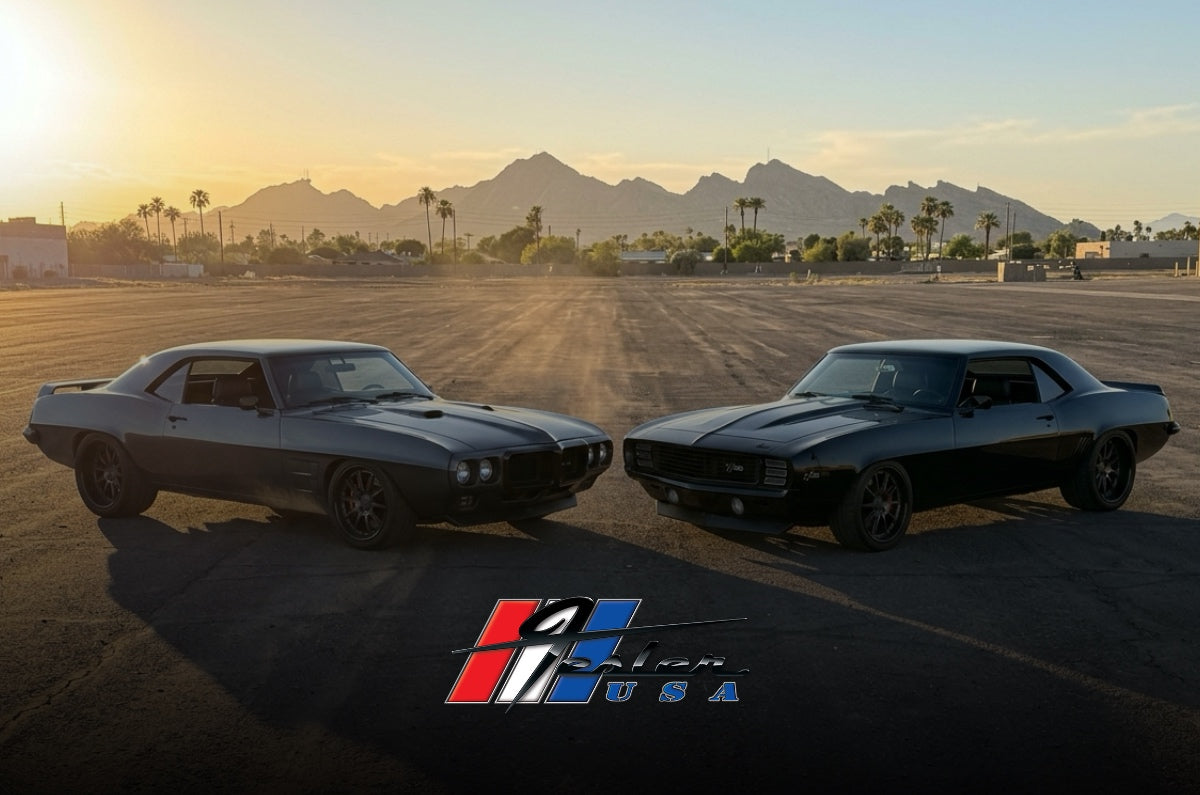
You have heard it at every cruise night. "A Firebird is just a Camaro with a different nose." It is one of the most repeated lines in the hobby, and it is wrong. The two cars share a platform, a roof, a floor, a set of doors, and every piece of glass. Almost everything you actually look at on a first gen Firebird is Firebird only.
Here is the number that ends the argument. A 1967 Firebird is 188.8 inches long. A 1967 Camaro is 184.7 inches long. Same 108 inch wheelbase. That four inch difference is almost entirely in the nose, and it exists because Pontiac refused to ship a badge job. This is the story of how that happened, what really interchanges, and how to check it on your own car.
Why did GM build two versions of the same car?
Because Pontiac lost a fight. In 1964 Pontiac, under John DeLorean, built a two-seat sports car prototype called the XP-833. You will see it called the Banshee today, but that name was attached to the car later. GM had rejected "Banshee" as a production name, since a banshee is a death omen. In any story set in 1964 to 1966 it is the XP-833.
GM killed it. The accepted explanation is that it would have cannibalized the Corvette. That version traces mostly to DeLorean's own telling. Bill Collins, a Pontiac engineer who was in the building at the time, said he was not privy to those discussions. So treat the Corvette story as the likely reason, not the documented one. Sources also disagree on when the car was killed, so we will not put a date on it.
What is documented is what came next. In March 1966, GM's Ed Cole told DeLorean to make a Pontiac out of Chevrolet's upcoming Panther, the car that became the Camaro. The program was approved in May 1966. The Camaro went on sale September 29, 1966. The Firebird went on sale February 23, 1967. Pontiac got the Camaro's shell, a five month head start for Chevrolet, and less than a year to make the car its own.
What is actually shared between a Firebird and a Camaro?
The structure. The unibody, floor pans, rockers, cowl, and roof. The doors and door skins. The deck lid. And the glass, all of it, which we will get to because it matters for your build.
Now the list of what is Firebird only on a 1967 to 1969 car:
- Front bumper and grille assembly, the split "beak" that adds most of the four inches
- Hood, both the standard hood and the scooped hood
- Front valance
- Quarter panels. The Firebird's chevron body line runs through them, so a Camaro quarter does not interchange
- Tail panel, tail lamps, and rear bumper
Read that list again. Nose, hood, quarters, tail. That is the entire visual identity of the car. "Nearly every panel" was not shared. The panels you cannot see were shared.
One honest caveat: the front fenders are genuinely contested. The first gen Firebird registry says 1967 to 1968 Camaro and Firebird fenders interchange with mild welding, because the turn signal cutouts differ. Reproduction catalogs list them as Firebird specific. Builders on forums say they do not interchange. We are not going to claim either way.
Did the Firebird have real Pontiac engines?
Mostly, and the exception is the best part of the story. The 326 and 400 cubic inch V8s were pure Pontiac. No Chevrolet engine went into a 1967 Firebird. So far so good for the "not a Camaro" camp.
The base engine was Pontiac's overhead cam six, which Pontiac was proud of and which was ahead of its time in Detroit. But the block was derived from the Chevrolet 230 cubic inch pushrod six. It displaced the same 230 cubic inches, and Ate Up With Motor notes that engineer Mac McKellar shared parts with the contemporary Chevrolet six to keep costs down. Mac's Motor City Garage goes further and calls it essentially a badge-engineered variant.
So the one engine that looked most distinctly Pontiac, the overhead cam six with the Sprint package, was the one with Chevrolet bones. Out of 82,560 Firebirds built for 1967, 17,664 were sixes. The V8 cars, the ones people argue about at shows, were all Pontiac.
Did Pontiac retune the suspension?
You will read that Pontiac retuned the chassis "until it drove like a Pontiac." Period testing does not support that. Car Life found a 1967 Sprint still hopped badly on a hard launch. Here is the real, checkable difference instead.
Both cars used the same single leaf Mono-Plate rear springs, which wind up into an S under hard acceleration. Chevrolet's fix on the Camaro was one radius rod on the passenger side. Pontiac used an I-beam section rod, and on manual transmission V8 cars the Firebird got a pair of them, one each side, per the Firebird service manual. By mid-1967 Chevrolet had adopted a comparable setup. That is the kind of difference that shows up on a lift, not in a brochure.
Do not go looking for staggered shocks on a 1967 car. Those arrived for 1968.
Go look at your own car
If you own either one, the argument settles itself in your garage.
- Measure the overhang. Stand at the front wheel and measure to the front of the bumper. That is where the Firebird's extra four inches live.
- Run your hand along the quarter. The Firebird's body line takes a chevron kick above the rear wheel. The Camaro's does not. That line is why the quarters never interchange.
- Look at the door hinges. A 1967 car uses three bolt hinges. A 1968 or 1969 car uses four bolt hinges. Camaro or Firebird does not matter here. Year does. Door shells swap between brands, but same year only.
- Check the glass. The windshield and rear glass part numbers are identical across both brands. More on that below.
What does this mean for your F-body build?
The shared structure is the good news, because the structure is where the expensive upgrades go. Glass is the clearest example. GM built the 1967 to 1969 hardtop windshield to the same part number for both cars, and the reproduction industry still does. Auto City Classic lists one windshield covering Camaro body jobs 12437, 12637, and 12337 alongside Firebird jobs 22437 and 22637. The coupe rear glass is one part number for both brands too.
That is why our 1967 to 1969 flush-mount glass kit fits a first gen Firebird exactly as it fits a Camaro. Same opening, same pinchweld, same DOT-certified glass. We cover fitment for every year in the Firebird and Trans Am flush-mount glass guide and the Camaro flush-mount glass guide. Same shell, so it is the same answer.
The interior is where you have to pay attention, because that is where the brands split. Our hand-laid fiberglass door panels mount to the shared door shell, so the 1968 to 1969 door panel set fits both a Camaro and a Firebird of those years. It does not fit a 1967 car, because of those three bolt hinges. Factory trim panels are model specific from 1968 on. The dash is shared for 1967 and 1968 but diverges for 1969. Instrument clusters were never shared, which is why direct-fit gauge systems like the Dakota Digital GRFX cluster for 1967 to 1968 Camaro and Firebird are spec'd to both cars by name.
The rule of thumb: structure and glass cross brands freely. Sheet metal you can see does not. Interior crosses same year only, and check the specific part. We wrote up the year-by-year Camaro side in first gen Camaro history for restomod builders.
Quick answers
Is the Firebird just a rebadged Camaro? No. They share the unibody, roof, floor, doors, deck lid, and glass. The nose, hood, valance, quarter panels, tail panel, and bumpers are all Firebird specific.
How much longer is a 1967 Firebird than a 1967 Camaro? About four inches. 188.8 inches versus 184.7, on the same 108 inch wheelbase, almost all of it in the nose.
Did the 1967 Firebird use Chevrolet engines? No complete Chevrolet engine was installed. The 326 and 400 V8s were Pontiac. The overhead cam six was derived from the Chevrolet 230 block.
When did the Firebird go on sale? February 23, 1967, about five months after the Camaro, which went on sale September 29, 1966.
Does Camaro glass fit a Firebird? Yes. The 1967 to 1969 windshield and coupe rear glass carry the same part numbers for both cars, and the same is true for 1970 to 1981.
Do Camaro and Firebird door panels interchange? Door shells swap same year only, since 1967 uses three bolt hinges and 1968 to 1969 use four. Fesler fiberglass panels fit both brands within those years. Factory trim panels are model specific from 1968 on.
Shop Fesler flush-mount glass for Camaro and Firebird or browse everything we make for the 1967 to 1969 F-body.

Leave a comment
This site is protected by hCaptcha and the hCaptcha Privacy Policy and Terms of Service apply.