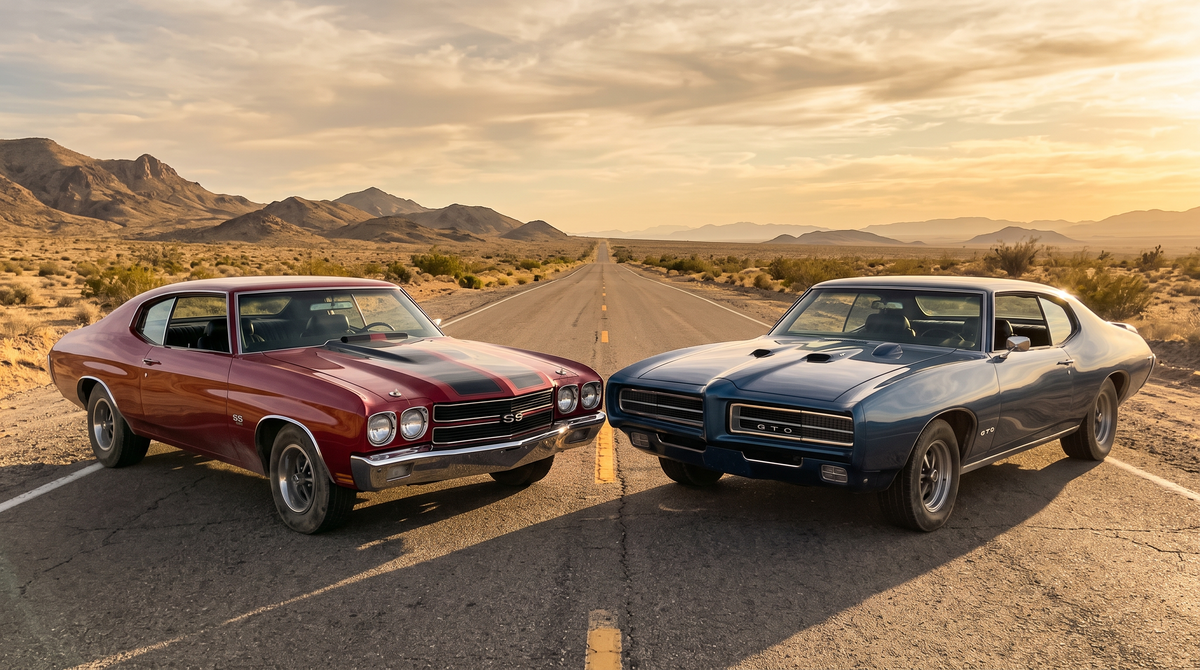
You have heard this one at every car show: the GTO started the muscle car era and the Chevelle SS just copied it. Half of that is true. Pontiac did start it, in 1964, by hiding a 389 in an option package that GM's own rulebook was not written to catch. The second half is wrong, and the production numbers prove it. By 1969 the Chevelle SS 396 was outselling the GTO, and by 1970 Chevrolet was shipping the highest factory horsepower rating of the entire era while Pontiac's sales fell by nearly half.
So give Pontiac the first round. Then go look at the scoreboard for the rest of the decade. Here is the claim, the record, and what it means for the Chevelle sitting in your garage.
Did the Pontiac GTO really start the muscle car era?
Yes, and we are not going to pretend otherwise. In 1964 GM had a corporate policy that capped intermediate cars at 330 cubic inches. John DeLorean, Bill Collins, and Russ Gee at Pontiac noticed the rule limited what a model could ship with as standard, not what could be ordered as an option. So the 389 from the full size Grand Prix went into the Tempest LeMans as an option package called GTO. By the time headquarters worked out what had happened, the order bank had decided the argument for them.
Pontiac planned on about 5,000 of them. They sold 32,450 in 1964. That is the part of the legend that holds up under every source we checked, and it is why the GTO gets credit as the first modern muscle car in most histories. Fair enough.
Was the Chevelle SS 396 a copy of the GTO?
No, and this is where the bar story falls apart. Chevrolet's first answer was not a me-too package. It was the 1965 Z16, and it was a more serious car than the GTO it was chasing.
- 201 built. Two hundred hardtops at the Kansas City plant, plus one prototype, is the commonly cited total. Roughly 75 are accounted for today.
- A 375 horsepower 396. The L37 hydraulic lifter big block, running 11.0:1 compression. GM's intermediate cap had been reset at 400 cubic inches by then, which is why the number on the fender reads 396 and not 389.
- Real chassis work. The Z16 used the reinforced convertible boxed frame, a narrowed rear axle, the biggest brakes from the full size Chevrolet line, and heavy duty suspension. The option cost $1,501 on top of the car.
- Never advertised. Chevrolet did not run a single ad for it. Magazines got test cars, Dan Blocker from Bonanza got one, and everybody else got a rumor.
Copying the GTO would have meant dropping a big engine in a stock chassis and calling it a day. Chevrolet did the opposite with the Z16, then pivoted the next year. Curbside Classic describes the 1966 SS 396 as a car "built to a price, to undercut the GTO," with a chassis mostly shared with the regular V8 coupes. That is not copying either. That is a different strategy: put the big block in a car more people could afford and let volume settle it.
Which sold more, the Chevelle SS 396 or the GTO?
This is the part nobody at the car show has memorized, so here it is. GTO figures are from the standard production record. Chevelle SS 396 figures for 1966 through 1968 are from Chevrolet's model production numbers. For 1969 and 1970 the SS became an option package and Chevrolet did not release a breakdown, so those two Chevelle numbers are the enthusiast registry estimates that every reference uses.
- 1966: GTO 96,946. Chevelle SS 396 72,272. Pontiac wins.
- 1967: GTO 81,722. Chevelle SS 396 63,006. Pontiac wins.
- 1968: GTO 87,684. Chevelle SS 396 62,785. Pontiac wins.
- 1969: GTO 72,287. Chevelle SS 396 about 86,307. Chevrolet wins.
- 1970: GTO 40,149. Chevelle SS 396 and SS 454 about 53,599. Chevrolet wins.
Pontiac's peak was 1966. From there the GTO slid every year but one, then fell off a cliff in 1970 and was down to 5,811 cars by 1972. The Chevelle SS went the other way, peaking in 1969 in the middle of the GTO's decline. If you only count the first three years of the war, Pontiac won. If you count the whole war, the car that "copied" the GTO ended up selling more of them when it mattered.
What happened when GM lifted the 400 cubic inch cap in 1970?
Both divisions opened the drawer. Pontiac put a 455 in the GTO, rated at 360 horsepower, with the Ram Air IV 400 rated at 370. The Judge package, which had debuted the year before in 1969, carried on.
Chevrolet answered with the LS6 454 Chevelle. The factory rating was 450 horsepower at 5,600 rpm and 500 lb-ft of torque, the highest factory horsepower rating of any production muscle car of the era. About 4,475 LS6 Chevelles were built. That is the car nobody at a show ever has to explain, and it is the reason the argument feels settled even to people who cannot tell you why.
One honest caveat. Factory horsepower ratings in 1970 were gross figures, and every manufacturer played games with them for insurance reasons. The 450 number is what Chevrolet printed. It is still the biggest number anyone printed.
Why does this matter for a Chevelle build today?
Because the strategy that won the war is the same one that makes the 1968 to 1972 Chevelle the best platform of the bunch to build now. Chevrolet built more of them, on a shared chassis, with a body that changed little across five years. That means parts fit, the aftermarket is deep, and you can find a solid car. The A-body GTO shares the frame, but the Chevelle sheet metal and interior support is wider by a mile.
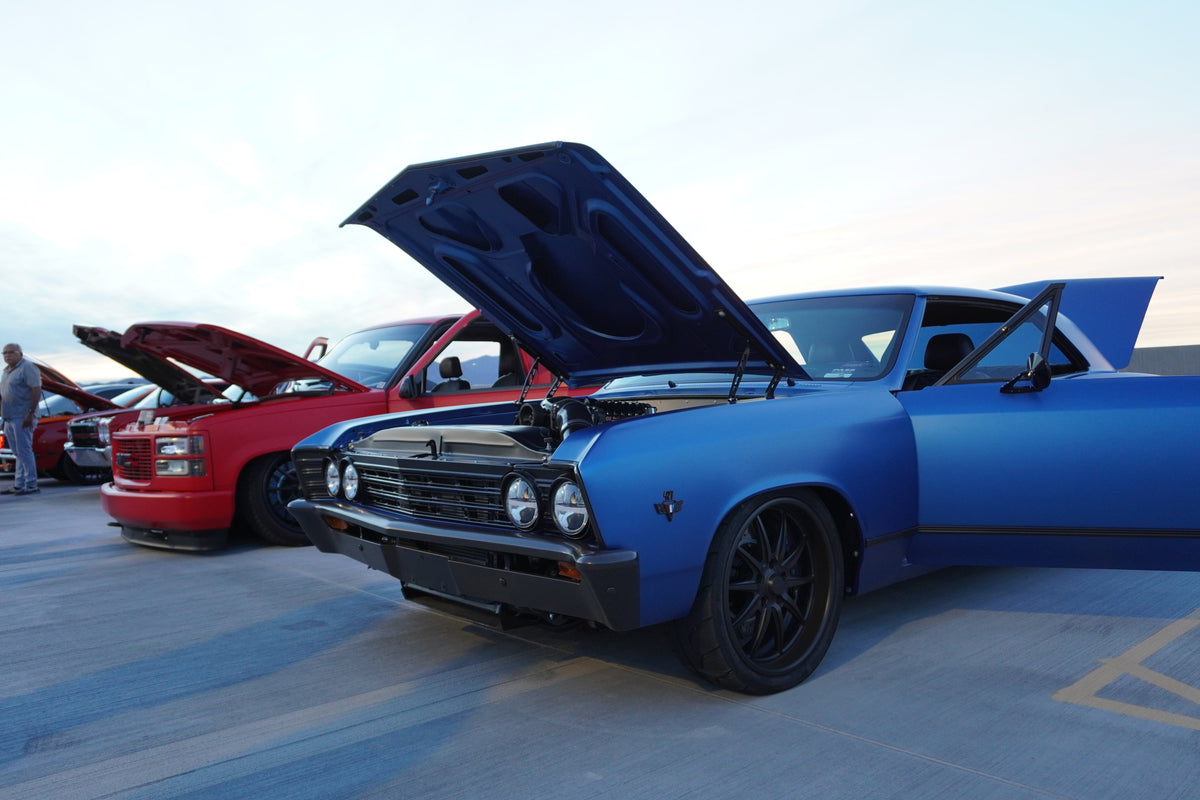
Go look at your own car. On a stock 1968 to 1972 Chevelle the windshield and back glass sit in rubber gaskets with stainless reveal moldings standing off the body. That was fine in 1970. On a pro touring car with straight paint it is the first thing that looks dated. Our 1968-72 Chevelle flush mount glass kit deletes the trim and the gasket, bonds DOT laminated glass flush to the pinch weld, and cleans up the roofline the way Chevrolet's stylists probably wished they could have. The full install walkthrough is in our Chevelle flush mount glass guide.
Inside, we manufacture a complete hand-laid fiberglass line for the 1968 to 1972 cars, starting with door panels, and we have put full builds on 1966, 1967, and 1970 Chevelles in our own shop. Everything we make for the car is in the 1968-72 Chevelle collection, with the earlier body in the 1966-67 Chevelle collection. For the platform background, year by year, read our Chevelle history from 1964 to 1972.
Quick answers
Did the GTO come before the Chevelle SS? Yes. The GTO launched for 1964 as an option package on the Tempest LeMans. Chevrolet's first big block Chevelle, the Z16 SS 396, arrived in mid 1965.
How did the GTO get around GM's engine rule? GM capped intermediates at 330 cubic inches, but the policy did not cover optional engines. Pontiac offered the 389 as an option package and sold 32,450 cars against a plan of about 5,000.
How many 1965 Z16 Chevelles were built? The commonly cited total is 201: 200 production hardtops plus one prototype. Around 75 are accounted for today.
Did the Chevelle SS ever outsell the GTO? Yes. In 1969 the Chevelle SS 396 total of about 86,307 beat the GTO's 72,287, and in 1970 the Chevelle SS beat the GTO again, roughly 53,599 to 40,149.
What was the most powerful factory Chevelle? The 1970 LS6 454, rated at 450 horsepower and 500 lb-ft, the highest factory horsepower rating of the muscle car era. About 4,475 were built.
When did The Judge come out? 1969, not 1970. It ran through 1971, when only 357 were sold.
Shop Fesler parts for the 1968-72 Chevelle or browse every flush mount glass kit we make.

Leave a comment
This site is protected by hCaptcha and the hCaptcha Privacy Policy and Terms of Service apply.