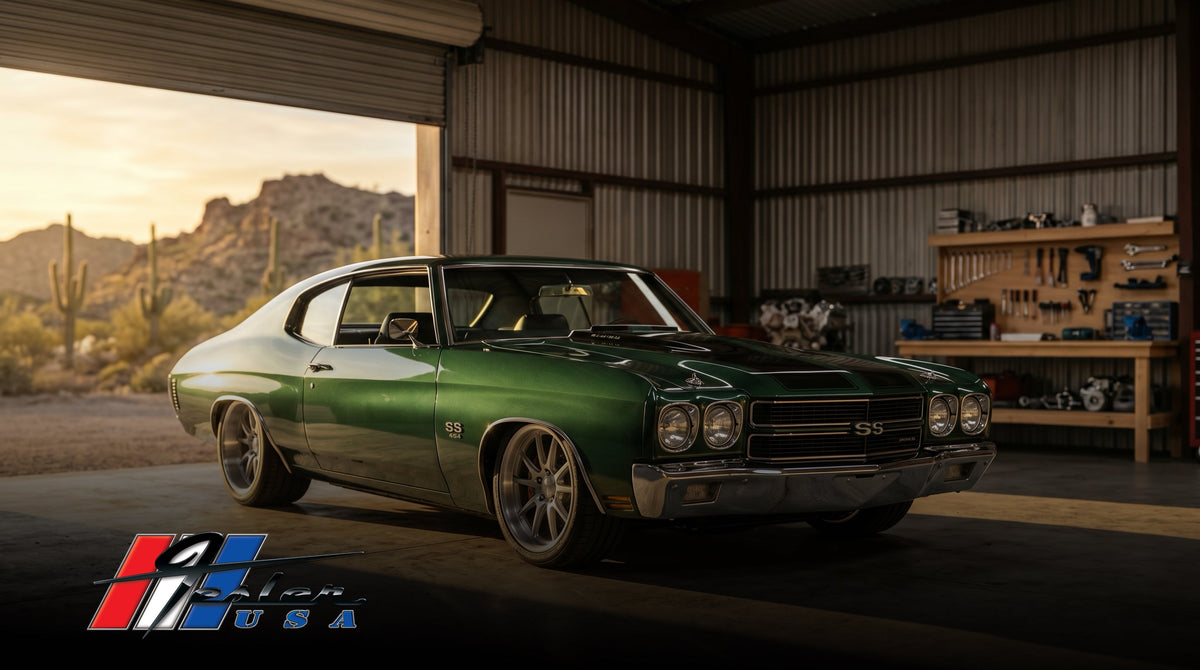
Chevrolet built 4,475 Chevelles with the LS6 454 in 1970, and it never built another. There is no 1971 LS6 Chevelle, no matter what a listing says. And the VIN on a real one reads exactly like the VIN on a V8 Malibu with a 307, which is why the LS6 is one of the most faked cars of the muscle era.
Here is what the 4,475 number actually counts, why 1971 never happened, and which pieces of a 1970 Chevelle can prove an LS6 and which cannot.
How many 1970 LS6 Chevelles were built?
The number everyone quotes is 4,475, and it holds up. Chevrolet's own option tally for 1970 shows 8,773 cars ordered with RPO Z15, the SS454 package. Of those, 4,298 got the LS5 454 and 4,475 got the LS6. That is where the figure comes from, and it is the only figure Chevrolet ever gave.
What the number does not do is break down by body. Z15 could be ordered on the Malibu sport coupe, the Malibu convertible, and the El Camino, and Chevrolet counted the option, not the body it went on. So nobody knows how many LS6 convertibles or LS6 El Caminos exist. Estimates for convertibles run from a few dozen to a couple hundred, and every one of them is a guess. Anyone who gives you an exact LS6 convertible count is telling you what they hope, not what Chevrolet recorded.
One more correction. You will read that Chevrolet built 4,475 LS6 engines. It built 4,475 Chevelles ordered with the LS6. Tonawanda built more engines than that, including service replacements, which matters when someone claims a bare block proves anything.
Why was there no 1971 LS6 Chevelle?
Because GM pulled it before production started. The LS6 was in the early 1971 Chevelle literature. Dealer order guides listed it with the price blank and a note reading Will Advise, and Motor Trend tested a 1971 LS6 Chevelle in its October 1970 issue. The plan was a detuned version, with 9.0 to 1 compression and aluminum heads, rated at 425 gross horsepower, to run on the low-lead fuel GM had committed to for 1971.
Then it was gone. The 1971 SS became a dress-up package that could be ordered with a 350, the 402 (still badged 396), or the LS5 454, and the LS5 was the only engine that required it. The LS6 went into the Corvette instead, where 188 were built for 1971, and that was the end of the LS6 as a production engine.
Why the Chevelle lost it comes down to the same forces that ended the whole era: emissions rules, insurance surcharges on high-output intermediates, and a shrinking performance market. Tonawanda records show a small batch of 1971 LS6 engines with Chevelle suffix codes, and there are stories of test cars. No production 1971 LS6 Chevelle left a dealership. If you are looking at one, you are looking at a 1971 with a swapped engine.
What does the VIN tell you on a 1970 Chevelle?
Almost nothing you need. In 1970 the Super Sport was not a model. It was option Z15 on a V8 Malibu, so the VIN of a real SS454 LS6 starts with 136 for the Malibu series, just like every other V8 Malibu built that year. The VIN encodes series, body style, engine type (V8 or six), year, plant, and serial number. There is no digit for Z15, no digit for the 454, and no digit for LS6.
This is different from 1968, when the SS396 had its own 138 series and the VIN did identify it. Chevrolet moved the SS to an option package for 1969 and left it there for 1970, and that decision is why 1970 is the year with the fakes. A 1970 Malibu coupe with a big-block has a VIN identical to the real thing, because it is identical.
Does the cowl tag prove an LS6?
No. The trim tag on the cowl records body style, paint code, interior trim, build date, and plant. It does not record engine or the Z15 package. A cowl tag can help you catch a fake, because it will expose a car that started as a four-door or was not the color it is now. It cannot confirm one. A perfect cowl tag proves the car is a 1970 Malibu sport coupe from a specific plant in a specific color. That is all.
What actually proves a real LS6?
Paper and stampings. Four pieces of evidence carry weight, and a serious car has more than one.
- The original build sheet. The broadcast sheet lists every RPO on the car, including Z15 and LS6. It was left in the car during assembly, usually under a seat spring, over the gas tank, or behind a door panel, and many were thrown away. It is the single best document that exists, because it is the only factory record that spells out LS6 for that VIN.
- The Protect-O-Plate. The metal warranty card that came with the car carries the VIN, the engine code, the transmission, and the axle. A Protect-O-Plate showing an LS6 engine code for that VIN is strong evidence.
- The engine stamp pad. On the block, in front of the passenger-side head, the factory stamped a partial VIN and a suffix code. For a 1970 Chevelle LS6, the suffix is CRV with the M22 four-speed or CRR with the TH400, plus CRX for the heavy-duty clutch version. The partial VIN has to match the car. On a car worth this kind of money, the stamp should be inspected by someone who has seen a lot of them.
- The dealer paperwork. Window sticker, dealer invoice, original title, or a documented ownership chain. Not factory records, but they corroborate the others.
What does not exist is a factory list of LS6 VINs. No GM record survives that ties a VIN to the LS6 option. The LS6 registries that exist are built from owners' documentation, not from Chevrolet, so a car in a registry is a car someone documented, not a car GM verified.
What about the parts?
The block casting number for a 1970 LS6 is 3963512. The LS5 used the same casting, so the casting number alone proves it is a 1970 454, not that it is an LS6. The differences were inside: the LS6 got a four-bolt main block, a forged crank, forged pistons, a solid-lifter cam, and 3964291 rectangular-port heads with an aluminum 3963569 intake and a Holley four-barrel. The LS5 got oval-port heads and a hydraulic cam. Those parts can tell you whether an engine was built as an LS6. They cannot tell you whether it was born in the car in front of you, because every one of them can be bought.
The same goes for the car. The cowl induction hood was an option (ZL2), not part of Z15, so a real LS6 could have a flat hood and a tribute can have a cowl hood. Stripes were an option, and the SS wheels and blacked-out grille were reproduced decades ago. Nothing you can see from ten feet away separates the real car from the tribute. Only the paper and the stampings do.
What does this mean for your build?
Most of the 1970 Chevelles that roll into our Phoenix shop are not LS6 cars. They are Malibus and tributes, and that is fine. A tribute is an honest car as long as it is sold as one, and it gives you freedom a documented LS6 does not: you can cut it, tub it, and put modern glass in it without touching something irreplaceable.
That is where our 1968 to 1972 Chevelle flush-mount glass kit comes in. It is a DOT laminated windshield and tempered rear glass with no trim, and it fits the 1968 to 1972 hardtop, two-door sedan, and El Camino regardless of what is under the hood. Convertibles use different glass. The full interior kit covers the A-pillars, door panels, kick panels, console, and package tray. If you are keeping the car original, read our Chevelle flush glass guide first, because that is a decision you make once.
If you want the engine side of the LS6 story, including what 450 gross horsepower means today and how the modern LSX454 compares, we covered it in Chevy 454 versus LSX454. For the whole 1964 to 1972 run, read Chevelle history, 1964 to 1972.
Quick answers
How many 1970 LS6 Chevelles were built? 4,475, according to Chevrolet's option count for RPO Z15 with the LS6. That total includes coupes, convertibles, and El Caminos, and Chevrolet did not break it down by body.
Was there a 1971 Chevelle LS6? No. It was listed in early 1971 literature at 425 gross horsepower and cancelled before production. The 1971 LS6 went only into the Corvette, where 188 were built.
Does the VIN identify a 1970 Chevelle LS6? No. The 1970 SS was an option on the Malibu, so an LS6 VIN starts with 136 like any V8 Malibu.
Does the cowl tag identify an LS6? No. It records body, paint, trim, date, and plant, not engine or the SS package. It can expose a fake but cannot confirm a real car.
What proves a real LS6? The original build sheet, the Protect-O-Plate with the LS6 engine code, and a factory stamp pad with a matching partial VIN and a CRV, CRR, or CRX suffix.
Does the block casting number prove an LS6? No. The 3963512 casting was used on both the LS5 and LS6 in 1970.
Shop Fesler glass and interior for the 1968 to 1972 Chevelle or browse every flush-mount DOT glass kit we make.

Leave a comment
This site is protected by hCaptcha and the hCaptcha Privacy Policy and Terms of Service apply.