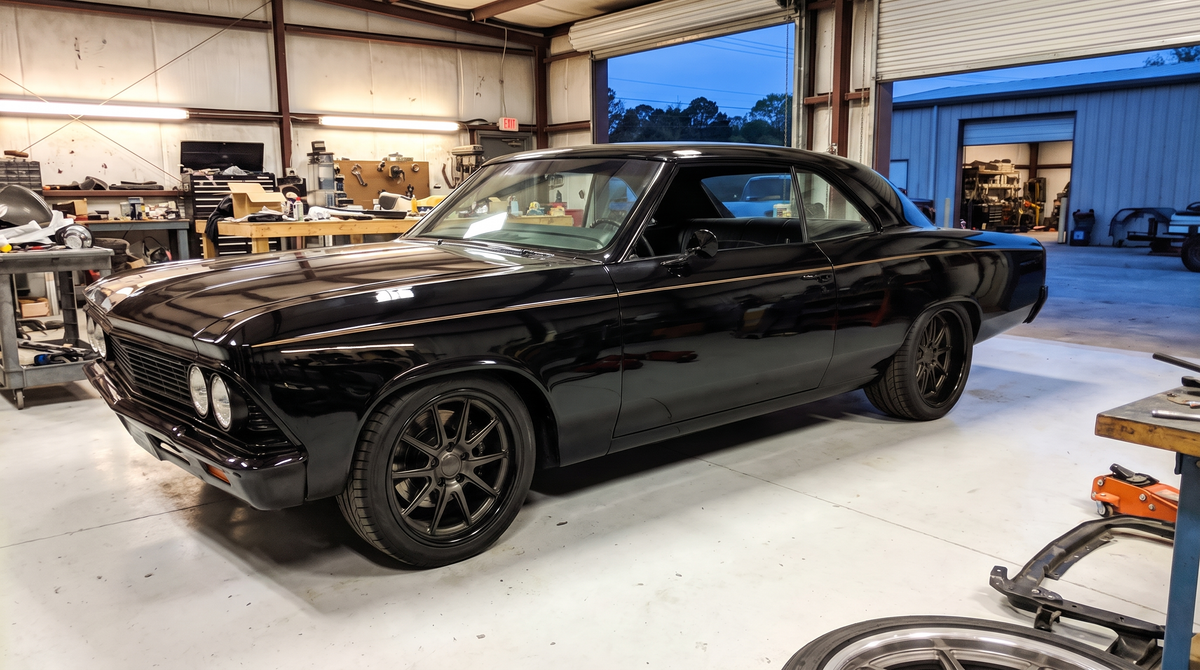
Smokey Yunick did not build a 7/8 scale Chevelle. He said so himself, in print, in his own Circle Track column in 1987, and the tape measure backs him up. A true seven eighths Chevelle would sit on a wheelbase of about 100 inches and lose more than two feet of length. That is not a Chevelle. That is a Vega with a big block in it, and nobody in the 1967 Daytona garage area was going to miss two feet.
What he actually did is better than the myth, and one piece of it is the reason we are writing this at all. He moved the body back on the frame, smoothed the underside, tucked the bumpers, and reworked the windshield so it sat flush with the sheet metal. He was chasing airflow in an era when almost nobody in stock car racing was thinking about it. Here is what the record supports, what it does not, and why the flush glass is the part worth stealing sixty years later.
What is the 7/8 scale Chevelle legend?
You have heard it. Smokey shrank the entire car. Every panel, every opening, every dimension scaled down to seven eighths so it punched a smaller hole in the air. Inspectors could not prove anything because they had nothing to measure it against, and he got away with it in front of everybody.
The story is so good that it still shows up in official places. NASCAR's own media coverage of the number 13 has repeated the line that the car "was about 7/8 the size of a production car." Chevelle forums argue about it every winter. It has been told so many times that most people assume it is settled.
Was Smokey Yunick's Chevelle really 7/8 scale?
No, and the arithmetic is the quickest way to see it. A 1966 Chevelle rides on a 115 inch wheelbase and measures about 197 inches long. Multiply either number by 0.875 and you get a car with a 100 inch wheelbase that is roughly 25 inches shorter than stock. Mac's Motor City Garage, which did the most careful teardown of this story we have found, puts the width loss at almost 10 inches and describes the result as "Vega-sized, not Chevelle-sized."
Picture that next to a stock Chevelle in the paddock. The doors would be the wrong length, the roof the wrong height, the wheel openings the wrong diameter. Race car people are the most observant people on earth when someone else is going faster. Nobody misses two feet.
Then there is Smokey. He denied it for the rest of his life. According to the same Mac's Motor City Garage account, his 1987 Circle Track column laid out where the story came from: NASCAR officials tried to build a Chevelle body template, but they built it off the wrecked and rebuilt car of Bobby Johns. The template would not fit Smokey's car. By Yunick's telling it would not fit any Chevelle they tried it on. The garage area filled in the rest by dinner, and the legend has been outrunning the facts ever since.
We will be honest about the limits here. Most of the modern accounts trace back to Smokey's own version of events, and Smokey was a storyteller with every reason to make himself look clever. Nobody has produced a period NASCAR document that says "the template was built off the wrong car." But nobody has produced a photograph of a visibly shrunken Chevelle either, and there were thousands of people looking at it.
What did Smokey Yunick actually change on the Chevelle?
This is the part the legend buries. He did not need to shrink the car. He found a stack of smaller advantages and ran all of them at once.
- The body was moved back on the chassis by about two inches, with the wheel wells reworked to match. That shifted weight distribution and moved the aerodynamic center of pressure rearward.
- The underside was smoothed into something close to a belly pan, so the air passing beneath the car stopped fighting it.
- The front bumper was set back into the bodywork and deepened, instead of hanging out in the wind.
- The windshield was reworked to sit flush with the surrounding sheet metal. Front and rear glass were Lexan, which by one account saved around 100 pounds.
- The engine was offset to the left and used as a frame cross member, with the driver moved back and to the left. The offset alone was a rulebook problem.
- The rear edge of the roof carried a subtle flip to generate a little downforce.
Yunick's own summary, quoted by DailySportsCar, was that the car had "power, aerodynamics and chassis." He was also blunt about whether it was a cheater. His answer was yes, but not by the published rule book of the day. The rule book had not caught up to what he was doing.
Two more facts people get wrong. First, there were three of these Chevelles, not one, and all three wore 1966 bodywork even though they raced in 1967. That is why you will see the same car called a 66 and a 67 in the same forum thread. Second, the most notorious of the three was not a garage special. Mac's Motor City Garage reports it was built by Chevrolet Engineering in Michigan and then finished by Smokey and a crew of Chevrolet technicians at his shop on North Beach Street in Daytona Beach. This was a factory effort in a period when GM was officially out of racing.
How fast was the Yunick Chevelle at Daytona in 1967?
Fast enough to make the myth feel plausible. Curtis Turner put the black and gold number 13 on the pole for the 1967 Daytona 500 at 180.381 mph, the first time a car had qualified for the 500 above 180. The car ran unsponsored, which is part of why the black and gold scheme is still so recognizable. It did not finish. Turner retired on lap 143 with engine failure and was scored 25th while Mario Andretti won.
The car also took the pole at the 1967 Atlanta 500, and that is where the story ends. Turner lost the rear coming off turn four and barrel rolled the car down the front stretch, at least six times by one account. Smokey told Turner he would never drive for him again because he did not want to be responsible for killing him. The wreck was crushed into a cube and parked outside the Best Damn Garage in Town, next to the other cubes.
Why does the flush windshield matter to a Chevelle build today?
Look at your own car. On a stock 1966 to 1972 Chevelle the windshield sits in a rubber gasket with a stainless reveal molding standing proud of the body. Air hits that lip on the way over the roof. Smokey saw that in 1966, decided it was a wall of turbulence, and cut it out of his program. He was not trying to make the car pretty. It happened to make the car look better anyway.
That is exactly what a flush mount glass kit does now, out in the open. The reveal molding comes off, the gasket goes away, and DOT certified laminated glass bonds directly to the pinch weld so paint runs straight into glass with nothing standing between them. Our flush mount DOT glass is built for the 1966-67 and 1968-72 Chevelle bodies, and the full install sequence, including how the pinch weld needs to be prepped, is in our Chevelle flush mount glass guide.
The rest of the car gets the same treatment in our shop. Hand-laid fiberglass 1968-72 Chevelle door panels, dash and console pieces, and billet hardware are all in the 1968-72 Chevelle collection, with the earlier body covered in the 1966-67 Chevelle collection. If you want the background on why this platform earned the attention in the first place, read our Chevelle history from 1964 to 1972.
Quick answers
Was the Smokey Yunick Chevelle really 7/8 scale? No. A true 7/8 scale Chevelle would have a 100 inch wheelbase and be about two feet shorter than stock. Yunick denied the story in print in 1987 and said the sheet metal was stock.
Where did the 7/8 scale story come from? By Yunick's account, NASCAR built a body template off Bobby Johns' wrecked and rebuilt Chevelle. It did not fit Smokey's car, and the rumor grew from there.
What did Yunick actually modify? The body was moved back about two inches, the underside was smoothed, the front bumper was recessed, the engine was offset left, and the windshield was reworked to sit flush with the body.
Was it a 1966 or 1967 Chevelle? The cars raced in 1967 but wore 1966 bodywork. There were three of them.
How fast did the Yunick Chevelle qualify at Daytona? Curtis Turner won the 1967 Daytona 500 pole at 180.381 mph, the first 180 mph qualifying lap for the race. He retired on lap 143 with engine failure.
What happened to the car? It was destroyed in a multiple rollover at the 1967 Atlanta 500 with Turner driving. Yunick had the wreck crushed into a cube and displayed outside his shop.
Shop Fesler parts for the 1968-72 Chevelle, browse the 1966-67 Chevelle lineup, or see every flush mount glass kit we make.

Leave a comment
This site is protected by hCaptcha and the hCaptcha Privacy Policy and Terms of Service apply.