
C10 is not a name. It is a code, and a short one. The C means two-wheel drive, which GM called a conventional chassis. The 10 means a nominal half-ton payload rating. A K10 is the same truck with four-wheel drive. A C20 is a three-quarter ton. A C30 is a one-ton. That is the whole system, and Chevrolet has used it since the 1960 model year.
The same code is stamped on your truck. Open the driver's door and look at the plate on the door pillar. The first few characters tell you drive type, payload series, engine family, body, year, and plant. Here is how to read them, and where the system came from.
What does the C in C10 stand for?
C stands for conventional. On the GM identification plate for 1967 to 1972 trucks, the chassis designation reads "C = Conventional, K = 4 Wheel Drive." Conventional meant a standard two-wheel drive chassis, which is why everyone today just says C is two-wheel drive and K is four-wheel drive. One is the factory word, the other is what it means on the road.
The letter did not come from a marketing meeting. It came from the chassis order code, and it worked well enough that Chevrolet kept it for the entire life of the C/K line, right up to the Silverado.
What do the 10, 20, and 30 mean?
Nominal payload ratings. 10 is a half-ton, 20 is a three-quarter ton, 30 is a one-ton. The word nominal matters. The GM plate lists the half-ton GVW range as 3,900 to 5,800 pounds, the three-quarter ton as 5,200 to 7,500, and the one-ton as 6,600 to 14,000. The 10, 20, and 30 were class labels, not scale readings, and they had already drifted from literal tonnage by the time the first C10 was built.
What did Chevrolet trucks use before C10?
Four-digit series numbers. From 1955 through 1959, the Task Force trucks were sold as the 3100, 3200, 3600, and 3800. The 3100 was the short-bed half-ton. The 3200 was the long-bed half-ton. The 3600 was the three-quarter ton. The 3800 was the one-ton. If you own a 1958 Apache, the Apache name was just the light-duty badge, and your truck is a 31 or a 32 series underneath it.
What changed in 1960?
Everything. The 1960 Chevrolet trucks were a clean-sheet design with a new frame, independent front suspension, a lower cab, and a new naming system. Chevrolet dropped the 3100, 3200, and 3600 designations and replaced them with 10, 20, and 30. C and K arrived at the same time, because the new line had factory four-wheel drive from day one and the code needed to say so.
The old badges did not vanish immediately. For 1960 and 1961 the light-duty 10 through 40 series still wore the Apache name, with Viking and Spartan on the heavier trucks. Those names were gone after 1961, which is why a 1960 or 1961 truck is often called a C10 Apache while a 1962 to 1966 truck is just a C10.
How do you decode a 1960 to 1966 truck?
The serial plate is on the driver's door frame. A typical 1965 short-bed reads C1445S100001.
- C or K. Two-wheel drive or four-wheel drive.
- 14, 15, or 25. Series plus wheelbase. 14 is a half-ton on the 115-inch short wheelbase. 15 is a half-ton on the 127-inch long wheelbase. 25 is a three-quarter ton on the 127-inch wheelbase. The one-ton rode a 133-inch chassis.
- 4. Pickup. Other digits cover panels, Suburbans, and chassis-cabs.
- Year digit. 5 for 1965, 6 for 1966, and so on.
- Plant letter. A is Atlanta, F is Flint, J is Janesville, K is Kansas City, S is St. Louis, Z is Fremont, 1 is Oshawa.
- Serial. Each plant started at 100001 every model year.
So a C14 is a short-bed and a C15 is a long-bed. The plate settles it.
How do you decode a 1967 to 1972 truck?
Chevrolet changed the format for the second generation and added the engine family. The plate is still on the left door pillar. A 1969 V8 half-ton pickup reads CE149S100001.
- C or K. Conventional (two-wheel drive) or four-wheel drive.
- E or S. E is an eight-cylinder engine, S is a six. This is the engine family the truck was born with, not the displacement.
- 1, 2, or 3. Half-ton, three-quarter ton, one-ton. This is the 10, 20, or 30 in the model name.
- 4, 6, or 8. 4 is a pickup, 6 is a Suburban, 8 is a Blazer.
- Year digit. 7 through 2 for 1967 through 1972.
- Plant letter, then a six-digit serial.
For 1972 only, Chevrolet added a leading C for the Chevrolet division, so a 1972 truck reads CCE142S100001. A 1972 GMC starts with T. If your plate has thirteen characters instead of twelve, that is why.
The plate also carries a longer model number, something like CE10934. The first two characters match the VIN. The middle pair is a cab-to-axle code and the last pair is a body-and-brake code. That model number is where a 1967 to 1972 plate tells you short-bed versus long-bed, because the VIN alone no longer does.
What does the VIN not tell you?
Trim. No character on a 1967 to 1972 Chevrolet truck VIN says base, Custom, CST, Cheyenne, or Cheyenne Super. The CST (Custom Sport Truck) was the top trim from 1967 to 1970. For 1971 the base trim became Custom, Custom became Custom Deluxe, and CST became Cheyenne. Cheyenne Super arrived above it for 1972. None of that is in the VIN. A truck sold as a Cheyenne Super needs the trim tag, the build sheet, or original paperwork to back it up.
The VIN also does not give the exact engine. E covers every V8 from the 283 to the 402, and S covers the 250 and 292 sixes. Displacement lives on the engine pad, not the door.
What did GMC call the same truck?
This is where people get tripped up, because GMC used two systems in the same twelve years. From 1960 to 1966, GMC used four-digit series numbers: 1000 for the half-ton, 1500 for the three-quarter ton, 2500 for the one-ton, and 3000 for the one-and-a-half ton. GMC used K for four-wheel drive but did not use the C prefix at all. So a 1965 GMC 1500 is the equivalent of a Chevrolet C20, not a C10.
For 1967, GMC moved to 1500, 2500, and 3500 for half-ton, three-quarter ton, and one-ton, lining up with Chevrolet's 10, 20, and 30. That is why a modern Silverado 1500 and Sierra 1500 share a number, while a 1966 GMC 1500 is a heavier truck than a 1966 Chevrolet C10. If you are shopping a 1960 to 1966 GMC, check the year before you trust the number.
GMC plates are their own puzzle. GMC changed its VIN format in 1967, 1968, and 1970 before matching Chevrolet's layout in 1972, so expect a 1967 to 1971 GMC plate to read differently.
What does this mean for your build?
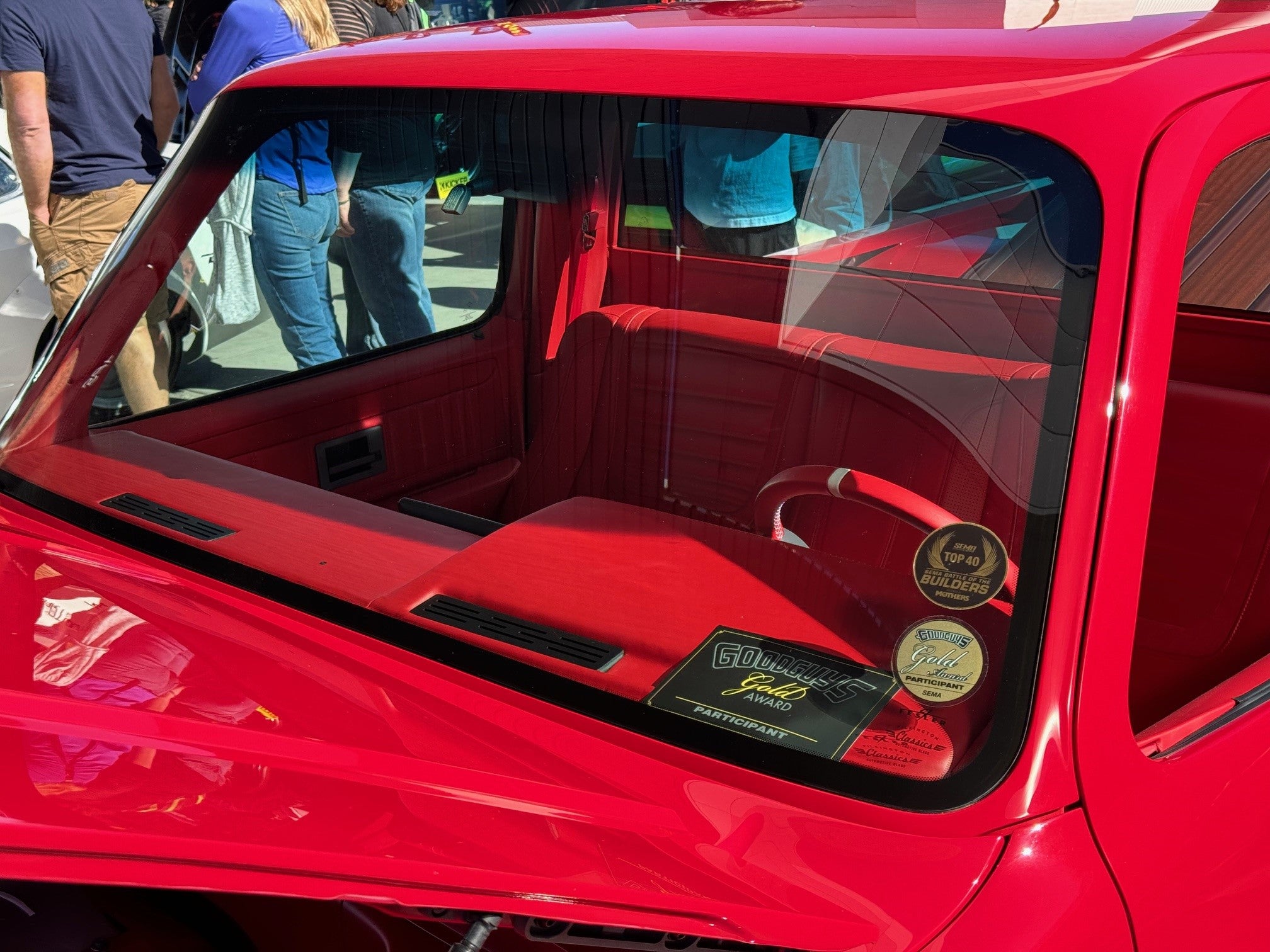
Read the plate before you order glass. The 1967 to 1972 trucks share a cab, so a C10, C20, K10, and K20 all take the same windshield and back glass, and our 1967 to 1972 C10 flush-mount glass kit covers all of them. The one thing the plate will not tell you is the back window. The cab came with a small rear window standard and a large rear window optional. Measure it, or send us a photo, and we will get you the right piece.
The 1960 to 1966 trucks are a different cab with different glass, and they split again in the middle. The 1960 to 1963 cab has the wraparound windshield and the 1964 to 1966 cab has the straight A-pillar, so a C14 and a C15 share glass within those year ranges but not across them. We carry 1960 to 1963 and 1964 to 1966 truck parts separately for that reason.
For the engineering side, read how the C10 was designed to drive like a Cadillac and 1967 to 1972 Chevy C10 and GMC trucks, history and hidden gems. If a vent-window delete is on your list, start with the C10 vent window delete guide.
Quick answers
What does C10 stand for? C is the conventional two-wheel drive chassis and 10 is the nominal half-ton payload series. K10 is the four-wheel drive version. C20 is three-quarter ton and C30 is one-ton.
When did Chevrolet start using C10? The 1960 model year. It replaced the 3100, 3200, 3600, and 3800 series numbers used on the 1955 to 1959 Task Force trucks.
Was the Apache a different truck from the C10? No. Apache was the light-duty badge on 1958 and 1959 Task Force trucks and stayed on the 1960 and 1961 C-series. It was dropped after 1961.
Is a 1965 GMC 1500 the same as a Chevy C10? No. From 1960 to 1966 the GMC 1500 was a three-quarter ton, equal to a C20. GMC did not use 1500 for the half-ton until 1967.
Does the VIN tell you if a 1967 to 1972 truck is a Cheyenne? No. The VIN encodes drive type, engine family, payload series, body, year, plant, and serial. Trim level is not in it.
Where is the VIN plate on a 1967 to 1972 Chevy truck? On the left door pillar, visible with the driver's door open.
Shop Fesler parts for the 1967 to 1972 Chevy truck and Blazer or browse every flush-mount DOT glass kit we make.



Leave a comment
This site is protected by hCaptcha and the hCaptcha Privacy Policy and Terms of Service apply.