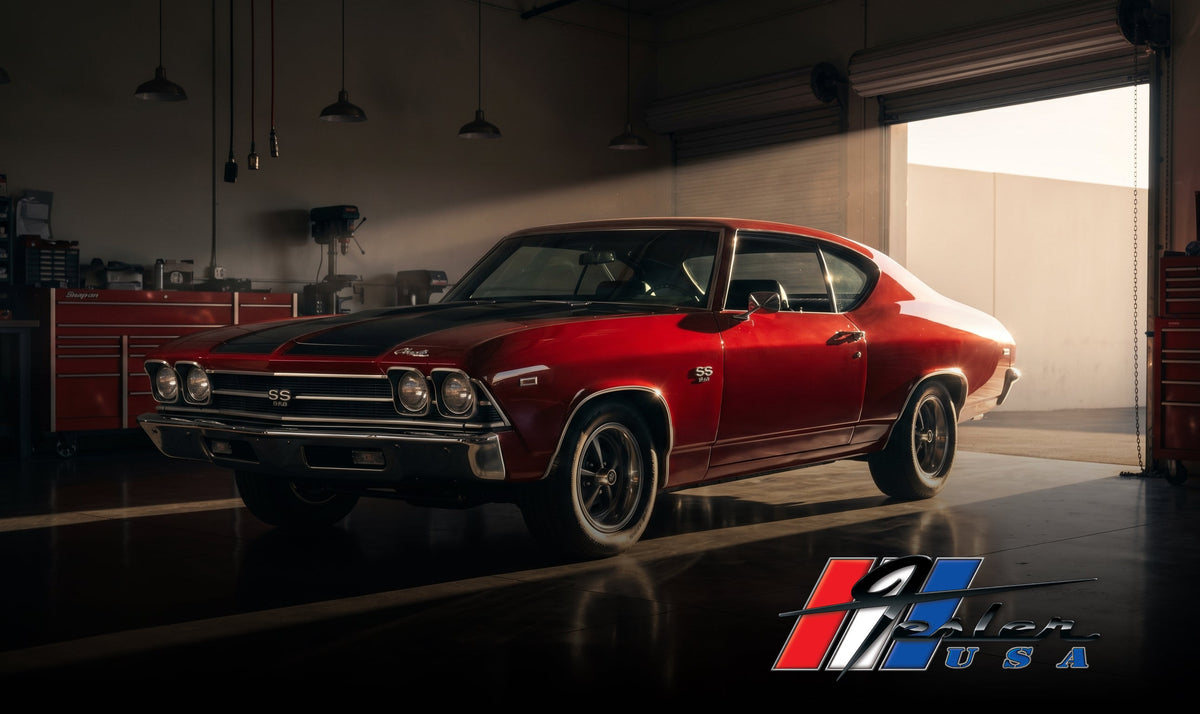
The rarest factory big-block Chevelle is not the 1970 LS6. It is the 1969 COPO 9562, a 427-powered Chevelle that Chevrolet was not supposed to build at all. The accepted production run is 323 cars. Ninety-nine of them went to Don Yenko, 17 went to Canada, and the rest went to any dealer who knew how to fill out the paperwork.
The LS6 gets the magazine covers, and it deserves them. But if you want to understand how deep the Chevelle bench really is, you have to look at the cars built around the rules, before the rules, and after the rules changed. Here are the ones we think matter, with production figures only where a real source backs them up.
What was the 1969 COPO 9562 Chevelle?
In 1969 General Motors capped its intermediate cars at 400 cubic inches. That is why the biggest engine on the Chevelle SS order sheet was the 396. The 427 was for Corvettes and full-size cars.
The workaround was the Central Office Production Order system. COPO was meant for fleet orders, taxi packages, and special paint. Dealers who understood it figured out they could use it to specify a drivetrain that was not on the order sheet. COPO 9562 put the L72 427 in a Chevelle. Every one of these cars got a heavy-duty rear axle with heat-treated 4.10 gears and either the Muncie four-speed or the TH400.
The numbers come from chevellestuff.net, which tracks the engine part numbers. The accepted production run is 323 cars. Records disagree on the transmission split: some show 93 automatics and 265 four-speeds, others show 96 and 277. The total is consistent, and the remaining L72 engines built under that part number went into service stock rather than into cars.
One warning. If you look this car up on Wikipedia, the COPO numbers for the Chevelle and the Camaro have been mixed up on some pages. Use chevellestuff.net or the Camaro Research Group for the Camaro side. We wrote about the Camaro version of this story in how a Chevy dealer used the taxicab ordering system to build the fastest Camaros.
What made the Yenko Chevelle different from a COPO Chevelle?
Nothing under the hood. The Yenko Chevelle is a COPO 9562 car that also carried COPO 9737, the Yenko Sports Car Conversion. That second code brought the stripes, the badges, and the dealer-installed extras that made it a Yenko. The engine was the same L72, factory rated at 425 horsepower, with the same 4.10 rear.
Yenko Chevrolet in Canonsburg, Pennsylvania took 99 of the 323 cars. That is why you will see the Yenko Chevelle described as a 99-car run. Both statements are true: 99 Yenkos, 323 COPO 9562 Chevelles in total. If someone tells you there were 99 COPO Chevelles, they are counting only the Yenkos.
A documented double-COPO car with build paperwork is one of the most valuable Chevelles that exists, and the paperwork is what separates a real one from a well-done tribute. If you are trying to sort out a 427 block on your own car, start with our 427 big block guide and RPO code breakdown.
Was the 1965 Z16 the first real muscle Chevelle?
Yes, and it is arguably rarer than the COPO. RPO Z16 was the 1965 Malibu SS 396. Chevrolet built 200 hardtops at the Kansas City plant beginning around March 1965, plus a prototype built at Baltimore, and the total is almost always quoted as 201. A convertible has been rumored for decades. No documented proof of it has ever surfaced, so we count it as a story until someone shows the car.
The Z16 was not a trim package. The 396 was a hydraulic-lifter version of the big block rated at 375 gross horsepower at 5,600 rpm and 420 lb-ft. The car rode on the boxed convertible frame, used narrowed Impala rear axle and brake assemblies, and came only with the Muncie wide-ratio four-speed. Car Life tested one at 14.9 seconds in the quarter at 98 mph.
The price is the part people forget. The Z16 package cost $1,501.05, which Car Life pointed out was close to 60 percent of the price of the base Malibu hardtop it was built on. Chevrolet aimed most of these cars at press and VIP buyers rather than the general public. Roughly 75 are accounted for today according to the 65chevelle.org registry, which makes the Z16 the Chevelle most builders will never see in person.
How rare is the 1967 L78 Chevelle?
This one hides in plain sight because it looks like every other 1967 SS 396. The L78 was the 375 horsepower version of the 396: solid lifters, 11:1 compression, a four-bolt main block, and a Holley on top. It was a mid-year addition, and per SS396.com the 1967 production figure is 612 cars.
That number is why the 1967 L78 is a "go look at your own car" moment. Thousands of 1967 SS 396 cars exist, and the SS badge does not tell you which engine you have. The block casting number, the engine stamp suffix, the Muncie M21, and the rear axle code do. If you have a 1967 SS 396 and have never checked, check.
Why did Chevrolet build the Heavy Chevy?
Because by 1971 an SS badge was an insurance surcharge. Premiums on performance cars were climbing hard, and a buyer under 25 could be priced out of a real SS by the policy alone. Chevrolet's answer was RPO YF3, the Heavy Chevy. It was coded as a base Chevelle, not an SS, so it did not trip the insurance flag. It still got the SS-style domed hood with pins, a blacked-out grille, stripes, and Heavy Chevy decals.
Production per chevellestuff.net was 6,727 cars in 1971 and 9,508 in 1972. Most were 307 and 350 cars. The interesting ones are the 1972 cars ordered with the LS3 402. Sports Car Market puts that number at 286, and says most of those were paired with the MC1 heavy-duty three-speed manual. The 454 was never available on a Heavy Chevy. It stayed exclusive to the SS.
A 402 Heavy Chevy with the three-speed is genuinely scarce. For where it sits in the bigger picture, see our full 1964 to 1972 Chevelle history.
Was the Laguna S-3 really banned from NASCAR?
Ruled ineligible is the more accurate phrase. The Laguna S-3 was the 1974 to 1976 Chevelle with the sloped urethane nose, which arrived mid-year in January 1975 and was designed with NASCAR in mind. Cale Yarborough won nine races and the 1976 championship in Junior Johnson's number 11 Laguna, then won nine more and a second title in 1977 in the same body. After the 1977 season NASCAR made the S-3 body ineligible for competition. The road car was slow by any muscle-car standard. The optional 400 four-barrel in 1976 was rated at 175 horsepower.
Production is where we hedge. Wikipedia lists 15,792 S-3 cars for 1974 and 9,100 for 1976 with no 1975 figure, and three-year totals quoted online range from about 31,500 to nearly 39,000. We are not printing a total without a source.
What about Baldwin-Motion Chevelles?
Joel Rosen's Motion Performance and Baldwin Chevrolet on Long Island built Phase III Chevelles on LS6 454s with a written promise of an 11.50-second quarter mile. Real program, real cars. But no verified production count exists, so anyone quoting a hard number is guessing. They existed, they were extreme, and documented examples are among the rarest dealer-built cars of the era.
What does this mean for the Chevelle in your garage?
Most Chevelles being built today are not COPOs or Z16s, and that is fine. These rare cars matter to a builder because they show how much range the platform has. The same 1968 to 1972 body that carried a 427 under a fleet order code is the one that makes an excellent pro-touring car now, and the 1966 to 1967 body that followed the Z16 is one of the best-proportioned shapes GM ever made.
We build for both. Our 1968-72 Chevelle flush-mount glass kit and 1966-67 Chevelle flush-mount glass kit are DOT-certified, American-made, and trimless front and rear. We also make hand-laid fiberglass door panels and interior pieces for the second-generation car. The full fitment rundown is in our Chevelle flush-mount glass guide. If your car is one of the rare ones above, keep it original. If it is one of the other million, build it the way you want to drive it.
Quick answers
What is the rarest big-block Chevelle? The 1969 COPO 9562 with the L72 427 at 323 cars, or the 1965 Z16 at 201 cars if you count the first SS 396. Both are rarer than the 1970 LS6.
How many Yenko Chevelles were built? 99, all in 1969. They are COPO 9562 cars that also carried COPO 9737, the Yenko Sports Car Conversion.
How many 1965 Z16 Chevelles were built? 200 hardtops at Kansas City plus a Baltimore prototype, usually quoted as 201. About 75 are accounted for today.
How many 1967 L78 Chevelles were built? 612, per SS396.com. The 375 hp L78 was a mid-year option and looks identical to a 325 or 350 hp SS 396 from the outside.
Could you get a 454 in a Heavy Chevy? No. The Heavy Chevy topped out at the LS3 402. The 454 stayed exclusive to the SS.
Why did NASCAR drop the Laguna S-3? The aero nose was ruled ineligible after the 1977 season, following Cale Yarborough's 1976 and 1977 championships in the body.
Shop Fesler 1968-72 Chevelle parts or browse the 1966-67 Chevelle lineup.


Leave a comment
This site is protected by hCaptcha and the hCaptcha Privacy Policy and Terms of Service apply.