
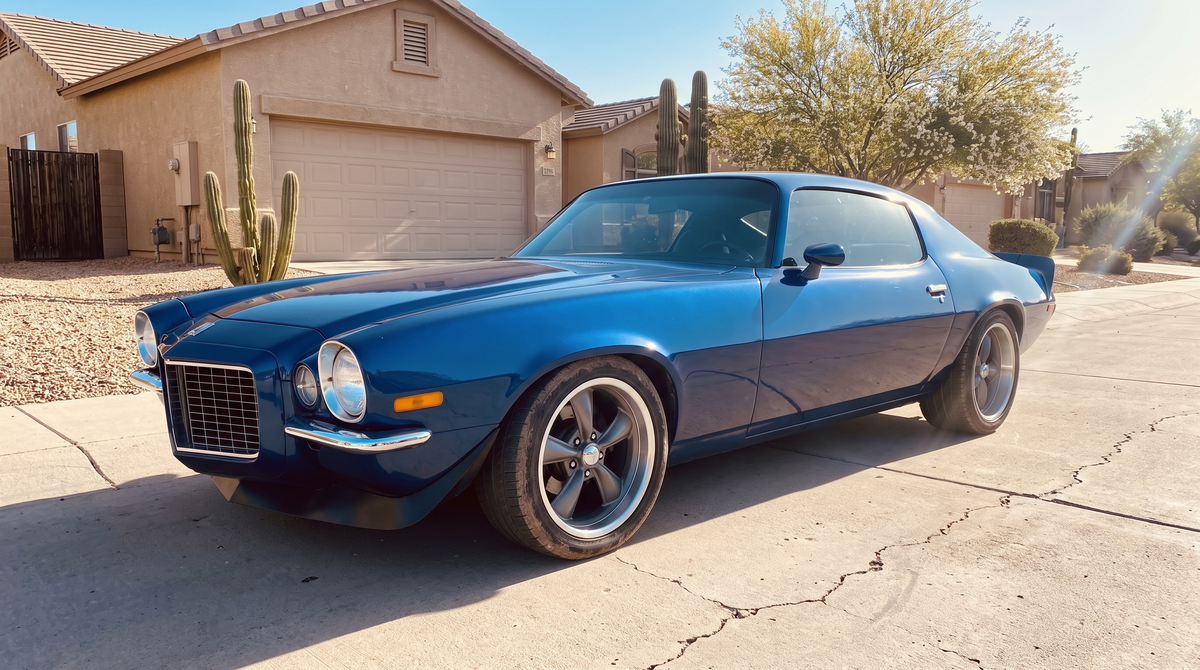
The biggest 1970-81 Camaro differences come down to two years: 1974, when federal bumper rules brought a new aluminum-bumper nose, and 1975, when the flat rear window gave way to a wraparound backlight. Everything else in the second generation, from the 1978 urethane bumpers to the 1979 dash, builds on those two splits. For a builder, the 1975 rear glass change is the one that decides which parts you order.
Chevrolet built the second-gen Camaro for twelve model years on one basic body, so a lot carries across the whole run. A lot does not. Below is what changed year by year, what that means when you shop, and which Fesler parts fit which cars. If you are shopping now, the parts are split into two collections: 1970-74 second-gen Camaro and 1975-81 second-gen Camaro.
What are the main 1970-81 Camaro differences by year?
The second-gen debuted in February 1970, and from there the car changed in steps. Here is the short version.
| 1970 | All-new body, longer, lower and wider than the first-gen. No convertible. Rally Sport split front bumper. |
|---|---|
| 1971-72 | Lower compression across GM engines. High-back buckets replace the 1970-only low-back seats. 1972 ratings switch to SAE net horsepower. |
| 1973 | Last year of the original small-bumper face and the split bumper. Type LT trim arrives. |
| 1974 | Aluminum bumpers front and rear, new fiberglass nose, wraparound taillights. Last year of the flat rear window. |
| 1975 | Wraparound rear window. Z28 dropped. Catalytic converter added. |
| 1977 | Z28 returns partway through the model year. |
| 1978 | Urethane front and rear bumper covers, revised taillights with amber turn signals, first T-top option. |
| 1979 | Restyled, flatter instrument panel. Berlinetta replaces Type LT. Optional electric rear defroster replaces the blower type. |
| 1980 | V6 replaces the inline six as the base engine. Z28 gets a hood scoop that opens at full throttle. |
| 1981 | Nearly unchanged. Computer Command Control on the engine. Final year of the second generation. |
1970 to 1973: the small-bumper cars
These are the cars most people mean when they say early second-gen: small chrome bumpers and round taillights. Rally Sport cars wore the split front bumper. Hagerty notes that 1973 was the last year for the split bumper, and the only year the split bumpers got additional reinforcement underneath.
Inside, the 1970 cars got low-back bucket seats with separate headrests, and those were replaced by high-back buckets for 1971. Engines went the other direction. Compression came down for 1971 under emissions pressure, and the switch to net ratings for 1972 made every engine look weaker on paper.
1974: the in-between year
For 1974 the bumper standard pushed Chevrolet into a real facelift. The Camaro got aluminum bumpers at both ends and an all-new fiberglass nose that Hagerty describes as having "deep sugar-scoop headlamp buckets." The taillights changed from round to a wedge-shaped wraparound design, and the car grew about seven inches longer.
What did not change in 1974 is the rear window. The 1974 car keeps the flat backlight and thick roof pillars of the 1970 to 1973 cars. That makes the 1974 a hybrid: late-style front and rear ends, early-style roof glass. That lines up with how Fesler splits its glass kits, covered below.
1975: why the rear glass is the real dividing line
The wraparound rear window arrived for 1975. Instead of a flat pane set between thick pillars, the new glass curves around into the roof pillars, mirroring the wraparound taillights and opening up the view out the back. For a builder this is the change that matters most, because it is where Fesler's glass kits split.
The same year, the Z28 went away and catalytic converters arrived. Hagerty notes the converter required a change to the passenger side floor, which is worth knowing if you shop floor pans or carpet by year. Fesler sells separate ACC molded carpet kits for 1970-74 and 1975-81 cars.
Fesler makes DOT flush-mount glass for both halves of the generation, made in North America with our partner Pilkington USA. The two kits are not interchangeable:
- 1970-74 Camaro flush-mount glass kit: listed for 1970-74 Camaro coupe and hardtop, and 1970-74 Firebird. DOT laminated windshield, tempered rear glass.
- 1975-81 Camaro and Firebird flush-mount glass kit: listed for 1975-81 Camaro and Firebird, including Trans Am, Formula and Esprit. The product page states it does not fit 1970-74 cars.
Both kits are priced the same at the time of writing: $2,099 for the front and rear kit, or $1,299 for front only or rear only. Adhesives, primer and labor are not included, and glass is non-returnable, so confirm your model year before you order. The product pages also note that reproduction shells may need body work to fit. Our Camaro flush-mount glass guide covers the look, the install timing and the DOT question in more depth.
1976 to 1977: trim changes and the Z28 comeback
These two years are mostly about trim and drivetrain. The 305 V8 joined the lineup for 1976. The Z28 came back partway through the 1977 model year, and 1977 was the year the Camaro outsold the Mustang for the first time. Hagerty sums up the 1976 body changes as minor trim revisions.
1978: urethane bumpers and a new face
For 1978 the aluminum bumpers gave way to body-color urethane bumper covers front and rear. Hagerty points out that the switch to urethane covers had been expected by 1976 and was delayed two years. The taillights got a more geometric pattern with amber turn signals, and the T-top showed up on the option list for the first time.
If you are building a 1978-81 car, it uses the same Fesler glass kit as a 1975. The 1975-81 kit page says the same glass fits all 1975-81 model years.
1979 to 1981: the new dash and the final years
For 1979 the Camaro got a restyled instrument panel, much flatter than the wraparound design it replaced, and Hagerty notes new brushed aluminum-style panel trim on every 1979 car. The Berlinetta replaced the Type LT, and an optional electric rear defroster replaced the old blower setup.
For 1980 the base engine became a V6, ending the inline six, and the federally mandated 85 mph speedometer arrived. The 1981 car is nearly a carryover, with Computer Command Control added to the engine. Production ended with the 1981 model year, and the third-gen took over for 1982. The 1975-81 kit page notes it does not fit the 1982 and later third-gen cars.
What interchanges between a 1970-74 and a 1975-81 Camaro?
Here we stick to what Fesler sells and what each live product page says. For original sheet metal, bumpers and trim, check a parts catalog for your exact year. Most of what Fesler makes for the second-gen is interior, and a lot of it carries across the whole run.
| Flush-mount glass kit | Split: 1970-74 kit and 1975-81 kit, not interchangeable |
|---|---|
| Fiberglass door panels (set of 4) | 1970-81 Camaro and Firebird hardtop |
| Fiberglass kick panels | 1970-81, all second-gen Camaro |
| Fiberglass dash overlay | 1970-81, over the factory metal dash structure |
| A-pillar panel | 1975-81 only. Not a direct fit on 1970-74 |
| Fiberglass center console | Split: separate 1970-74 and 1975-81 consoles |
| Steel center console | 1970-81 |
| Package tray | 1970-81 |
| Custom steel rear seat | 1970-81 Camaro and Firebird, accepts most tubs |
| Molded carpet kit (ACC) | Split: 1970-74 kit and 1975-81 kit |
| Dakota Digital HDX and VHX | 1970-81 |
| Dakota Digital RTX | 1970-78 |
Parts that carry across 1970-81
Our second-gen fiberglass door panels are listed for every year from 1970 through 1981, Camaro and Firebird hardtop. They are a set of four, hand-built in our Phoenix shop, with the fronts designed around 6.5 inch speakers. On tubbed cars the rear panels need a minor modification to clear the tubs. The product page also points out that door structures evolved over the run, so call us if your car has a history you are unsure about.
The fiberglass dash overlay is listed for the factory metal dash structure on every model year from 1970 through 1981. The kick panels, steel console and package tray are also listed for the full run. One note on the kick panels: they have no speaker provision, because the sheet metal behind them cannot be cut.
On gauges, Fesler sells Dakota Digital. The HDX and VHX systems for the second-gen Camaro are listed for 1970-81, and the RTX system is listed for 1970-78. Check the listing for your year before you order.
Parts that split at 1975
The flush glass is the big one, covered above. The fiberglass A-pillar is listed for 1975-81 only. The product page says some customers have molded the top of their original 1970-74 pillar into it to make it work, but plan on fabrication if you go that route. Fesler also sells separate fiberglass center consoles for 1970-74 and 1975-81 cars, and separate ACC molded carpet kits for each half of the run.
How do you tell a 1974 from a 1975 at a glance?
Look at the back of the roof. A flat rear window between thick pillars means 1970 to 1974. Glass that curves around into the pillars means 1975 or later. Then look at the bumpers: small chrome bumpers and round taillights are 1970 to 1973, big aluminum bumpers are 1974 to 1977, and body-color urethane covers are 1978 to 1981. Bodies get swapped and noses get changed over fifty years, so confirm with the VIN and paperwork before you order year-specific parts. Hagerty also flags the areas worth checking for rust on any second-gen: around the windshield and rear glass, floors, trunk, quarters, window channels, toe boards and frame rails. Rust under the glass openings matters a lot if flush glass is in your plans.
If you are coming from a first-gen car, the same kind of year-by-year sorting applies. Our 1967 vs 1968 vs 1969 Camaro interchange guide covers that generation.
Frequently asked questions
What are the main differences between a 1970-74 and a 1975-81 Camaro?
The 1975 model year brought a wraparound rear window that curves into the roof pillars, replacing the flat rear glass used through 1974. Later changes stacked on top of that: urethane bumper covers in 1978, a new instrument panel in 1979 and a V6 base engine in 1980. The 1974 car is a hybrid, with the long-bumper nose but the early flat rear window.
Is a 1974 Camaro early or late second-gen for parts?
For glass it is early. Fesler lists its 1970-74 flush-mount glass kit for 1974, and the 1975-81 kit page says it does not fit 1970-74 cars. For the parts Fesler lists across 1970-81, such as door panels, kick panels and the dash overlay, the year split does not matter.
Does 1975-81 Camaro flush-mount glass fit a 1970-74 Camaro?
No. Fesler sells separate kits, and the 1975-81 Camaro and Firebird kit page states it does not fit the 1970-74 Camaro or Firebird. Order the kit that matches your model year.
Do Fesler second-gen Camaro door panels fit every year?
Yes, per the product page. The fiberglass door panel set is listed for 1970 through 1981 Camaro and Firebird hardtops. On tubbed cars the rear panels need minor modification to clear the tubs.
Will a 1975-81 A-pillar fit my 1970-74 Camaro?
Not directly. The Fesler A-pillar is listed for 1975-81 cars and the page says it is not a direct fit on 1970-74. Some customers have molded the top of their original pillar into it, so plan on fabrication and call before ordering.
Ready to build? Shop the 1970-74 second-gen Camaro collection or the 1975-81 second-gen Camaro collection, and see every platform we make glass for in Fesler flush-mount DOT glass. Not sure which side of the split your car falls on? Call us at 480-748-2000 and we will help you sort it out before you order.
Sources: Hagerty, Your handy 1970-81 Chevrolet Camaro buyer's guide (year-by-year changes, rust areas); Wikipedia, Chevrolet Camaro (second generation) (rear window, dash and 1974 length changes); Fesler USA product pages (fitment and prices).


Leave a comment
This site is protected by hCaptcha and the hCaptcha Privacy Policy and Terms of Service apply.