
The SEMA Show is the biggest car show on earth, and it started because a model car company needed permission to use some logos. In May 1963, Revell brought about 20 speed equipment makers into one room in Hollywood. Four years later they held their first show under the bleachers at Dodger Stadium with 98 booths. Today it fills more than a million square feet in Las Vegas.
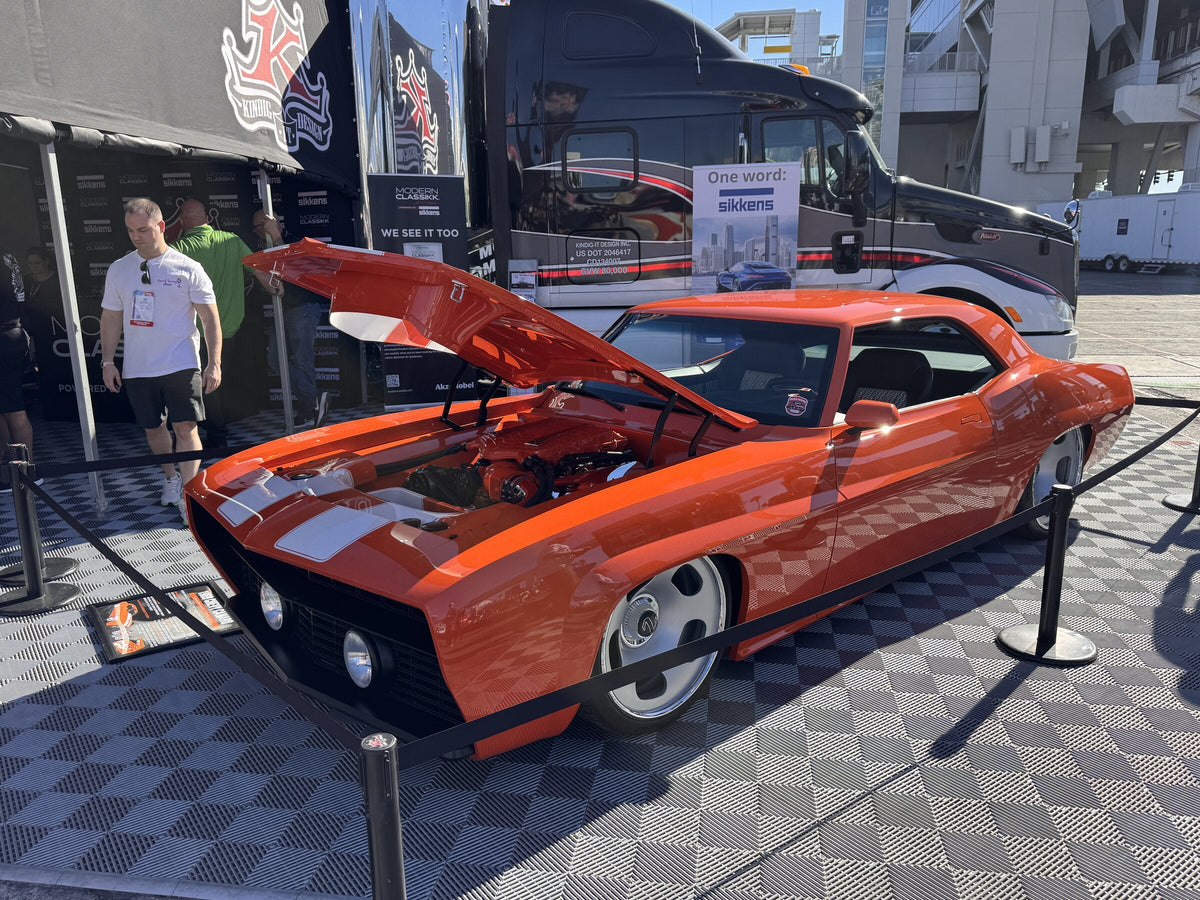
Above: Kindig-It Design's 1969 Camaro outside at SEMA 2025, running Fesler flush-mount glass.
Here is the full story of how it got here: who started SEMA, what the letters stand for, why "speed" got dropped from the name, and how a 98-booth show under a ballpark ended up taking over Las Vegas every November. Headed to the 2026 show? Our SEMA Show 2026 guide has the hall map, hours, tickets, food and how to get there.
SEMA history at a glance
| SEMA stands for | Specialty Equipment Market Association |
|---|---|
| Original name | Speed Equipment Manufacturers Association |
| Founded | May 1963, at Revell's offices on Hollywood Boulevard |
| Founding members | About 20 speed equipment makers. 36 companies by the end of 1963 |
| First president | Ed Iskenderian of Isky Cams |
| First SEMA Show | January 1967, under the grandstands at Dodger Stadium. 98 booths, about 3,000 people |
| "Speed" dropped | 1970 |
| In Las Vegas since | 1977, at the Las Vegas Convention Center |
| Today | More than a million square feet, more than 2,000 exhibitors, well over 100,000 people |
Who founded SEMA, and why?
SEMA started with a licensing problem. In the early 1960s, Revell, the plastic model kit company, wanted the real logos from speed equipment makers on its model car kits, the same names every hot rod kid knew. But there was no single group to deal with. Every speed shop was its own small business.
Revell marketing executive Henry Blankfort wanted licensing deals, and ad executive Ed Elliot pulled together about 20 manufacturers at Revell's headquarters on Hollywood Boulevard in May 1963. Blankfort pitched an idea bigger than model kits: start a trade association. One group could handle the paperwork more efficiently, and it could speak for the whole industry when regulators came calling.
The manufacturers agreed. The Speed Equipment Manufacturers Association was incorporated in May 1963. Cam grinder Ed Iskenderian, of Isky Cams, became the first president. Dean Moon of Moon Equipment, Roy Richter of Cragar and Els Mohn of Eelco were among the people in the room, and John Bartlett drafted the first bylaws. By the end of 1963, 36 companies had joined.
The stated mission was to develop uniform standards for products used in motorsports, and to give a young industry one voice in front of lawmakers. That second job has never gone away.
What does SEMA stand for?
Today, SEMA stands for the Specialty Equipment Market Association. It did not start that way. From 1963 to 1970 it was the Speed Equipment Manufacturers Association.
The change came in 1970. As government regulation of cars picked up, "speed" was a word that drew the wrong kind of attention, and the association's lawyer suggested dropping it. Speed Equipment became Specialty Equipment. It was the same people and the same parts, with a name that fit the whole aftermarket better and sounded a lot better in a government meeting.
Where was the first SEMA Show?
The first official SEMA Show was held in January 1967 under the grandstands at Dodger Stadium in Los Angeles. Hot Rod magazine publisher Robert "Pete" Petersen produced it. It had 98 booths and about 3,000 people. That was the whole thing.
It was not the first speed equipment trade show, though. In 1965, promoter and publisher Noel Carpenter held a Speed and Custom Equipment show at the Disneyland Hotel with about 70 exhibitors and roughly 1,000 attendees. SEMA did not organize it. In 1966 SEMA sponsored Carpenter's second show in exchange for a share of the profits, but SEMA counts 1967 at Dodger Stadium as the first SEMA Show.
Why is the SEMA Show in Las Vegas?
Because it outgrew everywhere else. After Dodger Stadium, the show moved to Anaheim, and it kept growing until it ran out of room. The last Anaheim show, in 1976, sold out with 570 booths, and people were being turned away at the door.
In 1977 the show moved to the Las Vegas Convention Center. More than 800 companies exhibited at that first Vegas show. Las Vegas offered room to grow, dependable weather, big-name entertainment and a world-famous location, and the show has been there every year since, apart from 2020.
SEMA Show timeline
| 1963 | About 20 speed equipment makers meet at Revell's Hollywood Boulevard offices. The Speed Equipment Manufacturers Association is incorporated in May. 36 companies join by year's end. |
|---|---|
| 1965 | Promoter Noel Carpenter holds a Speed and Custom Equipment trade show at the Disneyland Hotel, with about 70 exhibitors. SEMA does not run it. |
| 1966 | SEMA sponsors Carpenter's second show. It still does not count as the first SEMA Show. |
| 1967 | The first official SEMA Show opens in January under the Dodger Stadium grandstands. 98 booths, about 3,000 people. |
| 1970 | "Speed" is dropped. The group becomes the Specialty Equipment Market Association. |
| 1976 | The last Anaheim show sells out with 570 booths and people are turned away. |
| 1977 | The show moves to the Las Vegas Convention Center with more than 800 companies. |
| 1988 | Exhibitors start being grouped into sections, beginning with street rods. |
| 1992 | SEMA and other aftermarket groups line their shows up in the same week, known as Automotive Aftermarket Industry Week. |
| 2003 | The Proving Ground opens, the one place at the show where vehicles move. |
| 2011 | The SEMA Cruise, the parade of builds leaving the halls, becomes a formal event. |
| 2014 | SEMA Ignited and the first SEMA Battle of the Builders debut. |
| 2016 | The 50th SEMA Show draws nearly 140,000 people. |
| 2020 | The show is postponed because of Covid-19, and SEMA runs an online event called SEMA360 instead. |
| 2026 | November 3 to 6 at the Las Vegas Convention Center, with Friday open to the public. |
How big is the SEMA Show today?
The SEMA Show now fills more than a million square feet of the Las Vegas Convention Center across the North, West, Central, South Upper and South Lower halls, plus an International Pavilion. It draws more than 2,000 exhibiting companies and well over 100,000 people, and the SEMA Fest ticket page lists more than 2,400 vendors and more than 1,000 one-of-a-kind vehicle builds for 2026.
It is still a trade show first. Tuesday through Thursday are for people who own or work for companies in the automotive aftermarket, and only Friday is open to the public. If you are deciding whether you can go, start with our SEMA Show 2026 guide.
What are the SEMA Cruise, SEMA Ignited and Battle of the Builders?
The SEMA Cruise became a formal event in 2011. When the show closes on Friday, the builds roll out of the halls in a parade, and SEMA's 2026 attendee page puts the number at more than 1,000 vehicles. It is one of the few times you can see and hear the show cars move.
SEMA Ignited was introduced in 2014 as the show's after-party, and the first SEMA Battle of the Builders was held there the same year. Battle of the Builders is the show's builder competition. The 2026 categories include Hot Rod and Hot Rod Truck, Sport Compact and Import Performance, Off-Road, BFGoodrich Young Guns, and a new motorcycle category called the Bike Builder Shootout, with winners announced on stage through the week.
Why SEMA still matters to builders
For most of the people who walk the halls, SEMA is where the next five years of the hobby show up first. The parts, the finishes and the build styles you see on the floor in November tend to end up in home garages a few years later.
Look closely at the cars that read as clean from 30 feet away and you will start seeing the details that make them that way: glass that sits close to the body with no chrome trim or rubber gasket, interiors that look factory-correct but are built for comfort, and modern drivetrains hidden in old engine bays. If the glass is what caught your eye, our flush-mount glass guide explains how trimless glass works, and the Fesler flush-mount DOT glass collection shows every kit we make, built in North America with our partner Pilkington USA.
Is Fesler at SEMA 2026?
We are attending, not exhibiting. Our crew is walking the show this week to see the builds and spot every set of Fesler flush-mount glass we can find. If your car or truck is at SEMA, text the shop at 480-748-2000 with the hall and booth number, or where it is parked, and we will come see it.
Our next show with a Fesler booth is Dino's Git Down, November 13 and 14 at State Farm Stadium in Glendale, Arizona. Details are on the Fesler events page.
Frequently asked questions about SEMA history
What does SEMA stand for?
Today SEMA stands for the Specialty Equipment Market Association. When it was founded in May 1963 it was the Speed Equipment Manufacturers Association. The word "speed" was dropped in 1970.
When was SEMA founded?
SEMA was incorporated in May 1963, after about 20 speed equipment manufacturers met at the Revell model company's offices on Hollywood Boulevard in Los Angeles.
Who founded SEMA?
SEMA grew out of a 1963 meeting organized by Revell, the plastic model kit company, which needed a single group to license speed equipment logos for its model kits. Cam maker Ed Iskenderian was the first president. Dean Moon of Moon Equipment and Roy Richter of Cragar were among the manufacturers in the room.
Where was the first SEMA Show?
The first official SEMA Show was held in January 1967 under the grandstands at Dodger Stadium in Los Angeles. Hot Rod publisher Robert "Pete" Petersen produced it. It had 98 booths and about 3,000 attendees.
When did the SEMA Show move to Las Vegas?
The SEMA Show moved from Anaheim to the Las Vegas Convention Center in 1977, after sold-out Anaheim shows were turning people away. More than 800 companies exhibited at the first Las Vegas show, and the show has been there ever since.
Why did SEMA change its name?
In 1970, as government regulators paid more attention to the industry, the association dropped the word "speed" from its name. Speed Equipment Manufacturers Association became the Specialty Equipment Market Association, a name that better fit the broader aftermarket and played better in front of regulators.
How big is the SEMA Show?
The SEMA Show fills more than a million square feet of the Las Vegas Convention Center. It draws more than 2,000 exhibiting companies and well over 100,000 people, and SEMA Fest lists more than 2,400 vendors and more than 1,000 vehicle builds for 2026.
Has the SEMA Show ever been canceled?
The 2020 SEMA Show was postponed because of Covid-19, and SEMA held an online event called SEMA360 instead. Otherwise the show has run every year since 1967.
Building something you saw at SEMA? Browse the Fesler flush-mount glass collection and the Fesler interior collection, or call us at 480-748-2000 to talk through your car or truck.
Sources: SEMA Show official 2026 attendee pages (dates, hours, halls, registration and age rules); the SEMA Show 60th anniversary history and SEMA Show Timeline (founding, first show, moves and milestones); Old Cars Weekly; Wikipedia's SEMA entry (name change, Anaheim and Las Vegas details, current size); SEMA Fest 2026 ticket page (vendor and build counts).




Leave a comment
This site is protected by hCaptcha and the hCaptcha Privacy Policy and Terms of Service apply.