
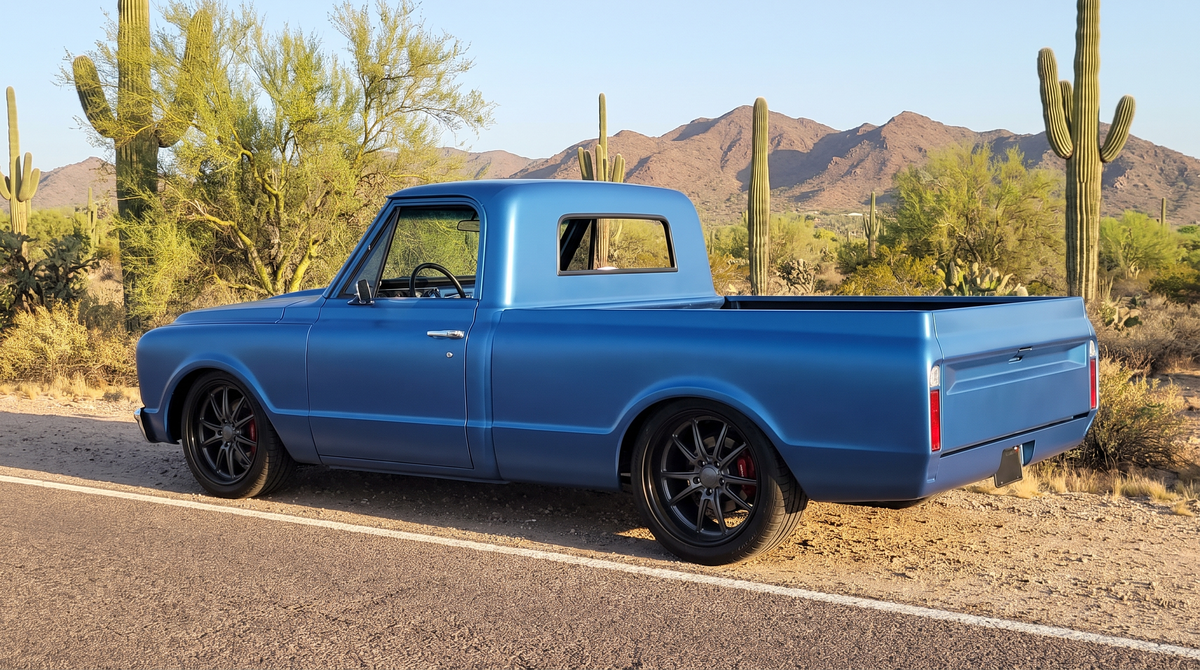
Here is the fastest way to date a 1967 to 1972 Chevy or GMC pickup, and it works from across a parking lot. Look at the back window. If it is the small one, the truck is a 1967. Not probably. Guaranteed.
The reason that works is the opposite of what most people will tell you. The small rear window was not the option in 1967. It was the standard cab. The wide glass everybody calls the big back window was the extra cost upgrade, and Chevrolet dropped the small window from light duty trucks the very next year. One model year out of six. That is the whole window, and it is why a small window cab is one of the cleanest single-detail tells on any GM truck.
Was the small back window standard or optional on a 1967 C10?
Standard. When the Action Line trucks launched for 1967, the small rear window was standard equipment on the half ton, the three quarter ton and the one ton. The wide rear glass was the extra cost option, and Chevrolet's own 1967 fact sheet calls it Full-View. You paid more to see more.
You will see an RPO code attached to the Full-View window in some enthusiast option lists. We are not going to print one. The lists disagree on what it stood for and we could not find a period GM document to settle it. Full-View is genuine GM wording. The code is not, so we leave it out.
Which years of the 1967-72 Chevy truck had the small window cab?
For light duty trucks, only 1967. For 1968 Chevrolet stopped offering the small window cab on the half ton, three quarter ton and one ton. Every light truck from 1968 through 1972 came with the Full-View glass, and there was no choice involved.
The small window did survive, just not on the trucks most of us build. It stayed standard on the 60 series two ton work trucks through 1972. That is why some glass vendors catalog the small rear glass as 1967-72. It does not mean a small window half ton could be a 1970. A catalog fitment note is not a production fact.
Hagerty puts it plainly in their buyer's guide for these trucks. 1967 is "the only year that a small rear window cab was available versus the larger window found with all other C/Ks." Jim Carter Truck Parts says it with more feeling: when you see a small window light truck in the distance, you can feel sure it is pure 1967.
How big is the difference between the small window and the Full-View glass?
Big enough to read from the other end of the lot. Published replacement glass dimensions put the small window at roughly 12 by 42 inches and the Full-View at roughly 14 by 60. Call it 42 versus 60 across, about 18 inches of difference. On a small window cab the glass sits like a mail slot in a lot of painted steel. On a Full-View cab it fills the back of the cab nearly corner to corner.
Why does the test only work in one direction?
A small window proves 1967. A big window proves nothing.
Most 1967 trucks left the factory with the Full-View option. So a 1967 with the wide glass is a perfectly normal 1967. A small window light truck is a 1967 and nothing else. The window rules one year in. It never rules a year out.
What almost everybody gets backwards about the small window
You will read, in a lot of places, that the small window was the option and that buyers rejected it for the visibility. Both halves need fixing.
The first half is wrong. The small window was the standard cab. The rarity is generational, not annual. Across the six year run the small window is scarce because it only existed for one year on light trucks. Inside 1967 itself it was the base truck, sitting on every dealer lot.
The second half is unsourced. Nobody has published why Chevrolet made the change. The outcome is documented. The motive is not. We will tell you what happened, and we are not going to invent a reason.
The same goes for numbers. GM never published option installation rates for 1967 light trucks, and these trucks carry no build sheet or RPO cowl tag. The Standard Catalog breaks 1967 out by tonnage, drive type, wheelbase and body style, and none of those tables split the rear window. Anyone quoting you a percentage of small window trucks is guessing. What is documented, per Hagerty's buyer's guide, is that 1967 and 1971 were the two lowest production years of the generation.
What other details prove a 1967 C10 or GMC?
If the window has you stuck, or you want a second data point before you hand over money, here are the tells that actually hold up, and the ones that do not.
- Front fender side markers. A 1967 has no side marker lamps on the front fenders. They showed up for 1968. Check the front fenders only. Rear side markers were handled separately, so a smooth bedside does not prove 1967 by itself.
- GMC grille letters. On a GMC, 1967 is the only year with the GMC letters stamped in the center of the grille. For 1968 they moved to the hood. Fast, visible, and one year only.
- Do not trust these. The two rectangular grille openings on the Chevy, the CHEVROLET letters across the hood front, the parking lamps under the bumper, and the hand parking brake all carried into 1968. Plenty of swap meet guides list them as 1967-only. They are not.
We do not print a legal explanation for the side marker change. The federal lighting standard rolled out in stages and the version people usually quote did not apply to a half ton on the date they quote. The visible fact is enough: a 1967 front fender is smooth.
Can you convert a small window cab to a Full-View window?
Yes, but it is not a glass swap. The back of the cab is a different stamping. Going from small window to Full-View means cutting the back of the cab and welding in the other panel, which is body shop work, not an afternoon in the garage.
Worth knowing before you buy a truck based on its window. If you want the rare cab, buy the rare cab. If you want the wide glass, buy a Full-View truck and skip the surgery. For the rest of the year-to-year differences in this generation, our 1967-1972 C10 and GMC history and hidden gems post covers the full run.
What does Fesler make for a 1967-72 C10, and does it fit a small window cab?
Whichever cab you have, the glass is sitting in rubber that is pushing sixty years old. Gaskets shrink, they let water in, and the chrome trim wrapped around the glass is the busiest thing on an otherwise clean truck. Our DOT flush mount glass bonds directly to the body with no gasket and no trim, so you get paint to glass in one seam. We cover the how and why in flush mount versus trim ring glass.
Here is the fitment, stated carefully because glass is not returnable.
- Windshield. The 1967-72 windshield opening is the same regardless of which rear window the cab has. Our 1967-72 C10 flush mount windshield fits a small window 1967 and a Full-View 1967 the same way it fits a 1972.
- Rear glass. The rear glass in our 1967-72 C10 kit is built to the opening that every 1968 through 1972 light truck has, which is the Full-View opening. If your 1967 has the Full-View glass, it fits. If your 1967 is a small window cab, contact us before you order. Do not assume the rear piece fits a small window opening, and do not order it on that assumption.
The rest of what we make for these trucks does not care which window you have. The 1967-72 C10 door panels and the full C10 interior kit fit any cab in the run. If you are planning a vent window delete to go with the flush glass, read our C10 vent window delete guide first, and check before you order so the fitment questions get answered before the parts ship.
Quick answers
Is a small back window C10 always a 1967? On a light duty truck, yes. The small window cab was only offered on the half ton, three quarter ton and one ton for 1967. It continued on the 60 series two ton through 1972.
Was the small window the standard or the option in 1967? Standard. The wide Full-View rear window was the extra cost option.
Does a big back window mean the truck is not a 1967? No. Most 1967 trucks were ordered with the Full-View window. The test only proves 1967 when the window is small.
How much bigger is the Full-View glass? Roughly 60 inches across versus roughly 42 for the small window, based on published replacement glass dimensions.
What percentage of 1967 trucks had the small window? Nobody knows. GM never published option rates for these trucks and no production table splits the rear window, so any percentage you read is a guess.
Does Fesler flush mount glass fit a small window 1967? The windshield does. The rear glass in the 1967-72 kit is built to the Full-View opening. Small window owners should contact Fesler before ordering rear glass.
Shop Fesler parts for 1967-72 Chevy trucks or browse the full flush mount DOT glass lineup.

Leave a comment
This site is protected by hCaptcha and the hCaptcha Privacy Policy and Terms of Service apply.