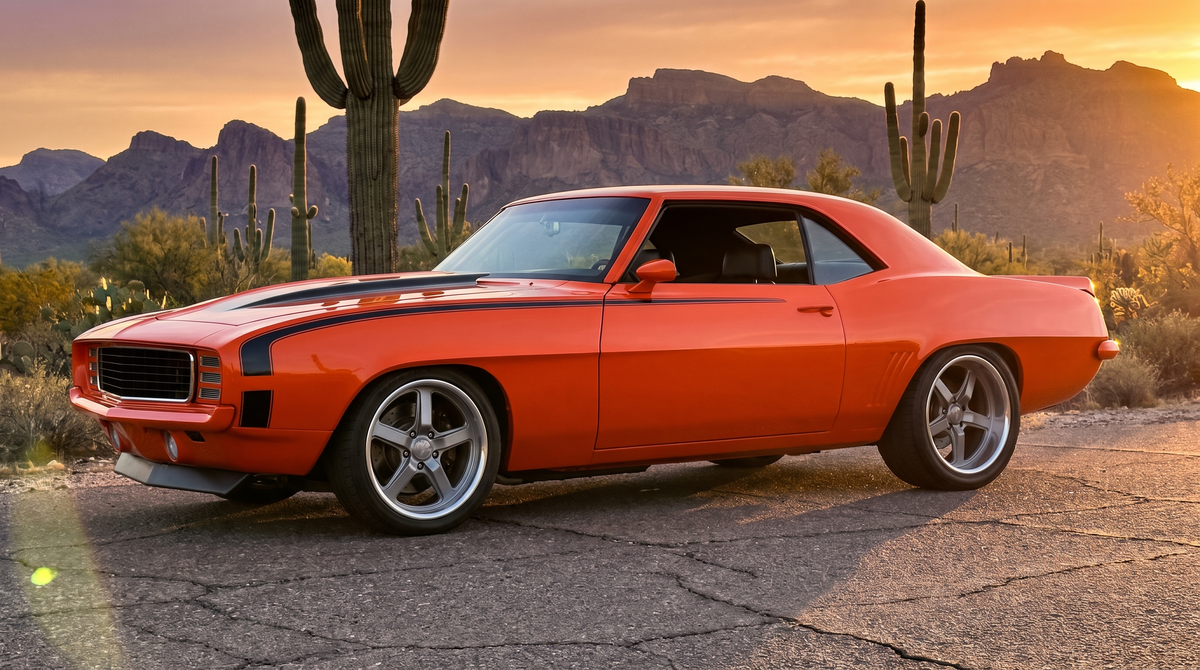
If someone tells you their 1969 Camaro is a factory Hugger Orange car, you do not have to take their word for it. Open the hood, look at the aluminum trim tag on the driver's side of the firewall, and find the PAINT line. A real Hugger Orange car reads 72. A 1969 Corvette in the same color reads 990 on its trim plate, because Chevrolet sold the identical paint on the Corvette as Monaco Orange. Same Ditzler formula, PPG 2084, two names.
That is the whole test, and it settles more arguments than any amount of squinting at a fender in the sun. Here is where the color came from, why it wore two names inside one division, and how to read your own tag before you buy, sell, or repaint.
Where did the name Hugger Orange come from?
From an ad campaign. When the Camaro was new, Chevrolet sold it as The Hugger, a nod to the way it stuck to the road instead of floating over it the way a full size car did. The nickname ran through the 1967 and 1968 advertising and worked well enough that when a bright orange showed up on the 1969 Chevrolet chart, the paint got named after the marketing. Code 72, Hugger Orange. A color named after a nickname the company invented for itself.
It showed up in the right places right away. The 1969 Indy 500 pace car replicas were Dover White with Hugger Orange stripes and an orange houndstooth interior, which put the color in front of every buyer who walked into a showroom that spring. Nobody remembers what Chevrolet called most of its 1969 paint codes. Everybody remembers this one.
Was Hugger Orange offered on the Corvette?
Yes, for 1969, but you will not find the words Hugger Orange on a Corvette order form. On the Corvette the same paint was sold as Monaco Orange, and the Corvette trim plate carries code 990 rather than 72. The period Ditzler chip chart for 1969 Chevrolet lists the color both ways on one page: Hugger Orange for the passenger cars, Monaco Orange for the Corvette, both cross referenced to PPG 2084 and both tied to code 72.
The Chevelle is where it gets confusing, and this is the part worth reading twice if you own one. Chevelle documentation from 1969 uses both names for the same code 72. Some GM paperwork says Monaco Orange, some says Hugger Orange, and the Chevelle registry notes it was restricted to cars with the SS or COPO option. So a plain 1969 Malibu showing code 72 deserves a second look, and a Chevelle owner arguing with a Camaro owner about whether their cars are the same color is arguing about a sales name. The paint in the can was the same.
Across the rest of the 1969 lineup the name was Hugger Orange and the code was 72: Camaro, Chevelle, El Camino, Nova, and the C10 and K5 Blazer trucks. For a color people associate almost entirely with the Camaro, it got around fast.
What years was Hugger Orange a factory color?
Not many. The main run was 1969 through 1971, with the code changing by year. It was 72 in 1969 and 65 for 1970. Paint suppliers list a 1976 return under code 78 as well. After that it was gone from the regular chart until Chevrolet pulled it back out for the 30th anniversary Camaro in 1999, as the stripe color on Arctic White, which tells you what they thought they had. Roughly three model years of genuine availability, and it became one of the most recognizable colors GM ever mixed.
If you want to see how the 1969 car itself came to be the one everybody chases, our first gen Camaro history covers the whole run.
Is Hugger Orange the same as Pontiac Carousel Red?
This is the argument that will not die, and we are going to give you a straighter answer than most. The 1969 Chevelle registry states flatly that Chevrolet's Hugger Orange and Monaco Orange are the same color as Pontiac's 1969 and 1970 Carousel Red, the color on the GTO Judge. Same OEM mixing formula, different sales names. Camaro World says the same thing. Both point at the same PPG 2084 number.
So why does the argument survive? Because two cars painted from the same formula in 1969, by two plants, with different primers and different metal, and then sun baked for fifty years, do not look the same from a foot away. Add a respray or two and the eye will never settle it. The paint code will. If you are standing between a Judge owner and a Camaro owner, the useful thing to say is that the formula was shared and the name was not. Then go look at both tags.
How do you check your own trim tag for Hugger Orange?
Go do this now if the car is in the garage. It takes two minutes.
- Find the tag. On a 1969 Camaro and Chevelle it is a small aluminum plate riveted to the driver's side of the firewall in the engine bay, near the master cylinder. On a 1969 Corvette it is the trim plate under the dash on the driver's side.
- Find the PAINT line. On the Camaro tag the body color is stamped twice for a car with no vinyl or convertible top. A Hugger Orange coupe with a painted roof reads 72 72. The first number is the lower body, the second is the top. A Hugger Orange car with a black vinyl top will read 72 followed by the top code instead of a second 72.
- Read what is actually there. 72 is Hugger Orange for 1969. If you are looking at a 1970 car, the code is 65. On a 1969 Corvette, 990 is Monaco Orange, which is the same paint.
- Check that the tag belongs to the car. Trim tags come off with a drill. Look for factory rivets, the right tag style for the plant, and a body number and build date that make sense against the VIN and the rest of the car. If you are deep enough into it to care about the paint code, you are deep enough to want the glass date codes to line up too, and we cover that in how to read the windshield bug date code.
One thing the tag cannot tell you. It says what color the car was born. It does not say how well the last body shop laid it down. Which brings us to the part we deal with every week.
What does a loud color need to look right?
A clean surface. Bright orange is unforgiving. Every reflection reads. From twenty feet away people see the color. From five feet they see everything that interrupts it, and on most sixty year old cars the biggest interruption is the band of stainless trim and gray rubber gasket wrapped around the windshield and the back glass.
That is exactly what our flush mount kits delete. The trim comes off, the gasket goes away, and DOT certified laminated glass bonds flush to the body so the color runs from the hood over the roof and down the deck without a break in it. On a white car it looks tidy. On a Hugger Orange car it is the difference between a color and a shape. Our 1967-69 Camaro flush mount glass kit covers every first generation year, and the Camaro flush mount glass guide walks through fitment for the later cars. Chevelle owners have the same option and the same guide, in our Chevelle flush mount glass guide.
Order the glass before the body work is done, not after. Flush glass changes how the opening gets finished, and the body shop needs to know that before the last coat of orange goes on.
Then there is the inside, which the sun out here treats badly. A code 72 car with a faded, cracked dash and sagging door panels is still a code 72 car, but nobody walks up to it. Our hand laid fiberglass interior panels are molded for the specific car, and our detail line exists because we are protecting our own paint under the same Arizona sun that is working on yours.
Quick answers
What is the paint code for Hugger Orange? Code 72 on 1969 Chevrolet passenger cars and trucks, 65 for 1970. The Ditzler and PPG formula number is 2084.
Was Hugger Orange available on the Corvette? Yes, in 1969, sold as Monaco Orange under code 990. Same paint formula as the Camaro's code 72.
Where is the paint code on a 1969 Camaro? On the aluminum trim tag riveted to the driver's side of the firewall in the engine bay. The PAINT line shows lower body then top color, so a solid Hugger Orange coupe reads 72 72.
Is Hugger Orange the same as Carousel Red? Chevelle and Camaro registries state they share the same OEM mixing formula, PPG 2084, sold under different names by Chevrolet and Pontiac.
What years did Chevrolet offer Hugger Orange? Mainly 1969 through 1971, with paint suppliers listing a 1976 return. It came back as the stripe color on the 1999 30th anniversary Camaro.
Why is it called Hugger Orange? Chevrolet advertised the early Camaro as The Hugger for its handling, and the 1969 orange was named after that campaign.
Shop Fesler flush mount DOT glass, 1967-69 Camaro parts, or detail products built in Phoenix.

Leave a comment
This site is protected by hCaptcha and the hCaptcha Privacy Policy and Terms of Service apply.