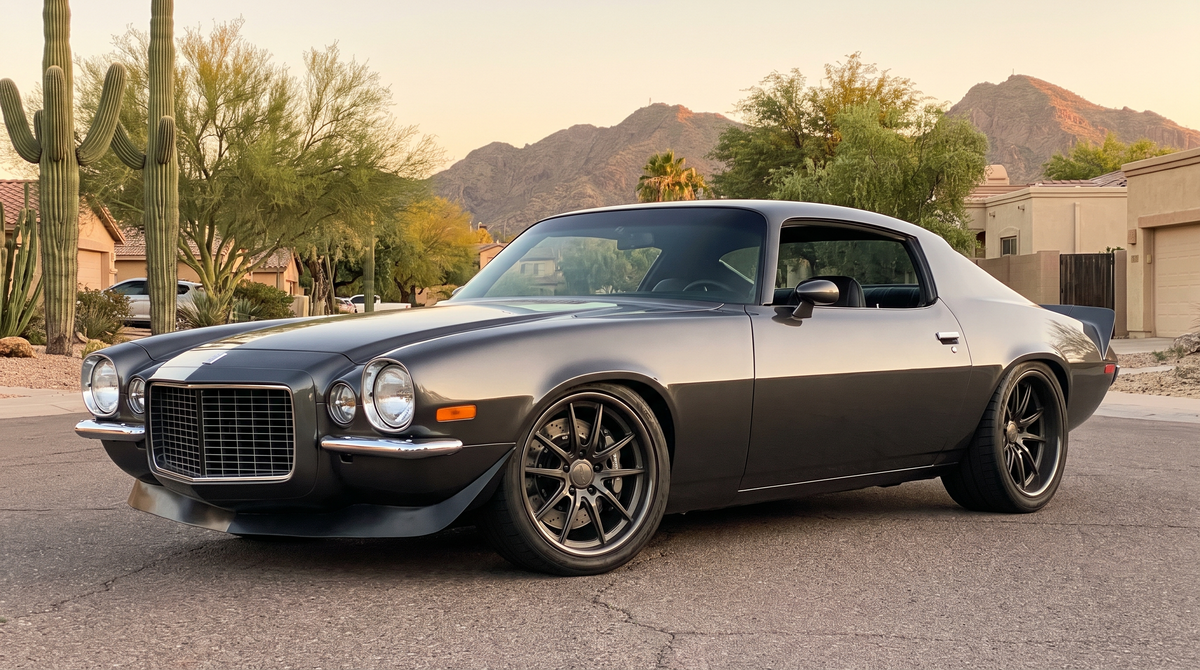
If your Chevrolet is a 1970, 1971 or 1972 and there is a 396 emblem on the fender, the big block behind it displaces about 402 cubic inches. For the 1970 model year Chevrolet opened up the bore on the 396, left the stroke alone, and in the Camaro kept calling the result a 396 for three more years. That part is not in dispute. The reason for it, and how far the 396 badge persisted on other models, is where most of what you read online falls apart.
Here is what the record supports, and how to find out what is really in your engine bay. The casting number will not tell you. The stamping pad will.
Why is a 1970 to 1972 Chevy 396 actually a 402?
The 396 that arrived in 1965 ran a 4.094 inch bore and a 3.76 inch stroke. For the 1970 model year Chevrolet bored the block roughly thirty thousandths over. The stroke never moved. Depending on which spec you trust, the new bore was 4.125 or 4.126 inches, and that small difference is why you will see the displacement quoted as anything from 401.99 to 402.19 cubic inches.
Both round numbers are roundings, by the way. The 396 was really 395.97.
One thing to watch on the date. Some references say the change happened in late 1969. That is calendar 1969, when 1970 model year production started. Think in model years. A 1969 Camaro SS 396 is a 396. A 1970 is a 402.
Which Chevys kept the 396 badge after the engine became a 402?
You will read everywhere that the Chevelle SS, Camaro SS and Nova SS all kept their 396 emblems through 1972. That is the most repeated line in this whole story, and it is wrong.
Only the Camaro did. Chevrolet's own 1971 and 1972 Camaro fact sheets both carry the same note: the engine was still called a 396 when installed in a Camaro. Reproduction 1971 and 1972 Camaro SS emblem sets still ship with a pair of 396 fender emblems because that is what the cars wore.
The Chevelle quit after 1970. For 1970 the SS 396 package went on a 402 and kept its name. From 1971 an SS Chevelle with the 402 wore a plain SS emblem and no engine size at all. If you ordered the 454 you got SS 454. By 1972 Chevrolet literature was calling the Chevelle's 402 the Turbo-Jet 400. The El Camino followed the Chevelle exactly.
The Nova is not even an argument. The big block Nova ran from 1968 through 1970. The 1970 cars got the 402 with 396 badges, and then the big block was gone. For 1971 and 1972 there was nothing left to badge.
More on the Chevelle side in our 1964 to 1972 Chevelle history.
What was the Turbo-Jet 400, and how is it different from the Turbo-Fire 400?
This is the part that is actually funny. In the same years, Chevrolet sold the very same 402 big block in the full size cars and the Monte Carlo under a different name: Turbo-Jet 400.
It also sold a Turbo-Fire 400 in the same showroom. That one was a small block, new for 1970, and it really did displace 400 cubic inches. 400.92, to be precise, from a 4.125 inch bore and a 3.750 inch stroke. Same nominal bore as the 402. Strokes one hundredth of an inch apart. Barely more than a cubic inch between them, and the two engines share almost nothing.
The 1970 Monte Carlo option list is the cleanest example. It offered a 400 cubic inch Turbo-Fire small block at 265 horsepower and a 402 cubic inch Turbo-Jet big block at 330, and the same 400 body emblem went on the car either way. So in 1970 you could walk onto a Chevrolet lot and order a 400 that was a 400, a 400 that was a 402, or a 396 that was also a 402.
Why did Chevrolet keep calling the 402 a 396?
Nobody actually knows. The most thorough technical history of the big block Chevrolet says it plainly: there are a couple of urban legends about why Chevrolet increased the bore, and no one knows the definitive answer. On the badge, the same author will only go as far as "maybe" the accountants and marketing decided not to mess with SS 396 sales.
That is the explanation you will hear most, and it is probably right. It is still a theory, not a documented decision, and we are not going to hand it to you as fact.
One theory we can rule out. You will find it written that federal emissions rules eased for engines over 400 cubic inches, so Chevrolet ducked under the line with the badge. Nothing supports that anywhere. It looks like a scrambled retelling of something real but unrelated: for 1970 GM lifted its own internal policy that kept engines over 400 cubic inches out of intermediate and smaller cars. That ceiling is why the 427 Camaros had to come through the COPO system, and lifting it is why the 454 Chevelle exists. It has nothing to do with a six cubic inch bump on a 396. For the 427 side of that story, read our 427 big block guide.
How do you tell if your 396 is really a 402?
Go look at your own car. Here is the order to do it in.
- Skip the casting number. This is the advice everyone gives, and for this question it is a dead end. Block casting 3969854 was a 396 in 1969 and a 402 from 1970 through 1972. Casting 3999290 did the same trick on truck blocks. A casting number can serve more than one displacement, and these two did.
- Read the stamping pad. Find the machined pad at the front of the block on the passenger side, next to the partial VIN. There is a two or three letter suffix code stamped on it. For 1970 through 1972, every passenger car big block suffix in Chevrolet's tables decodes to 402. In 1970 that is CGR, CKN, CKR and CKS for the LS3, CTW, CTX and CTZ for the L34, and CKO, CKP, CKQ, CKT, CKU and CTY for the L78. In 1971 the LS3 codes are CLA, CLB, CLL, CLP, CLR and CLS. In 1972 they are CLA, CLB, CLS, CTA, CTB, CTH and CTJ.
- Then the bore gauge, if you are that deep in. A stock 402 measures about 4.125. So does a 396 rebuilt thirty over. The stamping beats the gauge.
If your car is a 1972 there is one more tell, and it is a good one. The fifth character of a 1972 Camaro VIN encodes the engine, and U is the code for the 402 four barrel LS3. So a 1972 Camaro SS 396 contradicts itself right on the door jamb: the fender says 396, the VIN says 402. Only 970 SS 396 Camaros were built that year. This does not work on 1970 or 1971 cars, whose VINs only tell you six or eight cylinders.
What does this have to do with a flush glass company?
We build glass and interior parts, not engines. But we spend every day on the same kind of detail: the gap between what a car looks like it has and what is actually there.
Our 1970 to 1974 Camaro flush mount glass kit and our 1968 to 1972 Chevelle line bond DOT certified windshields and rear glass straight to the body. No rubber gasket, no chrome reveal, paint meeting glass in one flat seam. On a 1970 to 1972 SS it is the change people notice from thirty feet away and cannot put a name to. If you are new to the idea, start with our Camaro flush mount glass guide. And if your build is going up in displacement instead, our 454 versus LSX454 guide covers the engine that sat above the 402 on the order sheet.
Quick answers
Is a 1970 Chevy 396 really a 402? Yes. For the 1970 model year the bore went from 4.094 to about 4.125 inches with the same 3.76 inch stroke, which works out to just over 402 cubic inches. The 396 badge stayed on the Camaro through 1972.
Did the Chevelle SS keep the 396 badge through 1972? No. Only for 1970. From 1971 an SS Chevelle with the 402 wore a plain SS emblem with no engine size. Only the 454 cars got a displacement badge.
What is the difference between a Turbo-Jet 400 and a Turbo-Fire 400? The Turbo-Jet 400 was the 402 big block under another name. The Turbo-Fire 400 was a small block that really displaced 400.92 cubic inches. Different engine families that shared a nominal bore.
Can I tell a 396 from a 402 by the casting number? No. Casting 3969854 served as a 396 in 1969 and a 402 from 1970 to 1972. Use the suffix code on the stamping pad in front of the passenger side head instead.
Why did Chevrolet keep the 396 name on a 402? Nobody knows for certain. The most likely explanation is that Chevrolet did not want to give up four years of SS 396 branding, but no factory document confirms it. The claim that federal emissions rules eased above 400 cubic inches is not supported anywhere.
Shop Fesler flush mount DOT glass or browse everything we make for the 1970 to 1974 Camaro.

Leave a comment
This site is protected by hCaptcha and the hCaptcha Privacy Policy and Terms of Service apply.